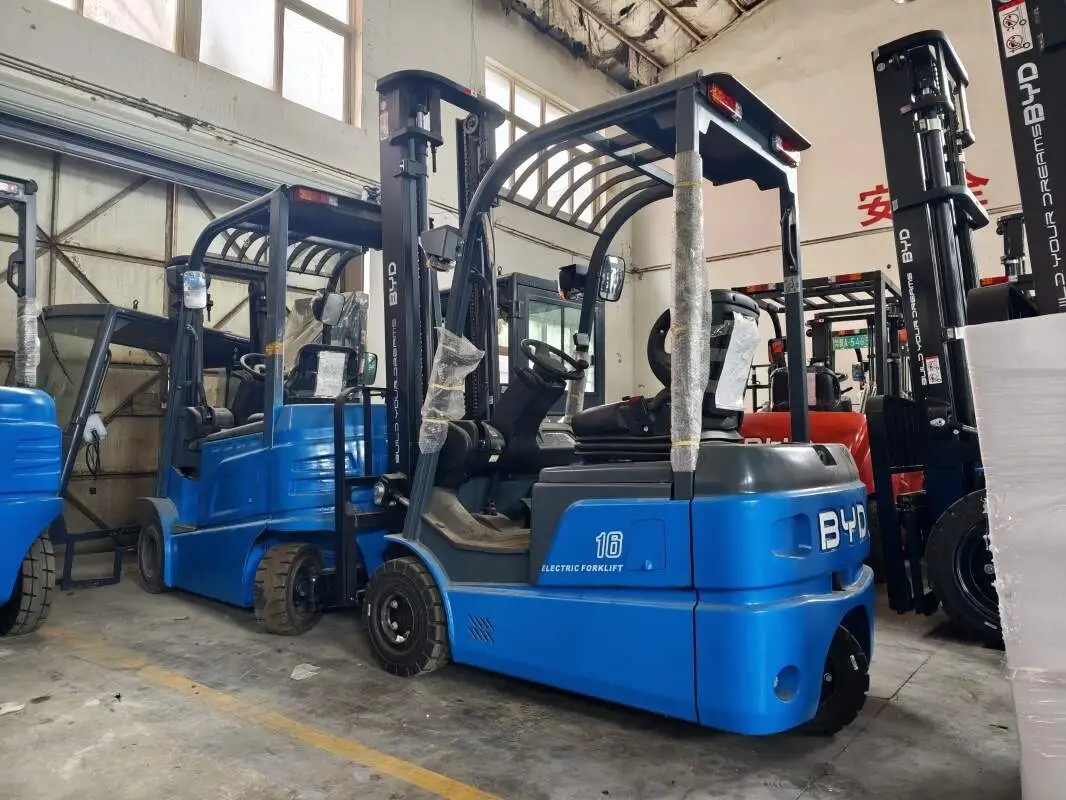
Zur Unterscheidung zwischen Gegengewicht und Reichweite elektrischer Gabelstapler, wie man verschiedene Lagerszenarien wählt

2026-06-30

Zur Unterscheidung zwischen Gegengewicht und Reichweite elektrischer Gabelstapler, wie man verschiedene Lagerszenarien wählt(Figur1)

Elektrostapler sind das Kernstück moderner Lager- und Logistikabläufe. Als zwei gängige Modelle unterscheiden sich Elektrostapler mit Gegengewicht und Reichweite erheblich in Struktur, Leistung und Anwendungsszenarien. Eine vernünftige Auswahl wirkt sich direkt auf die Effizienz des Lagerbetriebs und die Kostenkontrolle aus.

Analyse der Kernunterschiede zwischen den beiden

Strukturelle Konstruktionsunterschiede

Das Heck des Elektrostaplers mit Gegengewicht ist mit einem Gegengewichtsblock ausgestattet, der sich auf das Gegengewicht stützt, um die Last der Vordergabel auszugleichen, und die gesamte Karosseriestruktur ist breit; der vorwärts fahrende Elektrostapler hat kein Gegengewicht am Heck, und das Portal kann nach vorne verlängert werden, um die Gabel nach vorne zu treiben und sich über das Vorderrad zu bewegen. Die Karosserie ist relativ kompakt.

unterschiedliche Leistungsmerkmale

Der Elektrostapler mit Ausgleichsgewicht hat einen größeren Lastbereich und kann sich an die Handhabung schwerer Güter anpassen, erfordert jedoch eine höhere Bodenebenheit, und die Bodenturbulenzen können die Stabilität des Betriebs leicht beeinträchtigen. Der vorwärts fahrende Elektrostapler konzentriert sich auf die Raumnutzung und hat eine relativ moderate Belastung. Er kann den Frachtzugang auf kleinem Raum mit geringerem Energieverbrauch durchführen und ist für den langfristigen Betrieb in Innenräumen geeignet.

Unterscheidung zur beruflichen Flexibilität

Der Elektrostapler mit Ausgleichsgewicht hat einen großen Wenderadius, der einen geräumigeren Arbeitsraum erfordert, was den Betrieb in einem engen Kanal erschwert. Der Wenderadius des vorwärtsfahrenden Elektrostaplers ist klein, und die vorwärtsfahrende Konstruktion des Portals ermöglicht es, das Be- und Entladen der Ladung abzuschließen, ohne die Karosserie wesentlich anzupassen. Er eignet sich für Lagerumgebungen mit engen Kanälen.

Auswahlhilfe für verschiedene Lagerungsszenarien

Großes offenes Lager und schwere Ladungsszenarien

Wenn der Lagerort offen ist und Schwerlastumschlag und Stapeln die wichtigsten sind, empfiehlt es sich, einen Elektrostapler mit Gegengewicht zu wählen. Seine große Tragfähigkeit kann das Be- und Entladen sowie den Umschlag von schweren Gütern effizient durchführen, sich an die Bodenbedingungen des offenen Feldes anpassen und die Betriebsanforderungen großer Warenmengen erfüllen.

Schmaler Gang, kleiner Stauraum und Hochregal-Szene

Für Szenen, in denen die Lagerräume in engen Gängen und Hochhausregale dicht sind, ist der elektrische Gabelstapler mit Reichweite die bessere Wahl. Sein kompakter Körper kann flexibel durch enge Gänge pendeln, und die Türrahmen-Vorwärtsfunktion kann genau auf Regalwaren in Hochhäusern zugreifen, die Raumnutzung verbessern und den Energieverbrauch im Betrieb senken.

Kleine und mittelgroße Hochfrequenzhandhabungsszene

Wenn der tägliche Betrieb auf dem hochfrequenten Umschlag und der Lagerung von kleinen und mittleren Gütern basiert, sind die Vorteile der Flexibilität und des geringen Energieverbrauchs des Elektrostaplers mit Reichweite offensichtlicher, was die Betriebszeit verkürzen und die Effizienz des gesamten Lagerumlaufs verbessern kann; wenn es sich um den regelmäßigen Umschlag schwerer Güter handelt, kann er mit einem Elektrostapler mit Gegengewicht kombiniert werden, um den Betrieb zu ergänzen.

Bei der Auswahl eines Unternehmens müssen die tatsächlichen Anforderungen an Lagerraum, Ladegewicht und Betriebshäufigkeit berücksichtigt und die Eigenschaften der beiden Gabelstaplertypen umfassend berücksichtigt werden, um einen effizienten und kostengünstigen Lagerbetrieb zu erreichen.

We use cookie to improve your online experience. By continuing to browse this website, you agree to our use of cookie.

Cookies

Please read our Terms and Conditions and this Policy before accessing or using our Services. If you cannot agree with this Policy or the Terms and Conditions, please do not access or use our Services. If you are located in a jurisdiction outside the European Economic Area, by using our Services, you accept the Terms and Conditions and accept our privacy practices described in this Policy.
We may modify this Policy at any time, without prior notice, and changes may apply to any Personal Information we already hold about you, as well as any new Personal Information collected after the Policy is modified. If we make changes, we will notify you by revising the date at the top of this Policy. We will provide you with advanced notice if we make any material changes to how we collect, use or disclose your Personal Information that impact your rights under this Policy. If you are located in a jurisdiction other than the European Economic Area, the United Kingdom or Switzerland (collectively “European Countries”), your continued access or use of our Services after receiving the notice of changes, constitutes your acknowledgement that you accept the updated Policy. In addition, we may provide you with real time disclosures or additional information about the Personal Information handling practices of specific parts of our Services. Such notices may supplement this Policy or provide you with additional choices about how we process your Personal Information.


Cookies

Cookies are small text files stored on your device when you access most Websites on the internet or open certain emails. Among other things, Cookies allow a Website to recognize your device and remember if you've been to the Website before. Examples of information collected by Cookies include your browser type and the address of the Website from which you arrived at our Website as well as IP address and clickstream behavior (that is the pages you view and the links you click).We use the term cookie to refer to Cookies and technologies that perform a similar function to Cookies (e.g., tags, pixels, web beacons, etc.). Cookies can be read by the originating Website on each subsequent visit and by any other Website that recognizes the cookie. The Website uses Cookies in order to make the Website easier to use, to support a better user experience, including the provision of information and functionality to you, as well as to provide us with information about how the Website is used so that we can make sure it is as up to date, relevant, and error free as we can. Cookies on the Website We use Cookies to personalize your experience when you visit the Site, uniquely identify your computer for security purposes, and enable us and our third-party service providers to serve ads on our behalf across the internet.

We classify Cookies in the following categories:
 ●  Strictly Necessary Cookies
 ●  Performance Cookies
 ●  Functional Cookies
 ●  Targeting Cookies


Cookie List
A cookie is a small piece of data (text file) that a website – when visited by a user – asks your browser to store on your device in order to remember information about you, such as your language preference or login information. Those cookies are set by us and called first-party cookies. We also use third-party cookies – which are cookies from a domain different than the domain of the website you are visiting – for our advertising and marketing efforts. More specifically, we use cookies and other tracking technologies for the following purposes:

Strictly Necessary Cookies
These cookies are necessary for the website to function and cannot be switched off in our systems. They are usually only set in response to actions made by you which amount to a request for services, such as setting your privacy preferences, logging in or filling in forms. You can set your browser to block or alert you about these cookies, but some parts of the site will not then work. These cookies do not store any personally identifiable information.

Functional Cookies
These cookies enable the website to provide enhanced functionality and personalisation. They may be set by us or by third party providers whose services we have added to our pages. If you do not allow these cookies then some or all of these services may not function properly.

Performance Cookies
These cookies allow us to count visits and traffic sources so we can measure and improve the performance of our site. They help us to know which pages are the most and least popular and see how visitors move around the site. All information these cookies collect is aggregated and therefore anonymous. If you do not allow these cookies we will not know when you have visited our site, and will not be able to monitor its performance.

Targeting Cookies
These cookies may be set through our site by our advertising partners. They may be used by those companies to build a profile of your interests and show you relevant adverts on other sites. They do not store directly personal information, but are based on uniquely identifying your browser and internet device. If you do not allow these cookies, you will experience less targeted advertising.

How To Turn Off Cookies
You can choose to restrict or block Cookies through your browser settings at any time. Please note that certain Cookies may be set as soon as you visit the Website, but you can remove them using your browser settings. However, please be aware that restricting or blocking Cookies set on the Website may impact the functionality or performance of the Website or prevent you from using certain services provided through the Website. It will also affect our ability to update the Website to cater for user preferences and improve performance. Cookies within Mobile Applications

We only use Strictly Necessary Cookies on our mobile applications. These Cookies are critical to the functionality of our applications, so if you block or delete these Cookies you may not be able to use the application. These Cookies are not shared with any other application on your mobile device. We never use the Cookies from the mobile application to store personal information about you.

If you have questions or concerns regarding any information in this Privacy Policy, please contact us by email at . You can also contact us via our customer service at our Site.