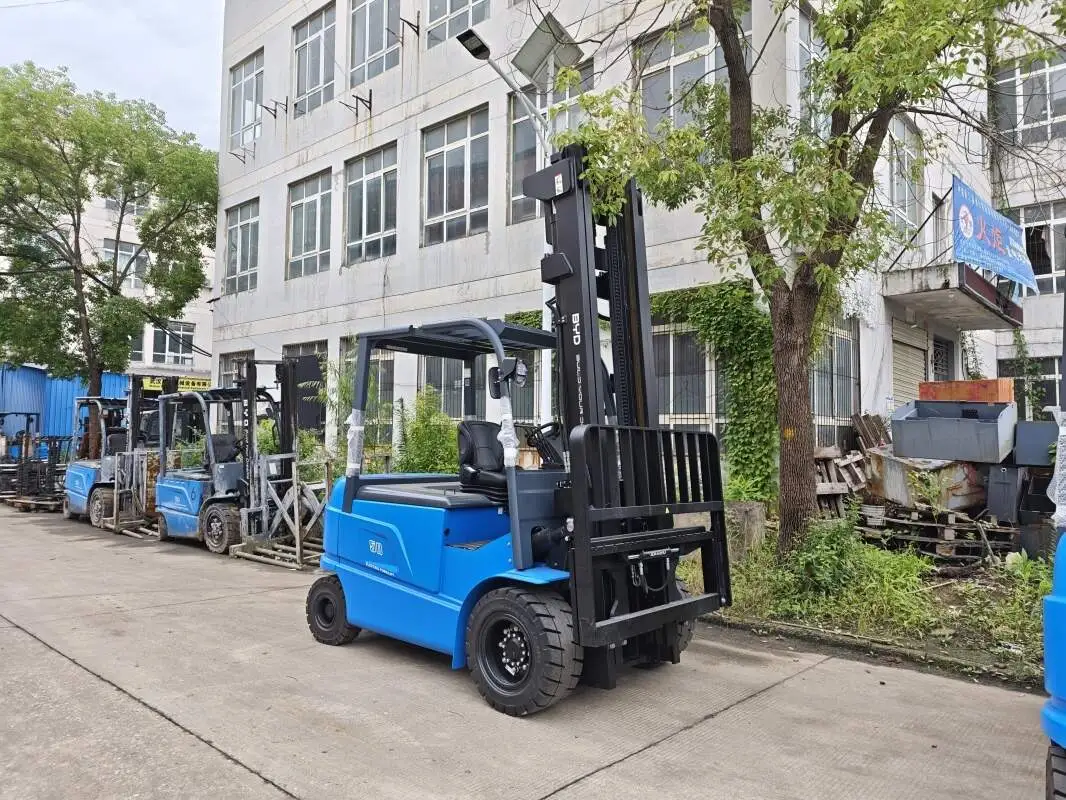
Lebensmittelverarbeitungsanlage wählt Betriebsplan für BYD-Elektrostapler zur Einhaltung der Vorschriften

2026-06-29

Lebensmittelverarbeitungsanlage wählt Betriebsplan für BYD-Elektrostapler zur Einhaltung der Vorschriften(Figur1)

Voraussetzungen für die Einhaltung des Gabelstaplerbetriebs in Lebensmittelverarbeitungsbetrieben

Lebensmittelverarbeitungsbetriebe sind spezielle Produktionsszenarien mit hohen Hygiene- und Sicherheitsanforderungen. Die logistischen Betriebsanlagen vor Ort müssen die Hygienestandards der Lebensmittelindustrie, die Sicherheitsvorschriften für die Produktion und die Umweltschutzstandards strikt einhalten. Der Gabelstapler als zentrales Handhabungsgerät steht in direktem Zusammenhang mit der Sicherheit von Lebensmittelrohstoffen und Fertigprodukten und wirkt sich auch auf die Stabilität der Produktionsumgebung aus. Daher ist es besonders wichtig, geeignete Elektrostapler auszuwählen und ein Compliance-Betriebssystem einzurichten.

Auswahlpunkte für die Einhaltung der Vorschriften für elektrische Gabelstapler

Anpassung von Material und Hygiene

Der von der Lebensmittelverarbeitungsfabrik ausgewählte Gabelstapler muss über lebensmittelechte Kontaktmaterialien verfügen. Das Gehäuse und die wichtigsten Komponenten sollten aus korrosionsbeständigem Material bestehen und keine Flecken ansammeln. Es ist bequem für die tägliche Reinigung und Wartung, um potenzielle Gesundheitsrisiken durch Rost und Restflecken zu vermeiden. Gleichzeitig ist ein perfektes Anti-Leck-Design erforderlich, um zu verhindern, dass das Austreten von Hydrauliköl, Batterieflüssigkeit und anderen Lecks den Produktionsbereich verschmutzt und die Umgebung der Lebensmittelproduktion zerstört.

Umweltschutz und Sicherheitsleistung

Elektrische Gabelstapler müssen die Umweltanforderungen der Emissionsfreiheit und der Geräuscharmut erfüllen, um zu vermeiden, dass Abgase oder Lärm den Lebensmittelproduktionsprozess und die Qualität beeinträchtigen. Darüber hinaus sind Sicherheitsvorrichtungen wie Notbremsungen, Antikollisionswarnungen und Überlastungsschutz erforderlich, um die Sicherheit von Bedienern, Ausrüstung und Produktionsmaterialien rundum zu gewährleisten.

BYD-Programm zur Einhaltung der Vorschriften für elektrische Gabelstapler

Als Antwort auf die Anforderungen von Lebensmittelverarbeitungsbetrieben wurden die BYD-Elektrostapler so konzipiert, dass sie den Eigenschaften der Branche entsprechen. Es verwendet ein geschlossenes Batteriesystem, das das Risiko des Auslaufens von Batterieflüssigkeit effektiv eliminiert und die Verschmutzung der Produktionsumgebung reduziert; die Karosserieoberfläche besteht aus integriertem glattem Material, keine Sackgassen und ist leicht zu reinigen, was für die tägliche Hygienewartung praktisch ist; geräuscharmer Betriebsmodus, der die leisen Anforderungen von Lebensmittelproduktionswerkstätten erfüllt; gleichzeitig ist es mit mehreren Sicherheitsschutzvorrichtungen ausgestattet, um die Sicherheitsproduktionsspezifikationen zu erfüllen und den Compliance-Schutz für den Betrieb von Lebensmittelfabriken zu bieten.

Praktiken des Compliance-Managements im täglichen Betrieb

Management der Bedienerqualifikation

Alle Gabelstaplerfahrer müssen über ein landesweit anerkanntes Gabelstaplerbetriebszertifikat verfügen und eine spezielle Projektbetriebsschulung in der Lebensmittelindustrie erhalten, die mit den Hygieneanforderungen der Lebensmittelfabrik, dem Betriebssperrgebiet und den Sicherheitsvorschriften vertraut ist, um sicherzustellen, dass der Betriebsprozess den Konformitätsstandards entspricht.

Tägliche Reinigung und Wartung

Der Gabelstapler muss vor und nach dem täglichen Betrieb vollständig gereinigt werden, wobei der Schwerpunkt auf der Reinigung der Teile liegt, die mit Lebensmitteln in Berührung kommen können, um Restflecken zu entfernen; Überprüfen und warten Sie regelmäßig den Batteriestatus, das Bremssystem, das Hydrauliksystem usw. und führen Sie vollständige Wartungsprotokolle, um sicherzustellen, dass das Gerät stets den Vorschriften entspricht.

Workflow-Spezifikation

Gabelstaplerbetriebe müssen sich strikt an die vorgegebene Route halten und Schlüsselbereiche wie Lagerbereiche für Lebensmittelrohstoffe und Produktionslinien meiden, um Quervorgänge zu vermeiden, die zu Umweltverschmutzung oder Sicherheitsunfällen führen; beim Umgang mit lebensmittelbezogenen Materialien müssen spezielle Reinigungsbehälter verwendet werden, um zu verhindern, dass Materialverschüttungen die Produktionsumgebung verschmutzen.

Langfristige Einhaltung

Einrichtung eines soliden Managementdokuments für die Einhaltung der Vorschriften für Gabelstapler, regelmäßige interne Selbstinspektionen zur Einhaltung der Vorschriften und aktive Zusammenarbeit mit der Überwachung und Inspektion der zuständigen Aufsichtsbehörden; rechtzeitige Beachtung der Aktualisierung der Vorschriften und Normen für die Lebensmittelindustrie, Anpassung der Spezifikationen für den Betrieb von Gabelstaplern und der Wartungsstandards, um die langfristige Einhaltung der Anforderungen an die Einhaltung der Vorschriften in der Produktion sicherzustellen.

We use cookie to improve your online experience. By continuing to browse this website, you agree to our use of cookie.

Cookies

Please read our Terms and Conditions and this Policy before accessing or using our Services. If you cannot agree with this Policy or the Terms and Conditions, please do not access or use our Services. If you are located in a jurisdiction outside the European Economic Area, by using our Services, you accept the Terms and Conditions and accept our privacy practices described in this Policy.
We may modify this Policy at any time, without prior notice, and changes may apply to any Personal Information we already hold about you, as well as any new Personal Information collected after the Policy is modified. If we make changes, we will notify you by revising the date at the top of this Policy. We will provide you with advanced notice if we make any material changes to how we collect, use or disclose your Personal Information that impact your rights under this Policy. If you are located in a jurisdiction other than the European Economic Area, the United Kingdom or Switzerland (collectively “European Countries”), your continued access or use of our Services after receiving the notice of changes, constitutes your acknowledgement that you accept the updated Policy. In addition, we may provide you with real time disclosures or additional information about the Personal Information handling practices of specific parts of our Services. Such notices may supplement this Policy or provide you with additional choices about how we process your Personal Information.


Cookies

Cookies are small text files stored on your device when you access most Websites on the internet or open certain emails. Among other things, Cookies allow a Website to recognize your device and remember if you've been to the Website before. Examples of information collected by Cookies include your browser type and the address of the Website from which you arrived at our Website as well as IP address and clickstream behavior (that is the pages you view and the links you click).We use the term cookie to refer to Cookies and technologies that perform a similar function to Cookies (e.g., tags, pixels, web beacons, etc.). Cookies can be read by the originating Website on each subsequent visit and by any other Website that recognizes the cookie. The Website uses Cookies in order to make the Website easier to use, to support a better user experience, including the provision of information and functionality to you, as well as to provide us with information about how the Website is used so that we can make sure it is as up to date, relevant, and error free as we can. Cookies on the Website We use Cookies to personalize your experience when you visit the Site, uniquely identify your computer for security purposes, and enable us and our third-party service providers to serve ads on our behalf across the internet.

We classify Cookies in the following categories:
 ●  Strictly Necessary Cookies
 ●  Performance Cookies
 ●  Functional Cookies
 ●  Targeting Cookies


Cookie List
A cookie is a small piece of data (text file) that a website – when visited by a user – asks your browser to store on your device in order to remember information about you, such as your language preference or login information. Those cookies are set by us and called first-party cookies. We also use third-party cookies – which are cookies from a domain different than the domain of the website you are visiting – for our advertising and marketing efforts. More specifically, we use cookies and other tracking technologies for the following purposes:

Strictly Necessary Cookies
These cookies are necessary for the website to function and cannot be switched off in our systems. They are usually only set in response to actions made by you which amount to a request for services, such as setting your privacy preferences, logging in or filling in forms. You can set your browser to block or alert you about these cookies, but some parts of the site will not then work. These cookies do not store any personally identifiable information.

Functional Cookies
These cookies enable the website to provide enhanced functionality and personalisation. They may be set by us or by third party providers whose services we have added to our pages. If you do not allow these cookies then some or all of these services may not function properly.

Performance Cookies
These cookies allow us to count visits and traffic sources so we can measure and improve the performance of our site. They help us to know which pages are the most and least popular and see how visitors move around the site. All information these cookies collect is aggregated and therefore anonymous. If you do not allow these cookies we will not know when you have visited our site, and will not be able to monitor its performance.

Targeting Cookies
These cookies may be set through our site by our advertising partners. They may be used by those companies to build a profile of your interests and show you relevant adverts on other sites. They do not store directly personal information, but are based on uniquely identifying your browser and internet device. If you do not allow these cookies, you will experience less targeted advertising.

How To Turn Off Cookies
You can choose to restrict or block Cookies through your browser settings at any time. Please note that certain Cookies may be set as soon as you visit the Website, but you can remove them using your browser settings. However, please be aware that restricting or blocking Cookies set on the Website may impact the functionality or performance of the Website or prevent you from using certain services provided through the Website. It will also affect our ability to update the Website to cater for user preferences and improve performance. Cookies within Mobile Applications

We only use Strictly Necessary Cookies on our mobile applications. These Cookies are critical to the functionality of our applications, so if you block or delete these Cookies you may not be able to use the application. These Cookies are not shared with any other application on your mobile device. We never use the Cookies from the mobile application to store personal information about you.

If you have questions or concerns regarding any information in this Privacy Policy, please contact us by email at . You can also contact us via our customer service at our Site.