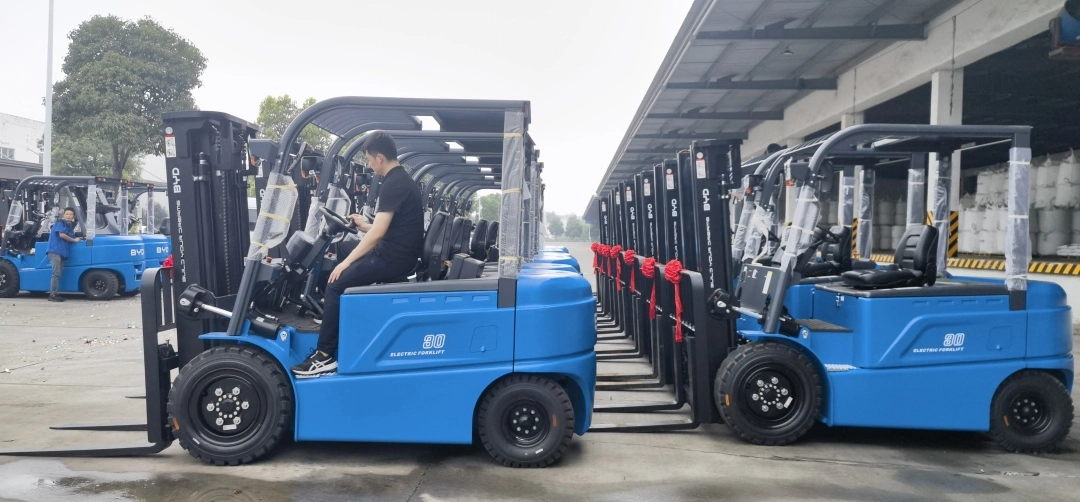
Regelmäßiger Wartungsprozess für elektrische Gabelstapler zur Reduzierung der langfristigen Wartungskosten

2026-06-25

Regelmäßiger Wartungsprozess für elektrische Gabelstapler zur Reduzierung der langfristigen Wartungskosten(Figur1)

Als gängiges Umschlaggerät für Lagerhaltung und Logistik wirkt sich der stabile und zuverlässige Betrieb des Elektrostaplers direkt auf die Betriebseffizienz und Kostenkontrolle aus. Viele Unternehmen haben vielleicht das Gefühl, dass die regelmäßige Wartung die unmittelbaren Ausgaben erhöht, aber tatsächlich ist die standardisierte regelmäßige Wartung ein wirksames Mittel, um kleinere Fehler im Voraus zu beheben, die Lebensdauer der Kernkomponenten zu verlängern und hohe Wartungskosten zu vermeiden. Als Nächstes sollten Sie eine Reihe von allgemeinen regelmäßigen Wartungsprozessen für den Elektrostapler ausarbeiten, um den Unternehmen zu helfen, gute Arbeit im Facility Management zu leisten.

Die tägliche Inspektion vor jeder Operation ist unerlässlich und kann in drei bis fünf Minuten abgeschlossen werden. Sie konzentriert sich auf die Details, die die Sicherheit und den grundlegenden Betrieb beeinträchtigen. Überprüfen Sie zunächst den Karosserierahmen, um zu sehen, ob es verformte, offensichtlich zerkratzte oder lose Teile gibt, um Sicherheitsrisiken durch strukturelle Probleme zu beseitigen. Überprüfen Sie dann die Reifen, um die Abnutzung des Profils zu beobachten, um festzustellen, ob der Reifendruck in einem angemessenen Zustand ist. Eine zu flache Lauffläche oder ein abnormaler Luftdruck können den Reifenverschleiß und den Energieverbrauch erhöhen und sogar Probleme wie Schleudern verursachen. Testen Sie dann die Funktionen von Bremsen, Blinkern, Warnleuchten und Hupen, um eine reibungslose Reaktion und ein klares Signal zu gewährleisten. Prüfen Sie abschließend, ob der Sicherheitsgurt in gutem Zustand angelegt ist und ob die Batterieleistung ausreichend ist. Wenn es nicht ausreicht, muss es rechtzeitig aufgeladen werden, um zu vermeiden, dass eine übermäßige Entladung die Akkulaufzeit beeinträchtigt.

Passen Sie das Intervall der wöchentlichen Wartung an die tatsächliche Arbeitszeit an. Im Allgemeinen wird empfohlen, einen Dauerbetrieb von etwa 40 Stunden durchzuführen. Wenn die Arbeitsumgebung feucht und staubig ist, kann das Intervall entsprechend verkürzt werden. Der Schwerpunkt der wöchentlichen Wartung liegt auf der Batterie und den grundlegenden Hydraulikkomponenten. Bei non-maintenance-free Batterien ist es notwendig, die Oberfläche von Staub, Schmutz und Überlaufspuren des Elektrolyten zu reinigen, um Leckagen oder Korrosion zu vermeiden. Prüfen Sie gleichzeitig, ob die Klemme oxidiert oder locker ist. Verwenden Sie ein weiches Tuch, das in eine kleine Menge neutraler Reinigungsflüssigkeit getaucht ist, um sie vorsichtig abzuwischen und festzuziehen. Bei wartungsfreien Batterien reinigen Sie nur die Oberfläche und das Terminal. Prüfen Sie auch den Ölstand des Hydrauliköls, um festzustellen, ob er sich in einem angemessenen Bereich der eigenen Skala des Geräts befindet. Prüfen Sie, ob Spuren von Leckagen in der Hydraulikleitung und den Verbindungen vorhanden sind, um eine Beeinträchtigung der Förderleistung durch unzureichendes Hydrauliköl zu vermeiden.

Der Dauerbetrieb umfasst etwa 160 Stunden monatliche Wartung, wobei der Schwerpunkt auf den drei Kernsystemen Lenkung, Bremsen und Fahren liegt. Prüfen Sie, ob der Kugelkopf der Lenkstange locker ist und ob der Spalt zwischen dem Lenkrad innerhalb des normalen Bereichs liegt, der nach der Bedienungsanleitung zulässig ist, um Lenkfehler zu vermeiden. Prüfen Sie den Verschleiß der Bremsreibungsplatte. Wenn der Verschleiß nahe an einem angemessenen Schwellenwert liegt, sollte sie rechtzeitig ausgetauscht werden; gleichzeitig prüfen Sie, ob die Bremsleitung beschädigt ist oder Öl austritt, um die Sicherheit beim Bremsen zu gewährleisten. Reinigen Sie den Kühlkörper des Antriebsmotors, um eine gute Belüftung zu gewährleisten und zu verhindern, dass eine Überhitzung die Leistung des Motors beeinträchtigt; Prüfen Sie die Dichtheit der Getriebekette oder des Riemens, um zu hören, ob während des Betriebs abnormale Geräusche auftreten, und stellen oder ersetzen Sie sie gegebenenfalls.

Es wird empfohlen, qualifiziertes Wartungspersonal für etwa 640 Stunden Dauerbetrieb oder vierteljährliche jährliche Systemwartung alle sechs Monate bis zu einem Jahr zu beauftragen. In dieser Phase ist eine umfassende Inspektion und Fehlersuche an Kernkomponenten wie dem Fahrzeugkreislauf, dem Hydrauliksystem, dem Motor, der Steuerung usw. erforderlich, um mögliche versteckte Fehler rechtzeitig zu erkennen; ersetzen Sie auch einige anfällige Teile wie Hydraulikölfilterelemente, Luftfilterelemente usw., um die Sauberkeit und den koordinierten und stabilen Betrieb jedes Systems zu gewährleisten.

Unternehmen können auf der Grundlage dieses Prozesses und des Benutzerhandbuchs ihrer eigenen Geräte einen detaillierteren Wartungsplan erstellen und eine spezielle Person beauftragen, die für die Wartungsaufzeichnungen verantwortlich ist und diese pflegt, wodurch nicht nur der Betrieb standardisiert, sondern auch die langfristigen Wartungsausgaben angemessen reduziert und die Effizienz und Lebensdauer der Geräte verbessert werden können.

We use cookie to improve your online experience. By continuing to browse this website, you agree to our use of cookie.

Cookies

Please read our Terms and Conditions and this Policy before accessing or using our Services. If you cannot agree with this Policy or the Terms and Conditions, please do not access or use our Services. If you are located in a jurisdiction outside the European Economic Area, by using our Services, you accept the Terms and Conditions and accept our privacy practices described in this Policy.
We may modify this Policy at any time, without prior notice, and changes may apply to any Personal Information we already hold about you, as well as any new Personal Information collected after the Policy is modified. If we make changes, we will notify you by revising the date at the top of this Policy. We will provide you with advanced notice if we make any material changes to how we collect, use or disclose your Personal Information that impact your rights under this Policy. If you are located in a jurisdiction other than the European Economic Area, the United Kingdom or Switzerland (collectively “European Countries”), your continued access or use of our Services after receiving the notice of changes, constitutes your acknowledgement that you accept the updated Policy. In addition, we may provide you with real time disclosures or additional information about the Personal Information handling practices of specific parts of our Services. Such notices may supplement this Policy or provide you with additional choices about how we process your Personal Information.


Cookies

Cookies are small text files stored on your device when you access most Websites on the internet or open certain emails. Among other things, Cookies allow a Website to recognize your device and remember if you've been to the Website before. Examples of information collected by Cookies include your browser type and the address of the Website from which you arrived at our Website as well as IP address and clickstream behavior (that is the pages you view and the links you click).We use the term cookie to refer to Cookies and technologies that perform a similar function to Cookies (e.g., tags, pixels, web beacons, etc.). Cookies can be read by the originating Website on each subsequent visit and by any other Website that recognizes the cookie. The Website uses Cookies in order to make the Website easier to use, to support a better user experience, including the provision of information and functionality to you, as well as to provide us with information about how the Website is used so that we can make sure it is as up to date, relevant, and error free as we can. Cookies on the Website We use Cookies to personalize your experience when you visit the Site, uniquely identify your computer for security purposes, and enable us and our third-party service providers to serve ads on our behalf across the internet.

We classify Cookies in the following categories:
 ●  Strictly Necessary Cookies
 ●  Performance Cookies
 ●  Functional Cookies
 ●  Targeting Cookies


Cookie List
A cookie is a small piece of data (text file) that a website – when visited by a user – asks your browser to store on your device in order to remember information about you, such as your language preference or login information. Those cookies are set by us and called first-party cookies. We also use third-party cookies – which are cookies from a domain different than the domain of the website you are visiting – for our advertising and marketing efforts. More specifically, we use cookies and other tracking technologies for the following purposes:

Strictly Necessary Cookies
These cookies are necessary for the website to function and cannot be switched off in our systems. They are usually only set in response to actions made by you which amount to a request for services, such as setting your privacy preferences, logging in or filling in forms. You can set your browser to block or alert you about these cookies, but some parts of the site will not then work. These cookies do not store any personally identifiable information.

Functional Cookies
These cookies enable the website to provide enhanced functionality and personalisation. They may be set by us or by third party providers whose services we have added to our pages. If you do not allow these cookies then some or all of these services may not function properly.

Performance Cookies
These cookies allow us to count visits and traffic sources so we can measure and improve the performance of our site. They help us to know which pages are the most and least popular and see how visitors move around the site. All information these cookies collect is aggregated and therefore anonymous. If you do not allow these cookies we will not know when you have visited our site, and will not be able to monitor its performance.

Targeting Cookies
These cookies may be set through our site by our advertising partners. They may be used by those companies to build a profile of your interests and show you relevant adverts on other sites. They do not store directly personal information, but are based on uniquely identifying your browser and internet device. If you do not allow these cookies, you will experience less targeted advertising.

How To Turn Off Cookies
You can choose to restrict or block Cookies through your browser settings at any time. Please note that certain Cookies may be set as soon as you visit the Website, but you can remove them using your browser settings. However, please be aware that restricting or blocking Cookies set on the Website may impact the functionality or performance of the Website or prevent you from using certain services provided through the Website. It will also affect our ability to update the Website to cater for user preferences and improve performance. Cookies within Mobile Applications

We only use Strictly Necessary Cookies on our mobile applications. These Cookies are critical to the functionality of our applications, so if you block or delete these Cookies you may not be able to use the application. These Cookies are not shared with any other application on your mobile device. We never use the Cookies from the mobile application to store personal information about you.

If you have questions or concerns regarding any information in this Privacy Policy, please contact us by email at . You can also contact us via our customer service at our Site.