
 简体中文
简体中文 繁体中文
繁体中文 Deutsch
 日本語
日本語 한국어
한국어 Tiếng Việt
 Русский
 ไทย
ไทย Bahasa Indonesia
 Bahasa Melayu
 Filipino
 لالعربية
 Français

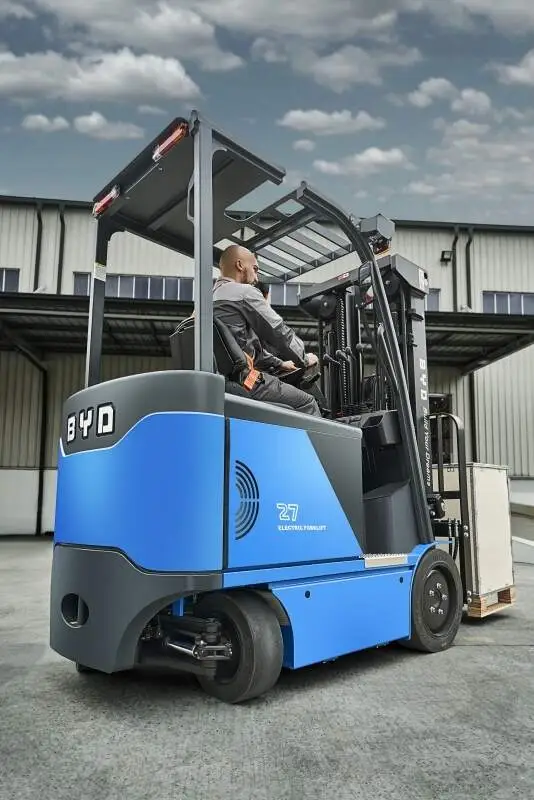
In the current context of rising land and operating costs in the warehousing industry, improving the utilization rate of warehouse space has become a core requirement, and the construction of narrow-channel warehouses has become the choice of many businesses. Narrow-channel warehouses have high requirements for the turning performance of supporting handling equipment. The 3.5-ton three-pivot lithium-electric forklift is one of the more common types of adaptation. The following is an analysis of its turning performance from the core parameters and working principle.
First of all, the core turning parameters of the 3.5-ton three-point lithium electric forklift have certain advantages. Ordinary counterbalanced electric forklifts rely on rear wheel steering, and the turning radius usually needs to be calculated in combination with multiple factors such as body length and fork extension length. The overall value is large, which is difficult to meet the operating space requirements of narrow channels. The rear wheels of the 3.5-ton three-point lithium electric forklift use single or two steering wheels side by side, and the minimum turning radius can usually be controlled within a small range. Some models can even realize in-situ steering operation. The realization of in-situ steering function allows the equipment to flexibly adjust the direction in a narrow area, further reducing the requirements for channel width.
Secondly, there are multiple reasons why the turning performance of the 3.5-ton three-point lithium-ion forklift is adapted to narrow channels. On the one hand, the structural design, compared with the four-point support of ordinary electric forklifts, the three-point support layout reduces the number of support restrictions of the rear wheel, and the rotation angle of the steering wheel can be larger; on the other hand, the power system and the steering system cooperate. The lithium-ion power system responds faster, and the power distribution is more stable during steering, which will not affect the smoothness and accuracy of steering due to power fluctuations. In addition, some 3.5-ton three-point lithium-ion forklifts are also equipped with steering assistance systems, which can help operators control the steering angle more easily and improve the safety and efficiency of operation.
However, the turning performance of a 3.5-ton three-point lithium-ion forklift truck also has applicable conditions, such as the need to pay attention to the position of the center of gravity of the goods when steering to avoid affecting the stability of the equipment due to the deviation of the center of gravity. At the same time, operators need to undergo professional training and be familiar with the turning operation characteristics of the equipment in order to better play its advantages.


