
 简体中文
简体中文 繁体中文
繁体中文 Deutsch
 日本語
日本語 한국어
한국어 Tiếng Việt
 Русский
 ไทย
ไทย Bahasa Indonesia
 Bahasa Melayu
 Filipino
 لالعربية
 Français

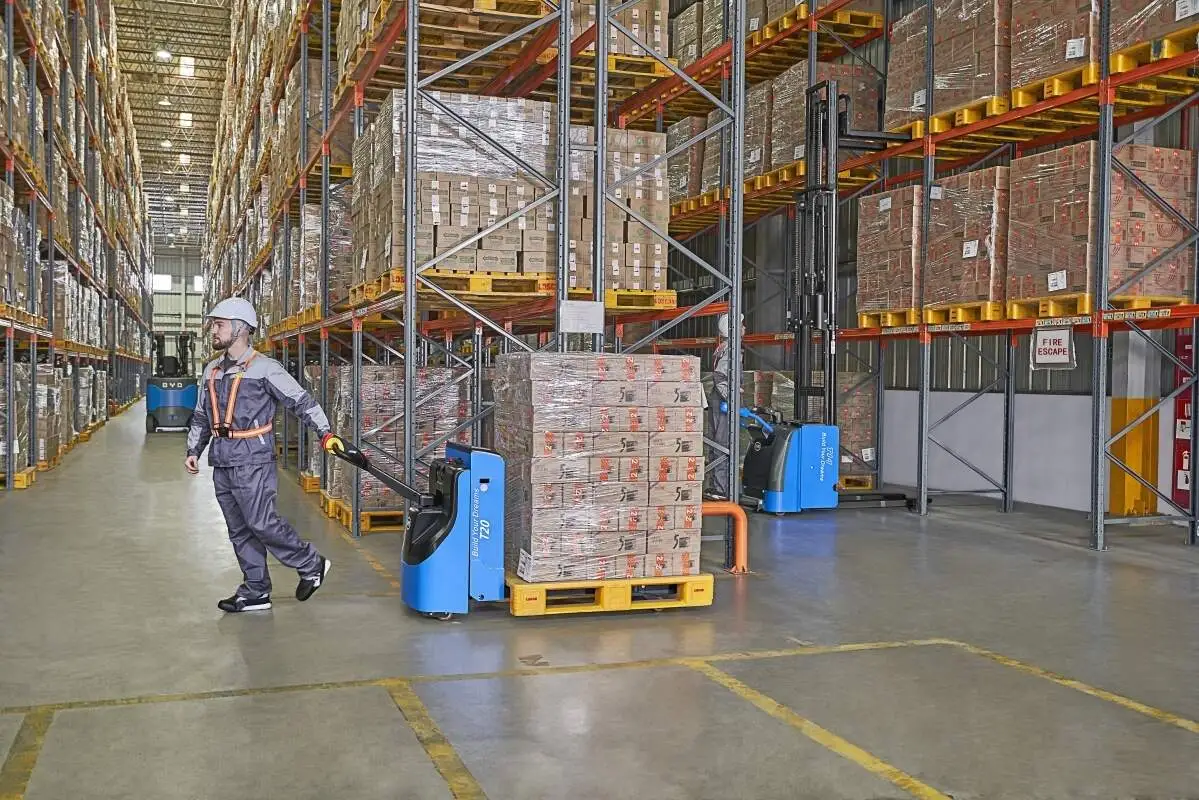
Core requirements for forklifts in warehousing operation scenarios
With the development of the warehousing industry towards high density and refinement, the layout of narrow aisles and dense shelves is becoming more and more common, and the mobility of forklifts has become a key factor affecting operation efficiency. Traditional warehousing forklifts are prone to limited steering and need to reserve wider aisles when operating in narrow aisles due to their large turning radius, which not only wastes warehousing space, but also slows down the rhythm of cargo handling.
Three-pivot lithium battery storage forklift, small turning radius, structural logic
The steering principle of three-pivot layout
The three-point lithium battery storage forklift adopts a unique three-point support structure. The front wheel has both driving and steering functions, and the two rear wheels are symmetrically distributed at the tail of the body to form a support point. Compared with the traditional four-wheel forklift, this layout makes the turning center of the forklift when turning closer to the body, and the radius of the steering track is greatly reduced. Under the same body length, the turning radius of the three-point forklift can be reduced by about 20% compared with the ordinary forklift, which can complete the steering operation in a narrower space.
The practical advantages of a small turning radius
Increase storage space utilization
The smaller turning radius allows the width of the channel to be reduced when the warehouse is laid out. The area that originally needed to reserve a wider channel can now be planned for more storage spaces, directly increasing the storage capacity of the warehouse. For urban storage centers where land is expensive, this advantage can effectively reduce space costs.
Improve operational efficiency
In daily handling operations, the small turning radius allows the forklift to complete the steering without having to adjust the position multiple times, reducing the operation steps during the operation and shortening the single handling time. Especially in the scene of frequent entry and exit of shelves and turnover of goods, the improvement of operation efficiency is more obvious.
Reduce operational risk
The flexible steering capability reduces the probability of forklifts colliding with shelves and goods in narrow passages, reducing the risk of damage to goods and equipment loss, and also provides more protection for the safety of operators.
Overall, the advantage of the small turning radius of the three-point lithium battery storage forklift adapts to the high-density operation requirements of modern warehousing, making it an important equipment choice for improving the efficiency of warehousing operations.


