
 简体中文
简体中文 繁体中文
繁体中文 Deutsch
 日本語
日本語 한국어
한국어 Tiếng Việt
 Русский
 ไทย
ไทย Bahasa Indonesia
 Bahasa Melayu
 Filipino
 لالعربية
 Français

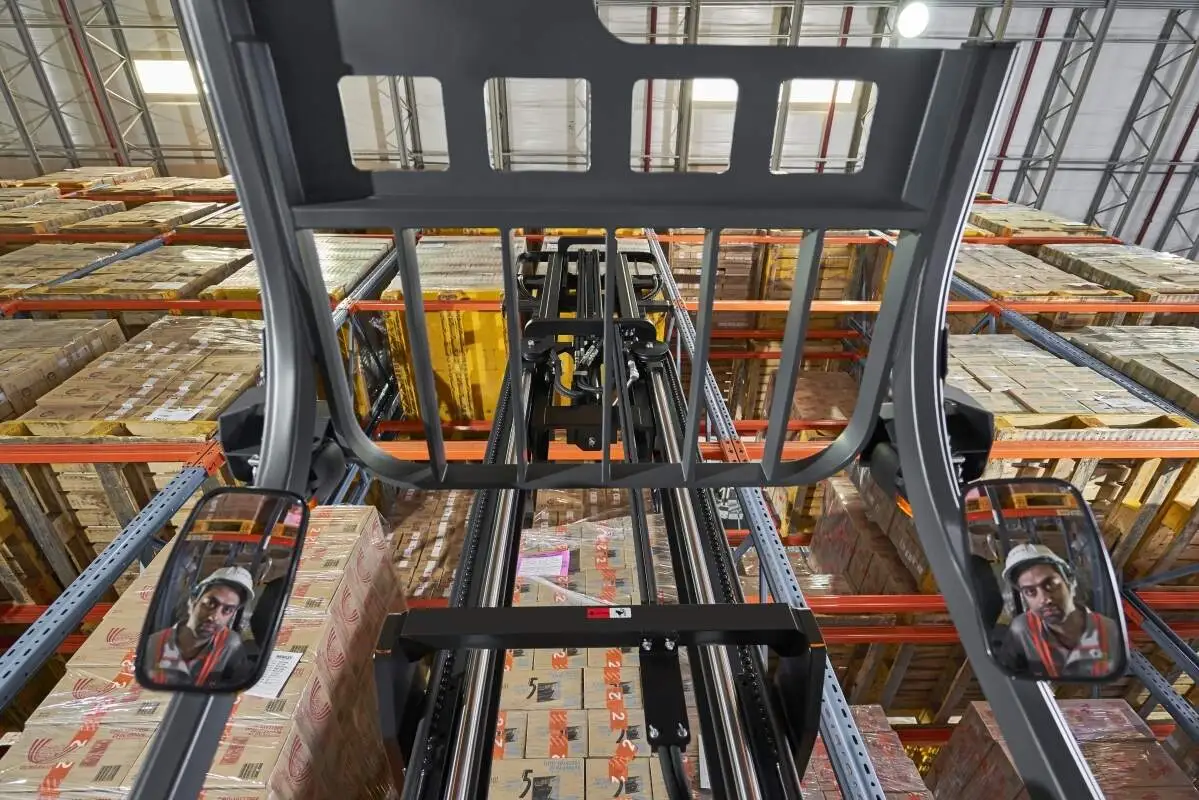
With the gradual increase in the production capacity of small and medium-sized manufacturing enterprises in recent years, many factories are facing the problem of insufficient warehouse space. Expanding the storage area often requires higher land or lease costs. Expanding high-level storage has become the choice of most enterprises. At this time, the front-moving lithium-ion forklift suitable for narrow aisles and high-level operations has entered the field of application.
Compared with common counterweight electric forklifts, the core structural feature of the reach forklift is that the gantry or fork can be moved back and forth along the body, without the need for additional heavy counterweight blocks, so the overall size of the body is shorter, and the requirements for the width of the working channel are lower. Under normal circumstances, the working channel width of the counterweight forklift needs to be at least three meters, while the forward forklift can be compressed to about two meters under the premise of ensuring the safety of steering and cargo access. Some special narrow channel models can even be adapted to a narrower space, which is obviously helpful for small and medium-sized factories to optimize the existing warehouse layout, increase the number of multi-layer shelves, and improve the utilization rate of vertical space.
The use of a reach forklift with lithium batteries can also better fit the daily production rhythm of small and medium-sized factories. Compared with traditional lead-acid batteries, lithium batteries do not need to stand for a long time or change the battery. They can be charged at any time, and the power can be replenished by using fragmented time such as workers' lunch breaks and shifts, reducing downtime caused by battery problems. At the same time, lithium batteries have lower maintenance costs, do not need to add electrolyte, wipe electrode plates, and do not have the risk of leakage of lead-acid batteries. They usually have a long service life, which can reduce long-term use costs to a certain extent.
In practical applications, small and medium-sized factories need to choose the model with appropriate parameters according to the size reserved for the passage of their own warehouses, the height of the highest shelf, and the average weight of single-access goods.


