
 简体中文
简体中文 繁体中文
繁体中文 Deutsch
 日本語
日本語 한국어
한국어 Tiếng Việt
 Русский
 ไทย
ไทย Bahasa Indonesia
 Bahasa Melayu
 Filipino
 لالعربية
 Français

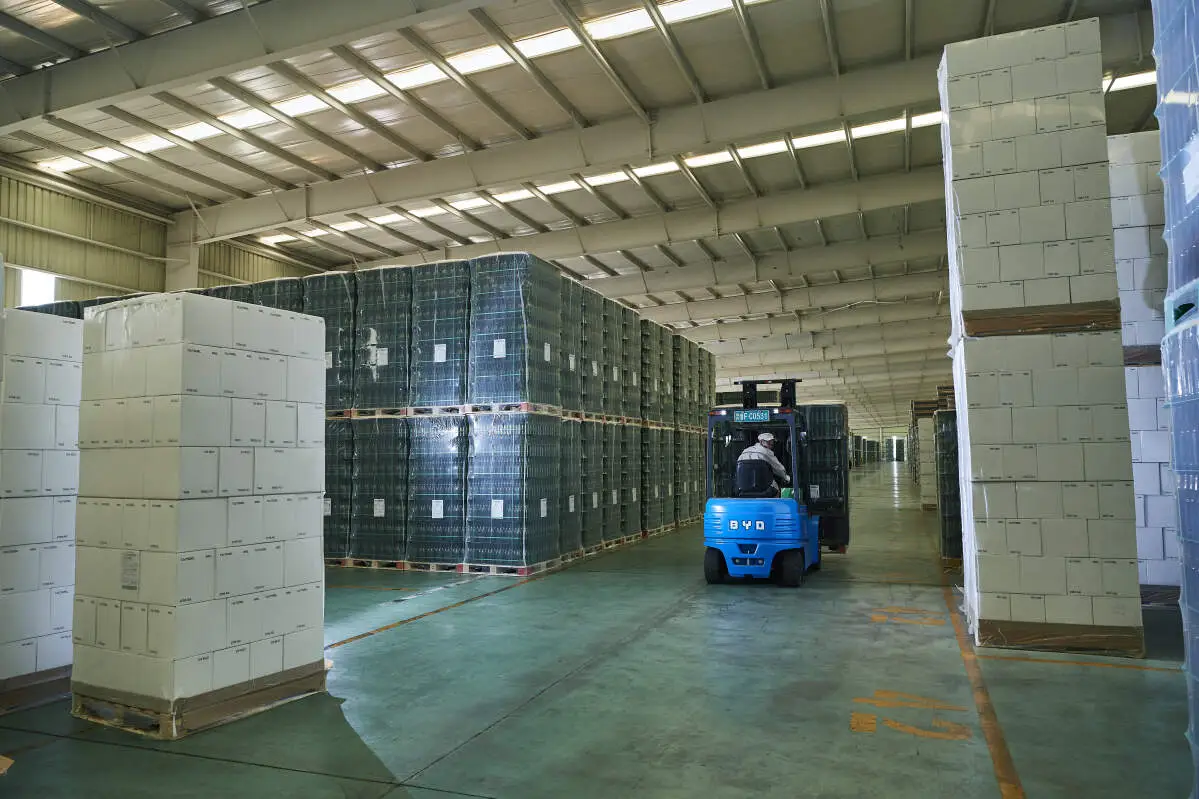
In warehousing and logistics operations, three-way stacking forklifts have become important equipment for narrow-channel warehousing operations due to their flexible steering and efficient stacking capabilities. The blade battery carried by BYD's RTR series three-way stacking forklifts provides reliable support for the stable operation of the equipment.
Blade battery configuration analysis
Battery structure and space adaptation
In view of the compact fuselage design of the three-way stacking forklift, the blade battery adopts a long structure layout, which can make full use of the longitudinal space inside the forklift and achieve a reasonable battery capacity configuration without taking up additional working space. This layout method not only ensures the stability of the battery pack, but also adapts to the working conditions of the forklift frequently turning and shuttling in the narrow channel, so as to avoid improper battery layout affecting the flexibility of the equipment.
Battery performance adapts to storage conditions
Combined with the characteristics of frequent starts and stops and short-distance high-intensity operations in warehousing operations, the charging and discharging characteristics of the blade battery have been optimized to quickly respond to the power requirements of the equipment, while maintaining a stable power output during continuous operation. In addition, the protective design of the battery is adapted to the dusty and occasionally humid environment in the warehouse, reducing the impact of external factors on battery performance.
Daily charging operation instructions
Preparation before charging
Before charging, turn off the power of the forklift, check the battery shell for any abnormal conditions such as deformation and leakage, and clean the dust and debris at the charging interface to ensure that the interface is dry and clean. If any abnormalities are found in the battery or interface, the charging should be suspended and a professional should be contacted for maintenance.
Charging environment and equipment requirements
Charging needs to choose an indoor area with good ventilation and away from flammable and explosive materials, and avoid charging operation in high temperature exposure or low temperature and cold environment. When charging, use the charging equipment matched with the forklift, and prohibit the use of charging devices that do not meet the specifications, so as not to affect the battery performance or cause safety hazards.
Charging process and subsequent operations
During the charging process, pay attention to the status indicator light of the charging device to confirm that the charging is normal. Try not to place heavy objects or perform other operations on the forklift during the charging period. After the charging is completed, disconnect the charging device from the forklift in time, organize the charging cable and store it properly. Avoid booster charging after excessive discharge during daily charging. It is recommended to start the charging process when the remaining power is about 20% to maintain the good condition of the battery.
Daily charging maintenance tips
Regularly clean the charging interface and battery surface to avoid dust accumulation leading to poor contact. At the same time, the specified charging time should be followed, and do not overcharge, so as not to cause unnecessary loss to the battery. If the forklift is idle for a long time, it is necessary to replenish the power every once in a while to keep the battery in a reasonable power range.


