
 简体中文
简体中文 繁体中文
繁体中文 Deutsch
 日本語
日本語 한국어
한국어 Tiếng Việt
 Русский
 ไทย
ไทย Bahasa Indonesia
 Bahasa Melayu
 Filipino
 لالعربية
 Français

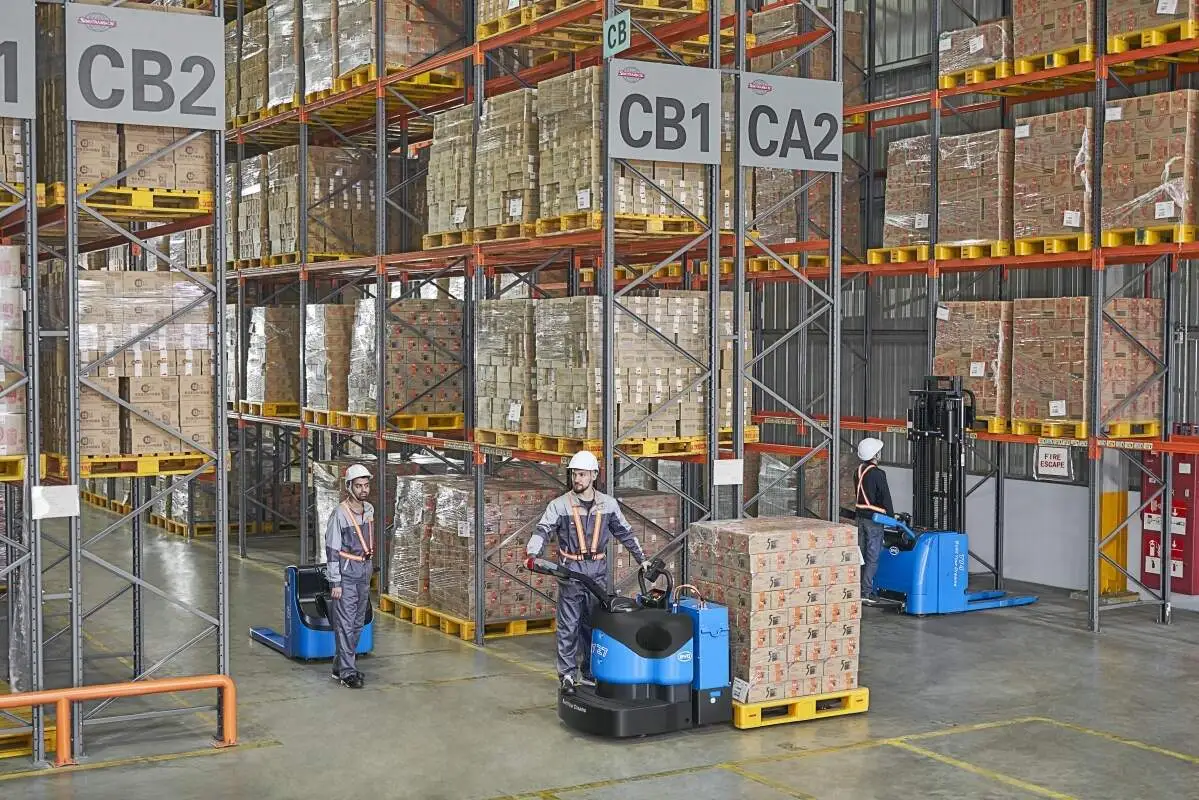
The central kitchen low temperature storage area is in a low temperature environment all year round, with high material storage density and fast circulation rhythm, which puts forward strict requirements on the adaptability and operation efficiency of handling equipment. Lithium-ion forklifts have become the core equipment of material stacking operations in this scenario due to their good low temperature tolerance and stable energy consumption performance. Mastering scientific operation skills can effectively improve storage circulation efficiency and reduce operation risks.
Environmental adaptation preparation before operation
Preheat equipment in advance. Low temperature environments may affect the battery activity and hydraulic system response speed of lithium-ion forklifts. Before operation, the forklift should be started in advance to allow the equipment to enter a stable operating state. After the battery temperature rises and the hydraulic system responds normally, the operation can be carried out to avoid operating errors due to poor equipment condition.
Check the shelves and storage space. Before stacking operations, carefully check the stability of the storage shelves to ensure that the shelves are not loose or deformed. At the same time, check the size and load-bearing limit of the storage space to ensure that the spacing of the storage space meets the requirements of forklift operations, and reserve sufficient space for subsequent stacking operations.
Standardize the stacking operation process
Precise alignment operation. When driving a forklift close to the shelf, it is necessary to maintain a low speed and smooth driving. Use the auxiliary positioning logo of the forklift to adjust the body position to ensure that the forkteeth are aligned horizontally with the slot of the cargo pallet to avoid the goods slipping due to the tilt of the forkteeth. During the alignment process, you can use the rearview mirror to observe the surrounding situation to avoid colliding with the shelf or other goods.
Smooth control of lifting speed. The response speed of the hydraulic system decreases in low temperature environments. When lifting goods, it is necessary to slow down the operation speed, especially when lifting goods to a high position. It is necessary to control the lifting rod at a constant speed to ensure that the goods are always in a stable state and reduce the risk of shaking or falling goods.
Plan the stacking method reasonably. According to the weight, volume and storage requirements of the goods, plan the stacking height. Heavy goods should be placed on the lower level and light goods on the upper level to ensure that the center of gravity of the goods is always close to the forklift teeth, improve the stability of the stacking, and avoid exceeding the upper limit of the shelf load.
Daily maintenance to ensure efficient operation
Regularly check the battery status. The battery life of the lithium battery will change in a low temperature environment. It is necessary to regularly check the battery's power, charge and discharge performance, and replenish the power in time to avoid insufficient power during operation. At the same time, pay attention to keep the battery surface clean to avoid the frost layer affecting the battery heat dissipation.
Clean the frost layer of equipment parts. Clean the frost layer of forkteeth, hydraulic rods, tires and other parts in time after operation to prevent the accumulation of frost layer from causing parts to get stuck or worn, which will affect the operation flexibility and service life of the forklift.
Calibrate equipment performance parameters. Regularly calibrate the lifting system and steering system of the forklift to ensure the operation accuracy of the equipment, improve the accuracy of the stacking operation, and reduce the time loss of repeated adjustments.
By following the above operation techniques, the efficiency of lithium-ion forklift stacking in the central kitchen cryogenic storage area will be effectively improved, while reducing equipment loss and operational safety risks, and better adapting to the operation requirements of cryogenic storage.


