
 简体中文
简体中文 繁体中文
繁体中文 Deutsch
 日本語
日本語 한국어
한국어 Tiếng Việt
 Русский
 ไทย
ไทย Bahasa Indonesia
 Bahasa Melayu
 Filipino
 لالعربية
 Français
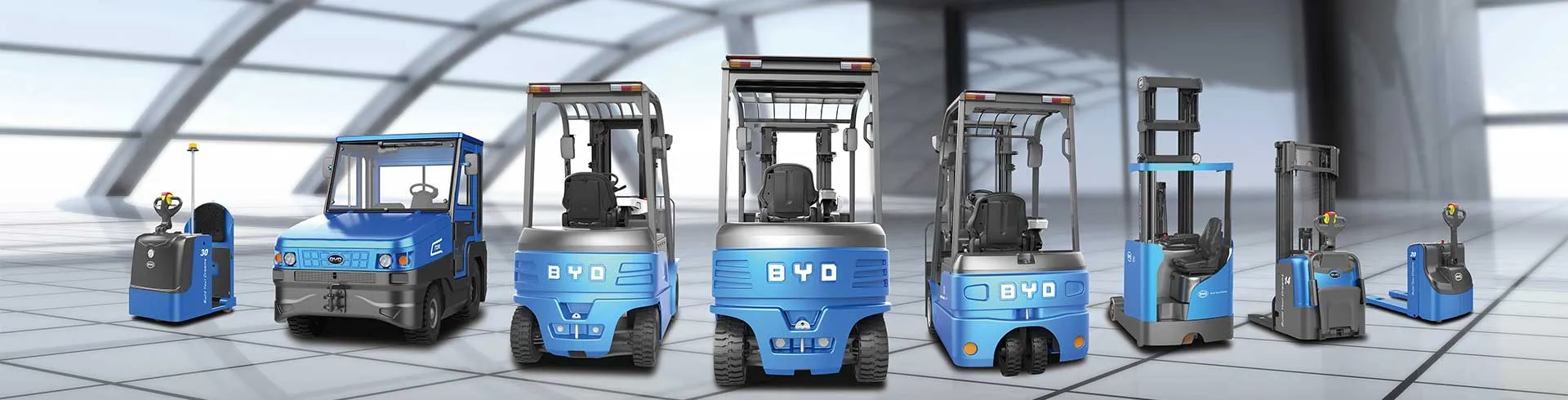
The petrochemical industry has a long production chain and a large scale of material turnover. The transfer of finished products and auxiliary materials in the workshop, the palletizing storage of finished products, and the loading and shipment of goods all have high requirements for the heavy-load capacity, continuous operation stability and environmental suitability of handling equipment. With the tightening of environmental protection supervision and the improvement of enterprises' demand for cost reduction and efficiency, the limitations of traditional internal combustion forklifts and lead-acid battery forklifts are gradually emerging. In response to the operation characteristics and logistics upgrade needs of the petrochemical industry, BYD forklifts rely on the accumulation of lithium iron phosphate electric technology to introduce suitable storage and handling solutions to help enterprises achieve the dual goals of green production and cost control while ensuring operational efficiency.
First, the core characteristics of handling conditions in the petrochemical industry
The warehousing and handling scene in the petrochemical industry has distinct attributes of heavy work conditions, mainly presenting four major characteristics.
Second, the operation time is long and high intensity. The industry generally adopts the three-shift operation mode, and some enterprises achieve 24-hour continuous operation, which requires high battery life and continuous operation reliability of the equipment.
The third is that indoor operations account for a high proportion. Most of the handling links are completed in the workshop and warehouse, and there are stricter environmental requirements for the emission level and operating noise of the equipment.
Fourth, it is mainly based on stacking operations. The stacking height of the finished product warehouse is mostly within 4 meters, which requires the equipment to have stable lifting operation ability and control accuracy.
Second, the application limitations of traditional handling equipment
The current petrochemical industry handling equipment is dominated by internal combustion forklifts, and the application of electric forklifts is also gradually expanding, but both types of traditional equipment have shortcomings in adaptability.
In terms of lead-acid battery forklifts, there are common problems such as cumbersome daily maintenance, the need for spare batteries, acid mist and hydrogen emissions during charging, and the need to build a special charging room. There are still many problems when adapting to high-intensity continuous operation.
III. BYD forklift industry-specific solutions
Combining the working conditions and existing pain points of the petrochemical industry, BYD forklift takes 3.0T/3.5T counterbalanced electric forklift as its core product, and builds an adaptation plan from four dimensions: power configuration, cost control, customized adaptation, and service guarantee.
At the level of heavy-duty adaptation, the model is equipped with high-power drive and lifting motor, and with brand drive axle, the power output is stable, and the driving, lifting speed and climbing degree can be adapted to the heavy-duty operation needs of the petrochemical industry. At the same time, it is equipped with mature mainstream controllers, hydraulic systems and other core components, and the reinforced body design ensures the reliability of the vehicle under long-term heavy working conditions.
In terms of safety and customization, the vehicle is equipped with multiple safety designs such as slope protection, overload protection, low cylinder buffer, vehicle power-off protection, low power protection, and turning speed limit; it supports highly customized gantry, fork specifications, and can be mounted on external side shifters, pushers, and other professional attachments; at the same time, it can provide fully enclosed cab, warning lights, fans, and other user-friendly configurations to meet the environmental requirements of indoor operations.
At the level of service guarantee, the battery provides a 5-year quality assurance cycle to reduce the maintenance concerns of enterprises for long-term use of vehicles; establish a full-link service system covering pre-sale, in-sale and after-sale, supporting a hierarchical response mechanism and stepped professional training, and supporting sales, financial leasing, operating leasing and other cooperation models, adapting to the procurement planning of different enterprises.
___PROTECTED_0___
IV. Industry landing practice
At present, BYD forklifts have been landed in petrochemical enterprises in China and South Korea, and are used in core operation scenarios such as work in progress warehouses and finished product warehouses. The stable heavy-duty performance and low-emission characteristics have been recognized by customers. In addition to the petrochemical industry, related models have also been put into use in many industries such as logistics, food, and automobile manufacturing, adapting to the needs of heavy-duty handling in different fields.
With the continuous advancement of green transformation and lean management in the petrochemical industry, the electrification of in-plant logistics has become an important direction for industry upgrading. BYD forklifts rely on their own lithium battery technology advantages and experience in adapting to heavy working conditions to continuously polish the exclusive handling solutions for the petrochemical industry. While ensuring operational efficiency and operational reliability, they help enterprises reduce long-term operating costs, meet environmental compliance requirements, and provide reliable equipment support for the logistics upgrade of the petrochemical industry.


