
 简体中文
简体中文 繁体中文
繁体中文 Deutsch
 日本語
日本語 한국어
한국어 Tiếng Việt
 Русский
 ไทย
ไทย Bahasa Indonesia
 Bahasa Melayu
 Filipino
 لالعربية
 Français

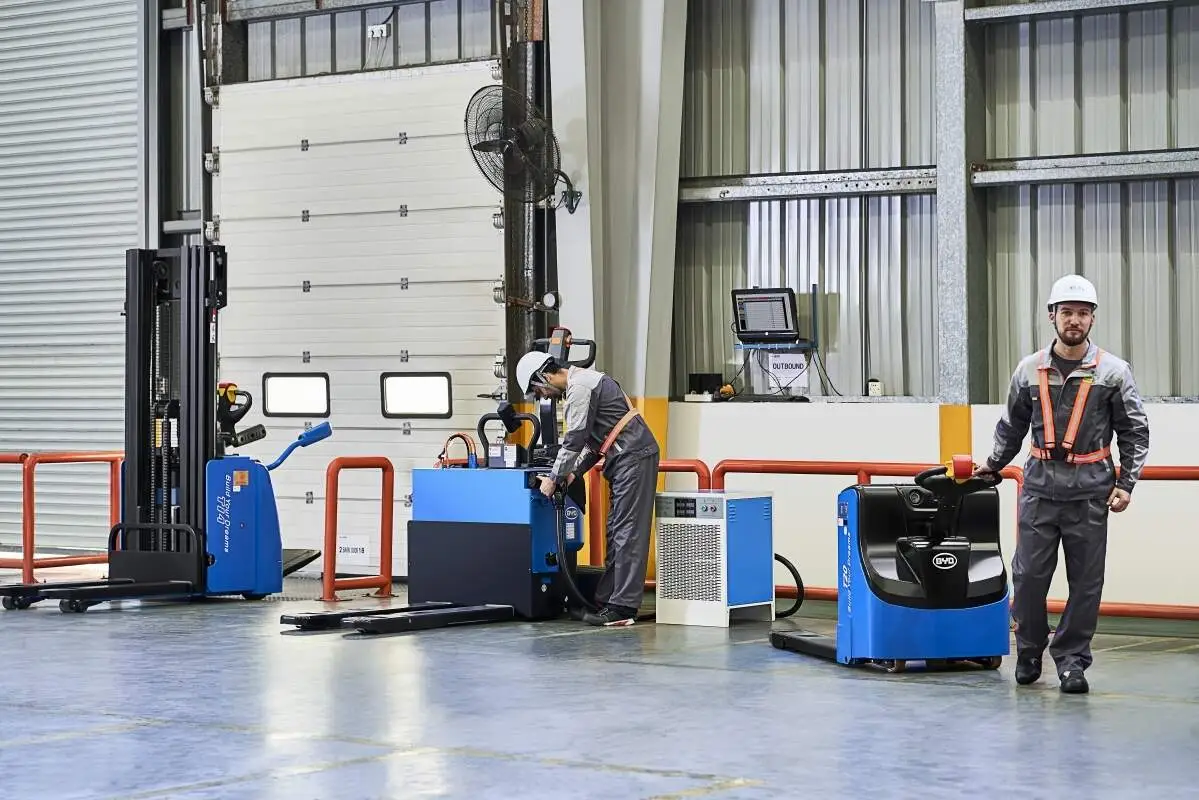
As the core node of warehousing and logistics, e-commerce distribution centers face scenarios with large order volumes and high operation timeliness requirements on a daily basis, and have strict requirements for the continuous operation capacity of material handling equipment. Electric forklifts have become a reliable choice in high-intensity operations of distribution centers due to their own adaptability, and their many practical characteristics effectively support the smooth development of continuous operations.
Battery life suitable for multi-shift operations
The e-commerce distribution center often adopts the operation mode of multi-shift rotation, and the electric forklift is equipped with a suitable power supply plan for this demand. Some models support fast charging technology, which can replenish enough power in a short time to meet the energy supply between shifts; other models use a replaceable battery design, which allows the operator to quickly complete the battery replacement and greatly shorten the downtime waiting time. At the same time, the intelligent battery management system can dynamically adjust the energy consumption according to the operation scene, and rationally distribute power under different states such as no-load driving and heavy-load handling, further extending the operation time after a single charge, and ensuring the battery life support of continuous operation.
Dynamic performance of stable output
There are complex operation scenarios such as ramp handling and heavy-duty transfer in the distribution center, and the power system of the electric forklift can maintain stable output characteristics. During the start acceleration and hill climbing, the power output is uniform and sufficient, and there will be no obvious attenuation due to long-term operation, ensuring the smoothness of cargo handling. In addition, the electric forklift adopts a low-noise power structure, which will not generate excessive noise when operating in a closed distribution center environment, which will not affect the communication and cooperation between operators, and can also create a relatively comfortable working atmosphere to adapt to the environmental requirements of long-term continuous operation.
Convenience of operation to meet the needs of the operation
In the continuous operation state, the fatigue of the operator will directly affect the operation efficiency, and the control design of the electric forklift fully fits the ergonomic requirements. The steering system is flexible and lightweight, and the operator can easily complete the steering and U-turn actions in a small space; the operation button is reasonably laid out, which is easy to use and reduces operation errors. At the same time, some models are equipped with intelligent auxiliary features, such as reversing warning and speed adaptive adjustment, which not only improve the safety of the operation, but also reduce the energy consumption of the operator, which helps to maintain the efficiency of long-term continuous operation.
The worry-free feature of reducing operation and maintenance costs
Continuous operation places high demands on the reliability of equipment, and the structural design of electric forklifts simplifies the maintenance process. Compared with traditional fuel forklifts, electric forklifts reduce complex fuel supply, exhaust and other system components, and the number of wearing parts is smaller. Daily maintenance only needs to focus on basic links such as battery status inspection and component cleaning, and the maintenance cycle is longer. This feature effectively reduces the operation interruption caused by equipment maintenance, reduces the operation and maintenance cost of the distribution center, and ensures the stability of continuous operation.
In the context of the rapid development of e-commerce business, these practical characteristics of electric forklifts provide strong support for the high-intensity continuous operation of distribution centers, making them an important equipment choice for improving the efficiency of warehousing and logistics.


