
 简体中文
简体中文 繁体中文
繁体中文 Deutsch
 日本語
日本語 한국어
한국어 Tiếng Việt
 Русский
 ไทย
ไทย Bahasa Indonesia
 Bahasa Melayu
 Filipino
 لالعربية
 Français

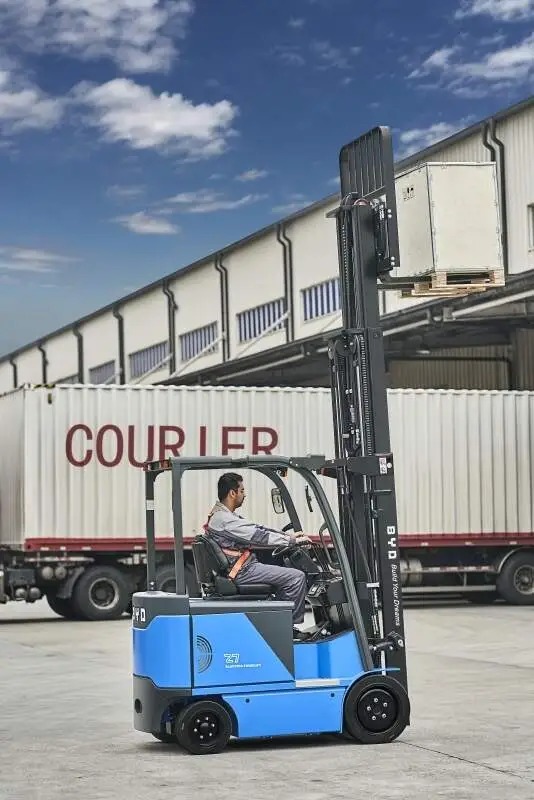
As a professional practitioner in the field of electric forklifts, I often receive inquiries from small and medium-sized enterprises about the selection of short-distance loading and unloading handling equipment. Compared with large heavy equipment, 2-ton electric forklifts are more adaptable and are one of the core choices for many small and medium-sized enterprises to build an efficient loading and unloading system. Today, combined with daily contact cases, I will take stock of several common practical application scenarios of it.
The first is the internal material turnover scene of a small production workshop. The space of such workshops is usually not particularly spacious, the channel width may be about three meters, and the turning radius of ordinary fuel forklifts is large, which is easy to scratch equipment or materials when passing. The body design of the 2-ton electric forklift is relatively compact, with a small turning radius, which can flexibly shuttle in narrow passages. At the same time, its load capacity just matches the handling needs of most small and medium-sized workshops for raw materials and work in progress, such as handling boxes of electronic components, textile fabrics, small hardware, etc., which is smooth and convenient to operate, can improve the efficiency of material circulation in the workshop, and reduce the physical consumption and safety hazards of manual handling.
Secondly, it is the stacking and picking scene of ordinary small and medium-sized warehouses. The shelf height of this type of warehousing is generally within five meters. After a 2-ton electric forklift is equipped with corresponding attachments, it can easily complete the operation of loading and removing goods from the shelves. Compared with a manual hydraulic stacker, it has a faster lifting speed and a wider operation range, and the daily operation volume can reach several times that of manual equipment. Moreover, the electric forklift has low noise during operation, does not cause too much interference to the storage environment, and does not have fuel exhaust emissions. It is suitable for storing food, medicine, precision instruments and other goods that require air quality. At the same time, it conforms to the current green production and management concept.
There are also scenes of loading and unloading goods at small logistics points or express stations. The daily volume of goods in and out of such places is not particularly large, but it is scattered and frequent, and equipment needs to be able to respond quickly. The start-up and operation of the 2-ton electric forklift are relatively simple, and staff with short-term training can use it. There is no need for a special high-skilled driver. It can be driven directly to the tail plate of the truck for loading and unloading. If used with pallets, it can greatly shorten the loading and unloading time of goods, improve the efficiency of logistics turnover, and reduce the cost and risk of manual loading and unloading.


