
 简体中文
简体中文 繁体中文
繁体中文 Deutsch
 日本語
日本語 한국어
한국어 Tiếng Việt
 Русский
 ไทย
ไทย Bahasa Indonesia
 Bahasa Melayu
 Filipino
 لالعربية
 Français

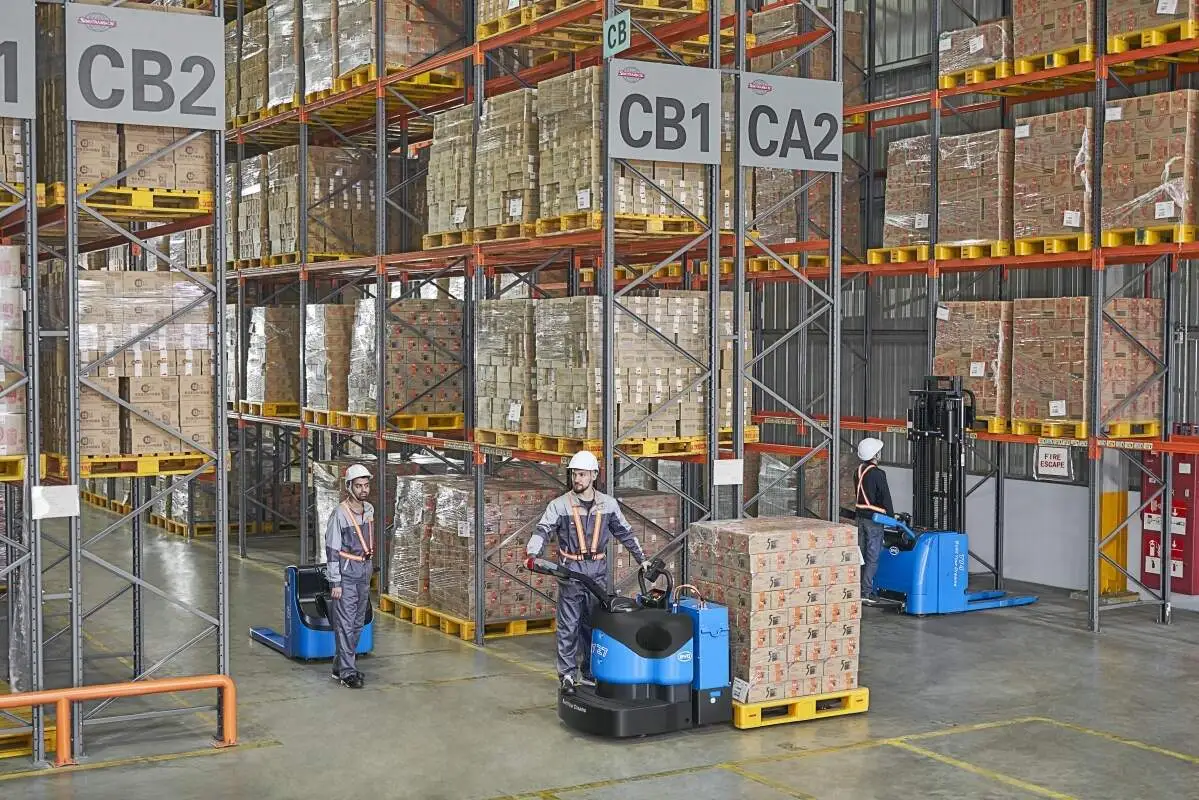
In the field of warehousing, logistics, and industrial handling, the operation stability of forklifts is directly related to operation efficiency and cargo safety. Four-wheel-mounted counterbalanced heavy-duty lithium-ion forklifts have become a reliable choice for stable operations due to their multi-faceted design.
Balanced weight structure ensures load stability
The counterweight is one of the core foundations for the stable operation of this type of forklift. Through a reasonable counterweight ratio design, it forms a mechanical balance with the load at the front of the body, which can effectively offset the forward tilting moment caused by the weight of the goods. When the forklift is handling goods of different weights, the counterweight can assist in maintaining the center of gravity of the body within a reasonable range, reducing the risk of tilting the body due to load changes, and ensuring that the body is always in a stable state during forking, handling, and stacking, reducing the possibility of goods falling.
Lithium battery power output improves operation stability
The lithium battery power system provides power support for the stable operation of the forklift. Compared with the traditional power type, the power output of the lithium battery forklift is more uniform and smooth, and there will be no obvious frustration during the start and acceleration process, allowing the forklift to maintain a stable driving state during the start and driving process. At the same time, the torque output characteristics of the lithium battery system are stable. When climbing hills or handling heavier goods, the power is continuous and balanced to avoid body shaking caused by power fluctuations and ensure the stability of the cargo transportation process.
Optimize the chassis to enhance driving stability
The chassis design of the four-wheel drive type further enhances the stability of the operation. The reasonable wheel base and wheelbase configuration enlarge the support surface of the forklift and improve the overall anti-rollover ability. The shock absorption device equipped with the chassis can effectively cushion the impact force caused by the ground turbulence. Whether it is working on a flat warehouse floor or a slightly undulating outdoor field, it can reduce the body vibration and maintain smooth driving. In addition, the design of four-wheel drive or rear-wheel drive with steering system allows the forklift to be more flexible and stable when steering, without excessive tail flick or offset.
Humanized control reduces operation deviation
The user-friendly design of the control system also plays an auxiliary role in stabilizing the operation. The ergonomic seat design allows the operator to maintain a comfortable sitting position, reducing fatigue after long-term operation, and thus improving the operation accuracy. The damping design of the steering wheel and the control handle is reasonable, and the operation force is moderate, which is convenient for the operator to accurately control the driving direction and lifting action of the forklift, and reduce the instability of the body or the displacement of goods caused by operation errors.
Overall, the four-wheeled counterbalanced heavy-duty lithium-ion forklift guarantees the stability of the operation process in multiple dimensions, from the structural design, power system to the control configuration, and can better adapt to the needs of various storage and handling scenarios. It provides strong support for enterprises to improve operation efficiency and ensure the safety of goods.


