
 简体中文
简体中文 繁体中文
繁体中文 Deutsch
 日本語
日本語 한국어
한국어 Tiếng Việt
 Русский
 ไทย
ไทย Bahasa Indonesia
 Bahasa Melayu
 Filipino
 لالعربية
 Français

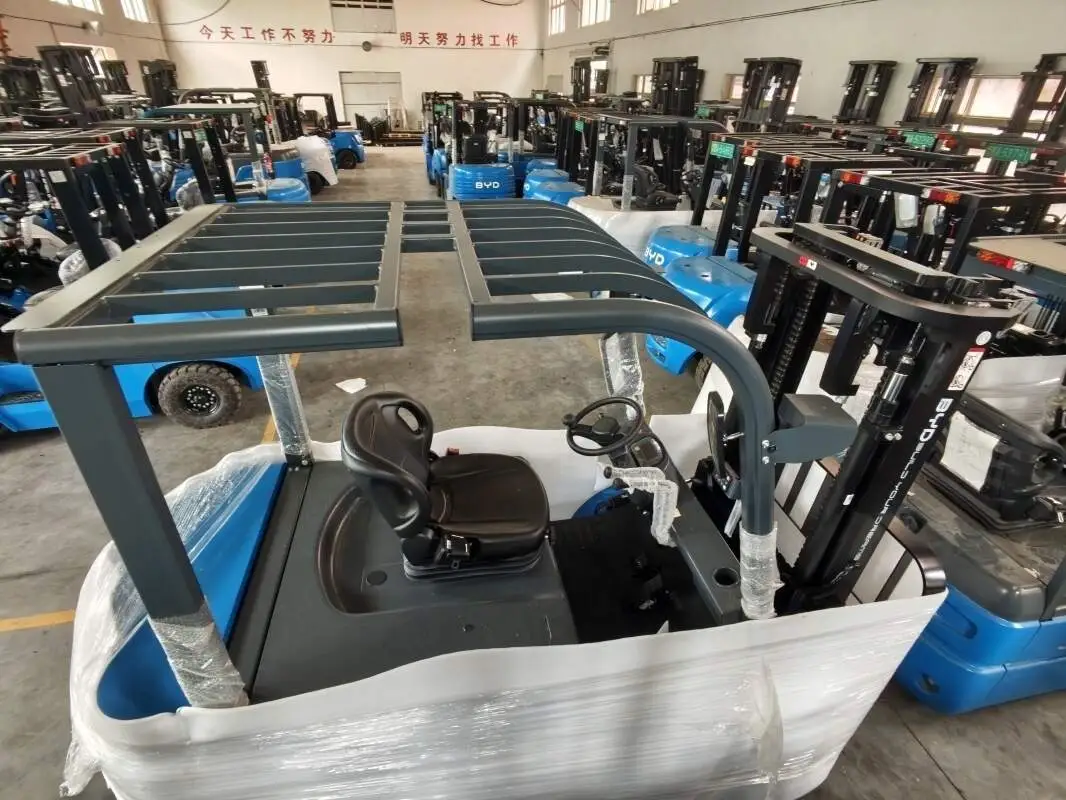
With the development of the warehousing industry towards high density and intelligence, three-dimensional shelf warehouses have become an important way to increase storage capacity, and operating equipment suitable for such scenarios has also attracted much attention. Reach-type lithium-ion forklifts have become an ideal working tool for such warehouses due to their many characteristics.
Space utilization advantages of three-dimensional shelves
The core feature of a three-dimensional shelf warehouse is the full utilization of vertical space, while the channel is usually narrow. The door frame of the forward-moving lithium-ion forklift can be extended forward, without the need to drive the entire body into the shelf channel. Only the front-end working device can enter to complete the cargo access, which can adapt to narrower working channels, effectively reduce the storage space occupied by the channel, allowing the warehouse to plan more shelf space and improve the overall storage capacity. In addition, the lifting height of this type of forklift is higher, which can meet the cargo access needs of high-rise three-dimensional shelves, and further tap the utilization potential of the vertical space of the warehouse.
The environmental protection and energy efficiency advantages of lithium-ion power
The three-dimensional shelf warehouse is mostly a closed or semi-closed environment, which requires high environmental protection of the operating equipment. The front-moving lithium-ion forklift is powered by lithium electricity, and there is no exhaust emission during the operation, which will not cause pollution to the air environment in the warehouse, and also avoid the odor and safety hazards caused by fuel equipment. At the same time, the lithium battery has a high energy density, stable battery life, can support long-term continuous operation, and the charging method is flexible. The fast charging mode can replenish the power in a short time, reducing the waiting time for equipment downtime. Compared with the traditional lead-acid battery forklift, the maintenance cost of the lithium-ion forklift is lower, and there is no need to regularly add water and maintain the electrolyte, which reduces the long-term cost of storage operations.
Flexible handling features that enhance operational efficiency
The body design of the forward-moving lithium-ion forklift is compact, with a small turning radius. It can flexibly turn and turn around in the narrow channel of the three-dimensional shelf warehouse, reducing the path adjustment time during the operation. Its operating device adopts a user-friendly design, and the operator can quickly get started and improve the operation proficiency. At the same time, the lifting and descending speed of the forklift can be adjusted according to the weight of the goods and the operation scene. Under the premise of ensuring safety, the rhythm of goods access can be accelerated, especially in high-frequency cargo turnover scenarios, which can effectively improve the overall storage operation efficiency.
Suitable for safety assurance at height
The operation of the three-dimensional shelf warehouse involves the access of high-altitude goods, and the safety of the equipment is of paramount importance. Reach-moving lithium-ion forklifts are equipped with multiple safety protection devices, such as anti-dumping systems, which can effectively prevent the body from tilting when the lifting height is high; speed limiting devices can limit the driving speed in narrow passages or high-altitude work to avoid accidents caused by operation errors. In addition, the vision of the forklift is reasonably designed, and the operator can clearly observe the position of the shelf and the goods, reducing the risk of collision caused by blind operation, providing a reliable guarantee for the high-altitude work of the three-dimensional shelf warehouse.
Overall, the forward-moving lithium-ion forklift has many advantages in three-dimensional shelf warehouses, which can effectively help warehousing enterprises improve operational efficiency and space utilization, and adapt to the development needs of the modern warehousing industry.


