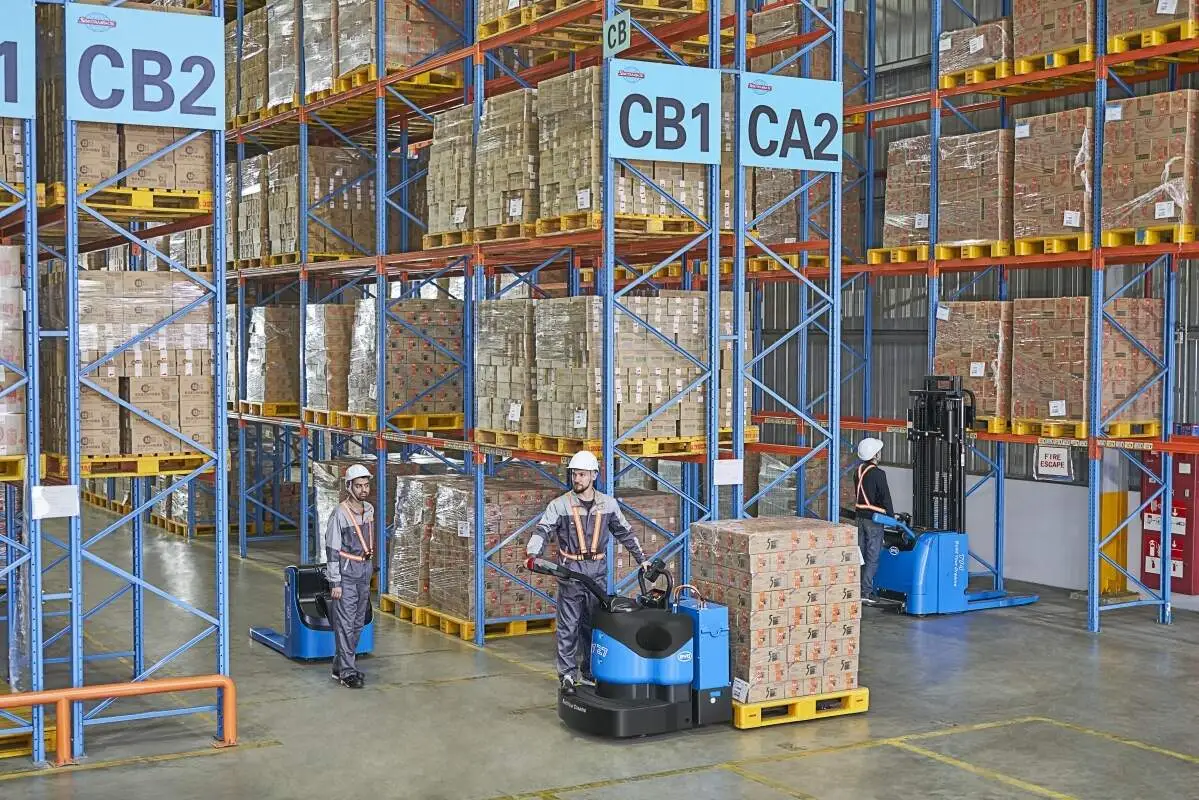
Sideways forklift tip overs are among the most dangerous incidents in warehouse and industrial settings, posing severe risks to operators, bystanders, and valuable equipment. Understanding the actions that contribute to these accidents is essential for preventing them and maintaining a safe workplace.
One primary cause of sideways tip overs is improper load handling. When an electric forklift carries a load that exceeds its rated capacity, or when the load is not properly centered on the forks, the vehicle’s center of gravity shifts dramatically. This imbalance becomes even more pronounced when the load is lifted to height, as the elevated weight raises the overall center of gravity, making the forklift far more susceptible to tipping during turns or on uneven ground. Even small discrepancies in load placement, such as heavy items shifted to one side of the forks, can create enough instability to trigger a sideways tip over.
Navigating uneven or sloped terrain is another critical action that leads to sideways tip overs. electric forklifts are designed to operate on flat, stable surfaces, but many workplaces feature uneven floors, ramps, or outdoor areas with inclines. When operators drive across these surfaces without reducing speed or adjusting their approach, the forklift’s weight can shift abruptly. For example, driving over a pothole or a raised edge can tilt the vehicle, and if combined with a partial turn, this movement can push the center of gravity beyond the forklift’s stability threshold, resulting in a sideways tip over.
Sharp turns made at high speeds are also a common culprit. Centrifugal force generated during fast turns pulls the forklift’s weight toward the outside of the turn, especially when a load is present. Operators who rush to meet deadlines or fail to adhere to speed limits often overlook the need to slow down before turning, which amplifies this force. Even a moderately loaded forklift can tip sideways if a sharp turn is executed at an unsafe speed, as the combined weight of the vehicle and load overwhelms the tire traction and stability base.
Operator errors and lack of proper training further increase the risk of sideways tip overs. Many incidents occur when operators fail to understand the basic principles of forklift stability, such as the importance of keeping the load low during travel or avoiding sudden maneuvers. Additionally, distracted operation—such as using a mobile phone while driving, or carrying passengers on the forklift—can lead to poor decision-making, like making an unexpected turn or failing to notice uneven terrain. Without regular safety training, operators may not recognize the warning signs of impending instability, making them more likely to engage in actions that lead to tip overs.
Preventing sideways tip overs requires a combination of proper training, adherence to safety protocols, and proactive equipment checks. Operators should always verify load weights and ensure loads are centered and secured before transport. They must reduce speed when navigating turns, uneven surfaces, or slopes, and keep loads as low as possible during travel. Regular safety training sessions can reinforce these best practices, empowering operators to identify and avoid high-risk actions that could lead to dangerous tip over incidents.