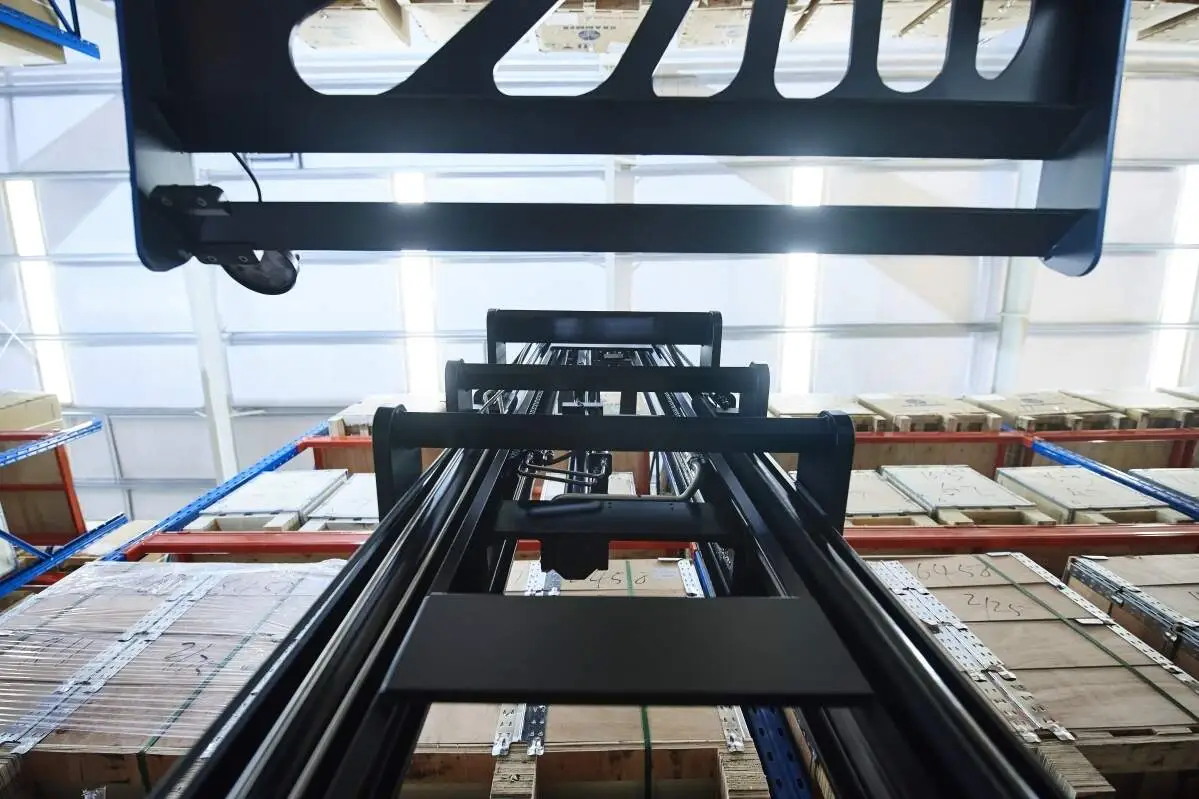
Sideloader forklift equipment has emerged as a specialized solution for material handling challenges that standard forklifts struggle to address. Designed with a side-mounted load carriage, these machines excel in navigating tight spaces and transporting long, bulky loads without compromising stability or maneuverability. Below are key application scenarios where sideloader forklifts deliver tangible operational benefits.
Narrow Aisle Warehousing. In modern warehouses, maximizing storage space is a top priority, leading to narrower aisles to fit more racking systems. Standard forklifts often struggle to turn or maneuver in these confined spaces, risking damage to inventory or infrastructure. Sideloader forklifts, however, operate by loading and unloading from the side, eliminating the need for wide turning radii. This allows them to navigate aisles as narrow as 2 meters, making them ideal for high-density storage facilities. They can efficiently retrieve and place long items like steel bars, pipes, or timber beams directly into racking, reducing the time and effort required for material handling while minimizing the risk of collisions.
Lumber and Timber Industry. The lumber sector frequently deals with long, heavy timber logs and processed planks that are difficult to transport with conventional forklifts. Sideloader forklifts are uniquely suited for this task, as their side-mounted carriage can securely hold loads up to 12 meters in length. Unlike standard forklifts that require balancing long loads across the front forks (which can lead to instability), sideloaders support the load along their entire length, ensuring safe and stable transportation. This capability makes them indispensable in sawmills, lumber yards, and distribution centers, where moving long timber products efficiently is critical to daily operations.
Construction and Building Materials Sector. Construction sites often have uneven terrain and limited space, with a constant need to transport long building materials such as steel beams, scaffolding poles, and precast concrete panels. Sideloader forklifts are designed to handle rough outdoor surfaces, with robust tires and stable chassis that maintain grip on gravel, dirt, or uneven ground. Their side-loading functionality allows them to access tight areas on construction sites, such as between partially built structures, where standard forklifts cannot reach. This versatility ensures that building materials are delivered exactly where they are needed, reducing downtime and improving overall project efficiency.
Port and Intermodal Logistics. Ports and intermodal terminals handle a wide range of long, heavy cargo, including steel coils, pipe sections, and large containers. Sideloader forklifts play a crucial role here by efficiently loading and unloading these items from trucks, ships, or railcars. Their ability to handle long loads without blocking access to other cargo makes them ideal for busy terminal environments where space is limited and turnaround times are tight. Additionally, sideloaders can operate in both indoor and outdoor terminal areas, adapting to varying weather conditions and ensuring continuous material flow.
In summary, sideloader forklift equipment offers specialized solutions for material handling challenges across multiple industries. Their unique side-loading design, maneuverability in tight spaces, and ability to transport long, bulky loads safely make them a valuable asset in narrow aisle warehousing, lumber processing, construction, and port logistics. By choosing the right equipment for specific application scenarios, businesses can optimize their material handling operations, improve safety, and enhance overall productivity.