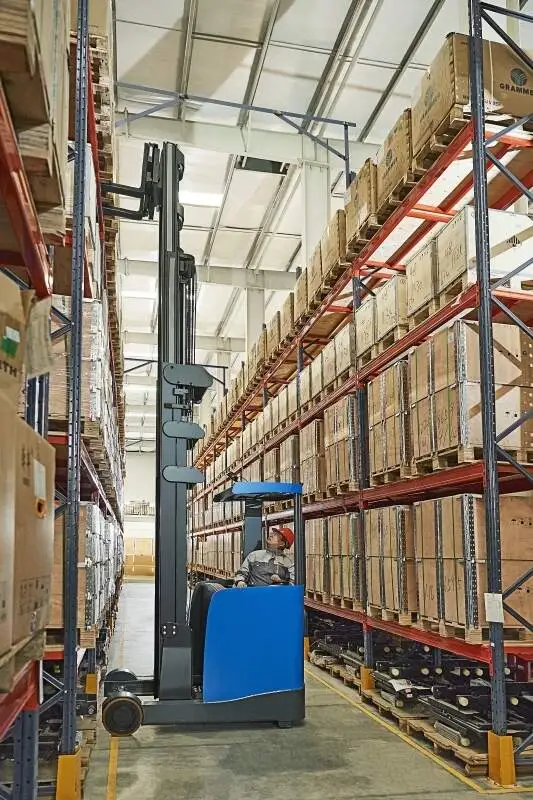
Operating forklifts safely requires a precise understanding of their safe lifting capacity, as exceeding this limit can lead to tip-overs, equipment damage, and serious injuries. Several calculation methods are employed to determine the maximum weight a forklift can lift under different conditions, ensuring compliance with safety standards and reducing operational risks.
1. Basic Load Capacity Calculation
The foundation of safe lifting capacity calculation starts with the forklift’s rated load capacity, which is specified by the manufacturer under standard conditions. A key variable here is the load center, defined as the horizontal distance from the front face of the forklift’s forks to the center of gravity (CoG) of the load. Most manufacturers use a standard load center of 24 inches (600mm) for rating purposes. When the actual load center exceeds this standard, the safe lifting capacity decreases. The formula for adjusting capacity based on load center is: Adjusted Safe Lifting Capacity = (Standard Load Center / Actual Load Center) × Rated Load Capacity. For example, if a forklift has a 5,000-pound rated capacity with a 24-inch standard load center, and the actual load center is 30 inches, the adjusted capacity becomes (24/30)×5,000 = 4,000 pounds.
2. Load Center Offset Adjustment
Irregularly shaped or unevenly distributed loads often have a shifted center of gravity, which deviates from the central line of the forks. In such cases, operators must first identify the actual CoG of the load. This can be done by balancing the load on a single fork temporarily or using weight distribution tools. Once the offset distance from the fork’s central axis is determined, the safe lifting capacity needs further adjustment. The calculation accounts for both the horizontal load center distance and the offset, ensuring the forklift’s stability is not compromised. Failing to account for this offset can result in uneven weight distribution, increasing the risk of lateral tip-overs.
3. Dynamic Load Correction
Static calculations do not account for the dynamic forces generated during forklift operation, such as acceleration, deceleration, and turning. These actions create inertial forces that add stress to the forklift’s structure and increase the risk of tip-over. To address this, a dynamic load correction factor is applied. The factor typically ranges from 1.1 to 1.3, depending on the operation speed and maneuver intensity. Higher speeds or sharp turns require a higher correction factor. The formula here is: Dynamic Safe Lifting Capacity = Static Adjusted Capacity ÷ Dynamic Correction Factor. For instance, if the static adjusted capacity is 4,000 pounds and the dynamic factor is 1.2, the maximum safe load during dynamic operations is approximately 3,333 pounds, ensuring the forklift remains stable under movement.
4. Environmental Factor Adjustments
Environmental conditions significantly impact a forklift’s safe lifting capacity. On sloped surfaces, the load’s weight creates additional force that pushes the forklift backward or forward. As a general rule, for every 1% increase in slope, the safe lifting capacity should be reduced by 1-2%. Uneven or slippery ground also reduces traction and stability, requiring operators to lower the load weight further. Outdoor operations introduce wind forces, which can destabilize lifted loads, especially at higher heights. In windy conditions, it is recommended to reduce both the load weight and lifting height to maintain control.
Combining these calculation methods allows operators to determine the accurate safe lifting capacity for any given scenario. Regular training on these calculations, paired with pre-operation inspections, ensures that forklift operations remain safe and compliant. By accounting for load center, dynamic forces, and environmental factors, businesses can minimize accidents, protect personnel, and extend the lifespan of their equipment.