In modern industrial and warehouse operations, electric forklifts have become indispensable equipment, offering eco-friendly and efficient material handling solutions compared to their internal combustion counterparts. Understanding the different varieties of electric forklifts helps businesses select the right model to match their specific operational needs.
Counterbalance Electric Forklifts
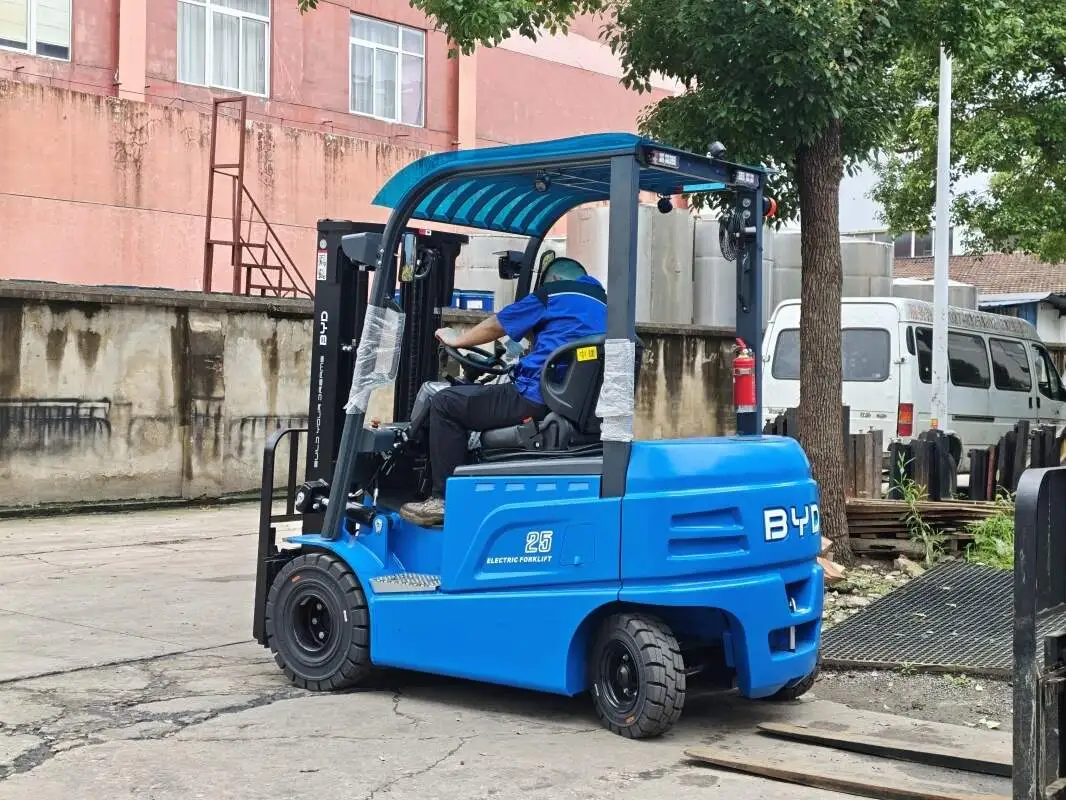
As the most widely used type, counterbalance electric forklifts feature a weight at the rear to offset the load lifted by the forks, eliminating the need for additional support structures like outriggers. This design allows them to operate both indoors and outdoors, making them versatile for tasks such as loading and unloading trucks, moving heavy pallets in warehouses, and transporting materials across factory floors. They are suitable for handling medium to heavy loads, with lifting capacities varying based on the model.
Stand-Up Electric Forklifts
Designed for operations in narrow spaces, stand-up electric forklifts allow operators to remain in an upright position while operating. Their compact footprint enables easy maneuvering through tight aisles, making them ideal for high-density storage warehouses where space is limited. These forklifts are particularly efficient for short-distance, frequent material moves, as operators can quickly get on and off the vehicle to handle tasks like pallet sorting or staging.
Reach Electric Forklifts
Reach electric forklifts are equipped with extendable mast arms that can reach deep into high racks, maximizing vertical storage space utilization. Unlike counterbalance models, they have outriggers that provide stability when lifting loads to greater heights. This type is primarily used in indoor warehouses with tall shelving systems, allowing workers to access goods stored at upper levels efficiently. Reach forklifts are perfect for medium-load tasks that require precise positioning in elevated storage areas.
Order Picker Forklifts
Order picker forklifts are tailored for order fulfillment processes, especially in e-commerce and retail distribution centers. These forklifts feature a platform that lifts the operator along with the forks, enabling direct access to individual items on shelves at various heights. This design reduces the need for ladders or manual picking, significantly improving picking accuracy and speed. Order pickers are ideal for handling small to medium-sized loads and are commonly used in environments where quick, item-level retrieval is required.
Electric Pallet Jacks
Also known as electric pallet trucks, electric pallet jacks are compact and lightweight, designed for short-distance transportation of palletized loads. They are easy to operate, making them suitable for tasks like replenishing stock in warehouse aisles, loading and unloading delivery vans, and moving goods within small storage areas. Unlike larger forklifts, pallet jacks are highly maneuverable in tight spaces and are cost-effective for light-load handling needs.
Each type of electric forklift serves a unique purpose, and choosing the right one depends on factors such as load capacity, operational space, height requirements, and specific task needs. By understanding the classification and features of common electric forklift varieties, businesses can optimize their material handling operations, improve productivity, and ensure a safe working environment.