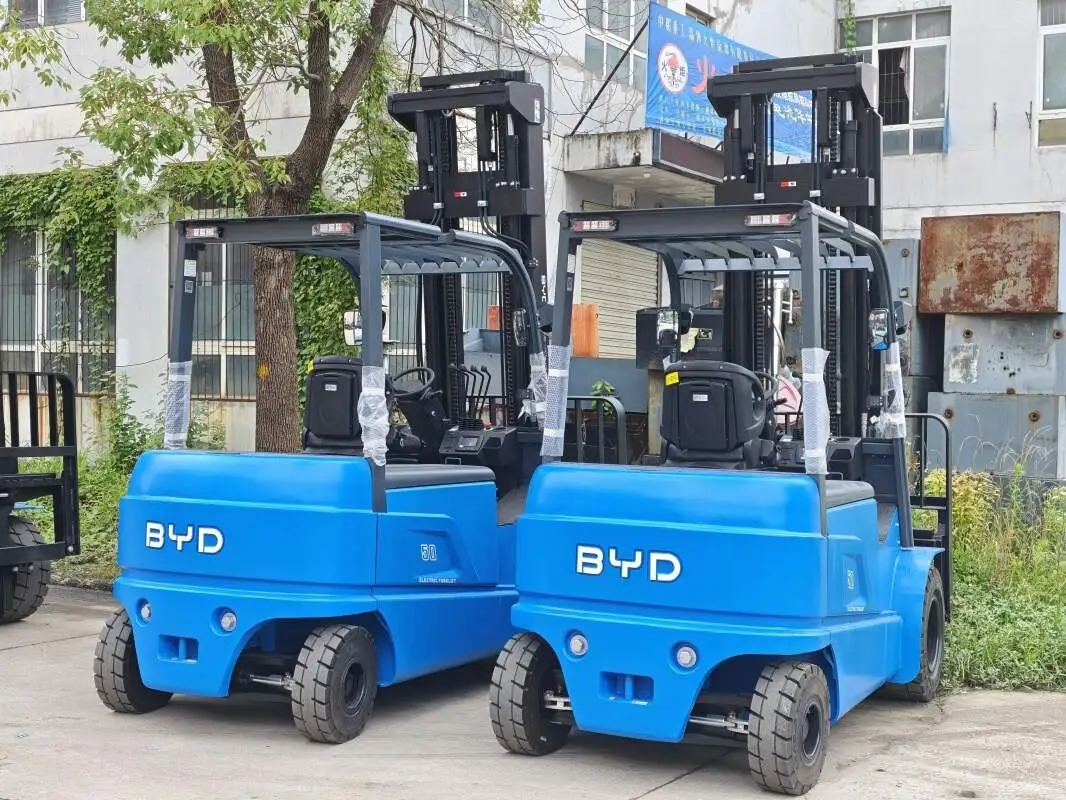
An electric forklift’s mast is the critical component enabling vertical load lifting, directly impacting operational versatility and load-handling efficiency. Understanding different mast types and their unique characteristics is key to selecting the right forklift for specific material handling tasks, ensuring safety, productivity, and optimal performance across various work environments.
Single-Stage (Simplex) Mast
The single-stage mast consists of a fixed outer rail and an inner carriage moving vertically within it. This compact design offers minimal height extension, typically limited to the mast’s retracted height. Its robust structure excels at handling heavy loads at lower lifting heights, providing exceptional stability. Ideal for low-clearance spaces like loading docks with overhead restrictions or warehouse aisles with low ceilings, this mast requires less maintenance due to its simplified mechanics, making it a cost-effective choice for basic material handling tasks.
Dual-Stage (Duplex) Mast
Featuring two telescopic sections, the dual-stage mast extends beyond the outer rail’s height, doubling the maximum lifting reach compared to a single-stage variant. It strikes a balance between lifting height and load capacity, handling moderate to heavy loads while reaching mid-level storage racks. This versatility makes it suitable for most general warehouse operations, retail stockrooms, and distribution centers. Operators benefit from improved visibility compared to taller multi-stage masts, enhancing safety during load positioning, though load capacity may slightly decrease at maximum extension due to increased leverage.
Triple-Stage (Triplex) Mast
Incorporating three telescopic sections, the triple-stage mast delivers significantly greater vertical reach, often exceeding 20 feet, catering to high-rise warehouse storage systems. While it offers exceptional height, its load capacity is lower at maximum extension compared to single or dual-stage masts. The additional sections create more leverage, reducing stability as the mast fully extends. This type is best suited for lighter to moderate loads stored in upper rack levels. Regular maintenance of telescopic components is crucial to ensure smooth operation, and operators need careful training to maintain balance during high-height lifts.
Quad-Stage Mast
For extreme lifting heights up to 30 feet or more, the quad-stage mast with four telescopic sections is the go-to choice, ideal for very tall automated warehouses or specialized storage facilities. Prioritizing vertical reach over heavy load handling, it has the lowest load capacity among common mast variants, especially at maximum height. It works well for lightweight items like cartons or small containers stored in the highest rack levels. Its complex design demands frequent maintenance to keep telescopic mechanisms functional, and operators require specialized training to handle the mast safely at extreme heights.
Selecting the right mast type depends on factors like required lifting height, load weight, workspace constraints, and operational frequency. By evaluating these against each mast’s characteristics, businesses can choose an electric forklift that aligns with their specific needs, boosting overall efficiency and workplace safety.