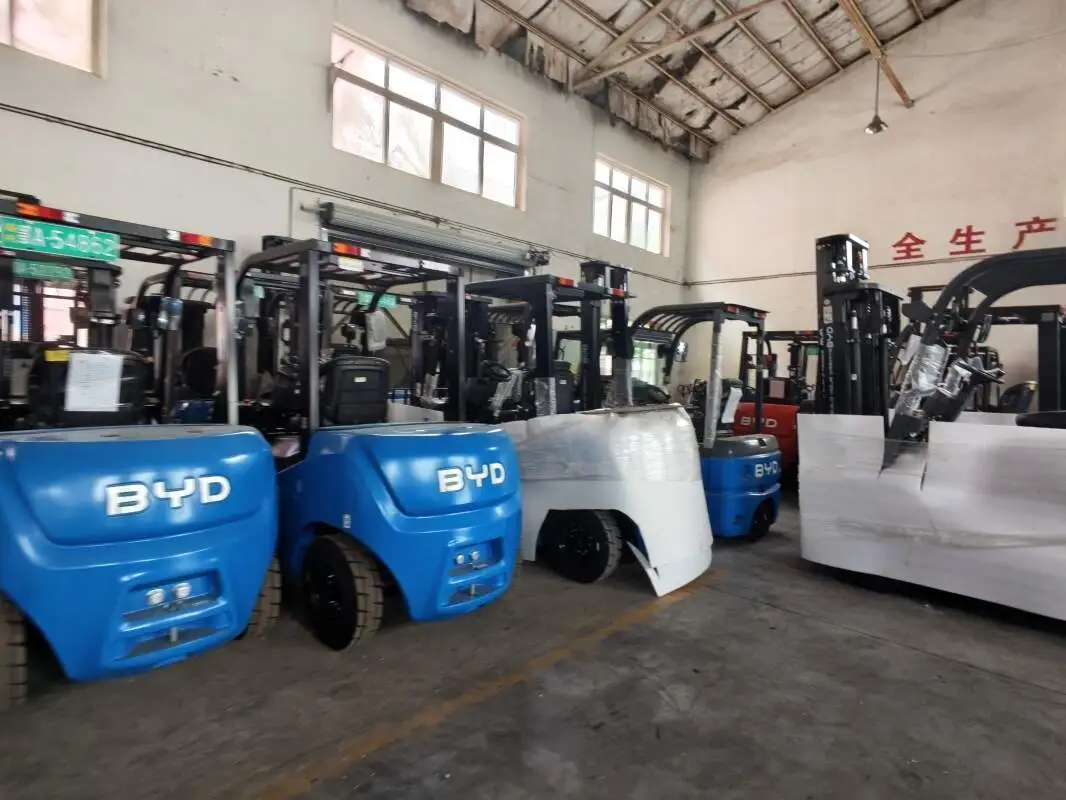
In modern material handling operations, choosing the right forklift is critical to optimizing efficiency, reducing operational costs, and ensuring workplace safety. Two popular options dominating the market are omnidirectional forklifts and conventional forklifts, each with unique strengths tailored to different operational needs. This article provides an objective performance comparison to help businesses make informed decisions based on their specific warehouse requirements.
Maneuverability stands as one of the most distinct differences between the two forklift types. Conventional forklifts rely on front-wheel steering, requiring a wide turning radius to navigate corners and tight spaces. This limitation means they struggle in narrow aisles or densely packed warehouses, often requiring additional space to maneuver safely. In contrast, omnidirectional forklifts utilize specialized wheel systems that enable movement in any direction—forward, backward, sideways, and even diagonally—without the need to turn the entire vehicle. This allows them to easily navigate tight aisles, squeeze between storage racks, and access hard-to-reach areas, making them ideal for facilities with limited space.
Space utilization directly ties into maneuverability and has a significant impact on warehouse storage capacity. Conventional forklifts typically require aisles of at least 12 to 15 feet wide to operate effectively, which reduces the number of storage racks that can be installed. Omnidirectional forklifts, however, can function in aisles as narrow as 6 to 8 feet, depending on the model. This narrower aisle requirement allows businesses to maximize vertical and horizontal storage space, increasing overall storage density by a notable margin in suitable settings. For warehouses focused on maximizing storage capacity, this can translate to substantial cost savings and improved inventory management.
When it comes to load capacity and stability, conventional forklifts hold an edge in heavy-duty applications. Most standard conventional forklifts can handle loads ranging from 5,000 to 30,000 pounds, with specialized models capable of even heavier weights. Their design, with a counterweight at the rear, provides excellent stability when lifting heavy loads at moderate heights. Omnidirectional forklifts, while versatile, generally have a lower maximum load capacity, typically ranging from 3,000 to 10,000 pounds. Their complex wheel systems may slightly reduce stability when lifting very heavy loads to extreme heights, making them more suitable for medium-weight material handling tasks.
Operational complexity and training requirements also differ between the two. Conventional forklifts have a straightforward control system that most operators can learn in a short period, with basic certification courses covering essential skills. Omnidirectional forklifts, however, have more advanced controls to manage their multi-directional movement, requiring operators to undergo specialized training to master precise navigation and handling. While this adds an upfront cost in training, the long-term efficiency gains in tight spaces often offset this investment for businesses with suitable operational needs.
Choosing between the two depends heavily on specific operational scenarios. Conventional forklifts are the go-to choice for large warehouses with wide aisles, heavy-duty load requirements, and straightforward material flow. They are also more cost-effective for businesses that don’t need specialized maneuverability. Omnidirectional forklifts excel in small to medium-sized warehouses, e-commerce fulfillment centers with narrow aisles, and facilities where maximizing storage density is a priority. They are also ideal for operations involving frequent movement of goods between tight spaces or complex layouts.
In conclusion, there is no one-size-fits-all solution when comparing omnidirectional and conventional forklifts. Businesses must evaluate their warehouse layout, load requirements, storage goals, and operator training resources to select the forklift that best aligns with their operational needs. By understanding the key performance differences outlined above, organizations can make strategic decisions that enhance efficiency, reduce costs, and improve overall material handling operations.