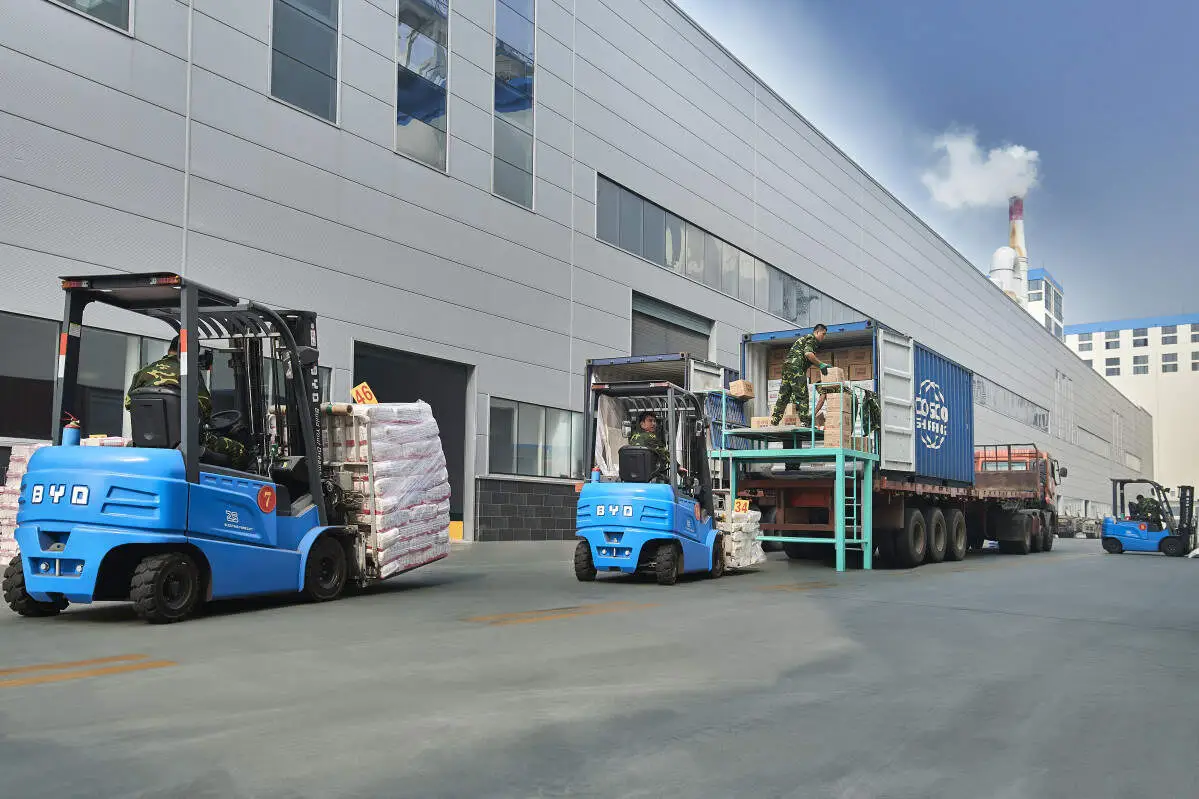
In busy industrial environments like warehouses, distribution centers, and construction sites, clear communication is critical to preventing accidents and ensuring smooth forklift operations. Standard hand signals serve as a reliable non-verbal communication tool between forklift operators and spotters, especially when noise levels make verbal instructions hard to hear. Mastering these signals is a fundamental part of forklift safety training, ensuring all team members understand and respond appropriately to each command.
Basic Movement Signals
The most frequently used hand signals relate to core forklift movements. To indicate "start operation," the spotter extends one arm straight up with the palm facing forward, making slow circular motions with their hand. For "stop," the arm is raised straight above the head, palm forward, held in a fixed position—this signal is used whenever immediate halting is required, whether for safety checks or unexpected obstacles.
For directional commands, "turn left" involves extending the left arm straight out to the side, palm down, and making small, deliberate leftward swings. Conversely, "turn right" uses the right arm in the same manner. To signal "raise the forks," the spotter holds one arm up with fingers together, moving the hand upward in a steady motion. To "lower the forks," the arm is held down, fingers together, with the hand moving downward.
Load Handling Signals
Proper load handling requires precise signals to avoid damage to goods or equipment. When instructing the operator to "tilt forks forward," the spotter extends one arm forward with the palm facing down, pushing the hand forward in a gentle, repeated motion. For "tilt forks backward," the arm is extended backward, palm up, pulling the hand toward the body.
To indicate "lower the load to the ground," the spotter holds both arms down at their sides, palms facing the ground, and moves their hands downward in unison. For "secure the load," the spotter crosses their arms over their chest, indicating the operator should ensure the load is stable before moving.
Emergency Signals
In urgent situations, clear emergency signals can prevent serious incidents. The "emergency stop" signal is one of the most critical: the spotter raises both arms straight up, palms forward, and waves them rapidly up and down. This signals the operator to halt immediately, regardless of current activity.
For a "distress call" if the spotter needs immediate assistance, they raise one arm above their head and wave it rapidly from side to side. This alerts the operator and nearby personnel that help is needed quickly.
Best Practices for Using Hand Signals
To ensure effectiveness, all personnel involved in forklift operations should undergo training to learn and practice standard hand signals consistently. Signals should be made in clear view of the operator, with movements that are deliberate and easy to interpret. Avoid making vague or ambiguous gestures, as this can lead to miscommunication and accidents. Additionally, operators should confirm they understand a signal by nodding or using a pre-agreed response before acting.
By adhering to these standard hand signals, forklift teams can significantly reduce the risk of collisions, load damage, and workplace injuries. These simple yet powerful communication tools are a cornerstone of safe and efficient material handling operations in any industrial setting.