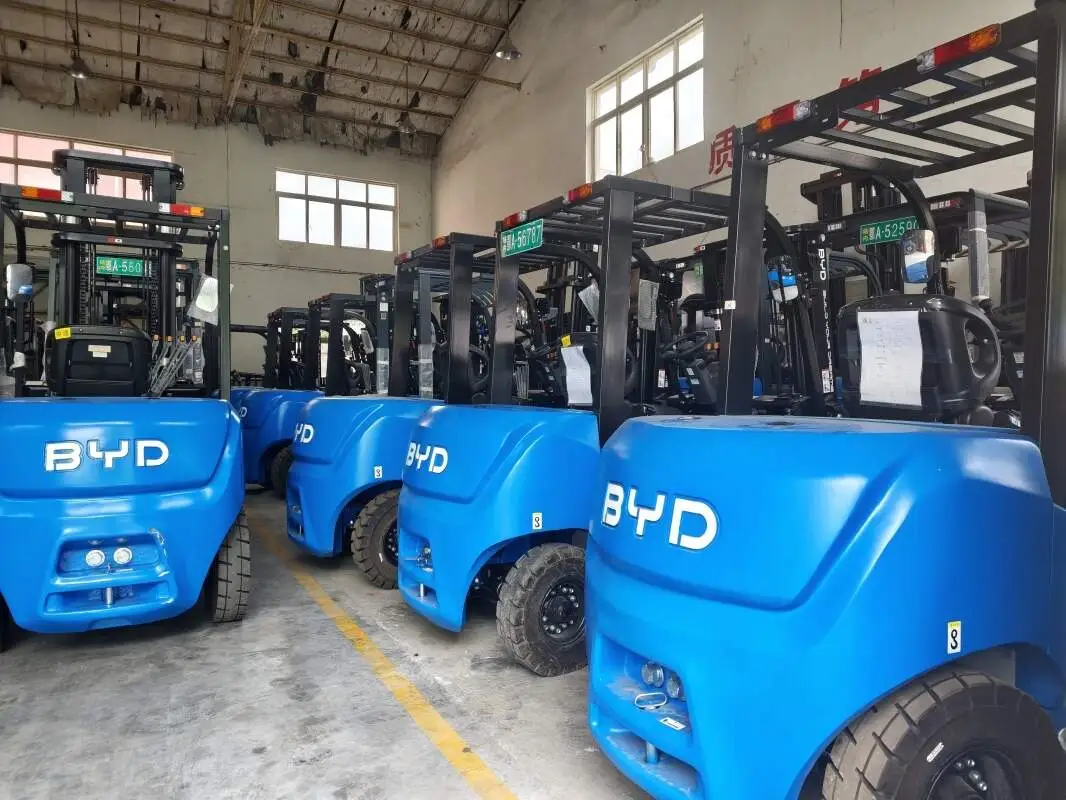
Counter balance forklifts are widely utilized in general material handling across warehouses, manufacturing facilities, and distribution centers, thanks to their ability to lift and transport heavy loads without relying on external support structures. Their design and operational mechanics are centered around stability and efficiency, making them a staple in industrial material management.
The defining feature of a counter balance forklift lies in its core balance principle. A rear-mounted counterweight offsets the load lifted by the front forks. When a load is placed on the forks, it creates a forward tilting moment that could cause the vehicle to tip forward. The counterweight at the rear generates an opposing moment, ensuring the forklift remains balanced and stable during operation. This principle remains critical even when navigating uneven surfaces or making turns, as the counterweight distributes forces evenly across the chassis to maintain equilibrium.
The lifting and lowering of loads depend on a precision hydraulic system that converts fluid pressure into mechanical force. A pump, powered by the forklift’s engine, pushes hydraulic fluid through reinforced hoses to cylinders located near the forks. When the operator activates the lift control, fluid flows into the cylinder, extending the piston and raising the mast along with the attached load. Lowering the load involves releasing hydraulic pressure, allowing fluid to flow back into the reservoir, which retracts the piston and lowers the mast smoothly. This system provides operators with precise control over load movement, enabling them to handle materials at various heights with minimal risk of damage.
Counter balance forklifts also feature a unique rear-wheel steering mechanism that enhances maneuverability in tight spaces. Unlike standard vehicles, turning the rear wheels allows the forklift to pivot within a small radius, making it easier to navigate narrow warehouse aisles and position loads accurately. This steering system works in tandem with the balance principle; during turns, the counterweight counteracts centrifugal force, reducing the risk of tipping even when moving with a fully loaded set of forks.
Beyond basic mechanics, built-in safety logic is an integral part of the forklift’s working principles. Most models include a tilt cylinder that allows the mast to lean backward slightly when lifting loads. This tilting action shifts the load’s center of gravity closer to the forklift’s chassis, further enhancing stability during transport. Additionally, many units are equipped with overload sensors that trigger visual or auditory alerts if the load exceeds the vehicle’s rated capacity, preventing structural damage and reducing safety hazards for operators and bystanders.
Understanding these working principles is essential for both operators and facility managers. By leveraging the balance mechanism, hydraulic system, and maneuvering features, counter balance forklifts deliver reliable performance for a wide range of general material handling tasks, from pallet transport to stacking inventory. Their design prioritizes stability, efficiency, and safety, ensuring they can adapt to diverse industrial environments and support smooth daily operations.