


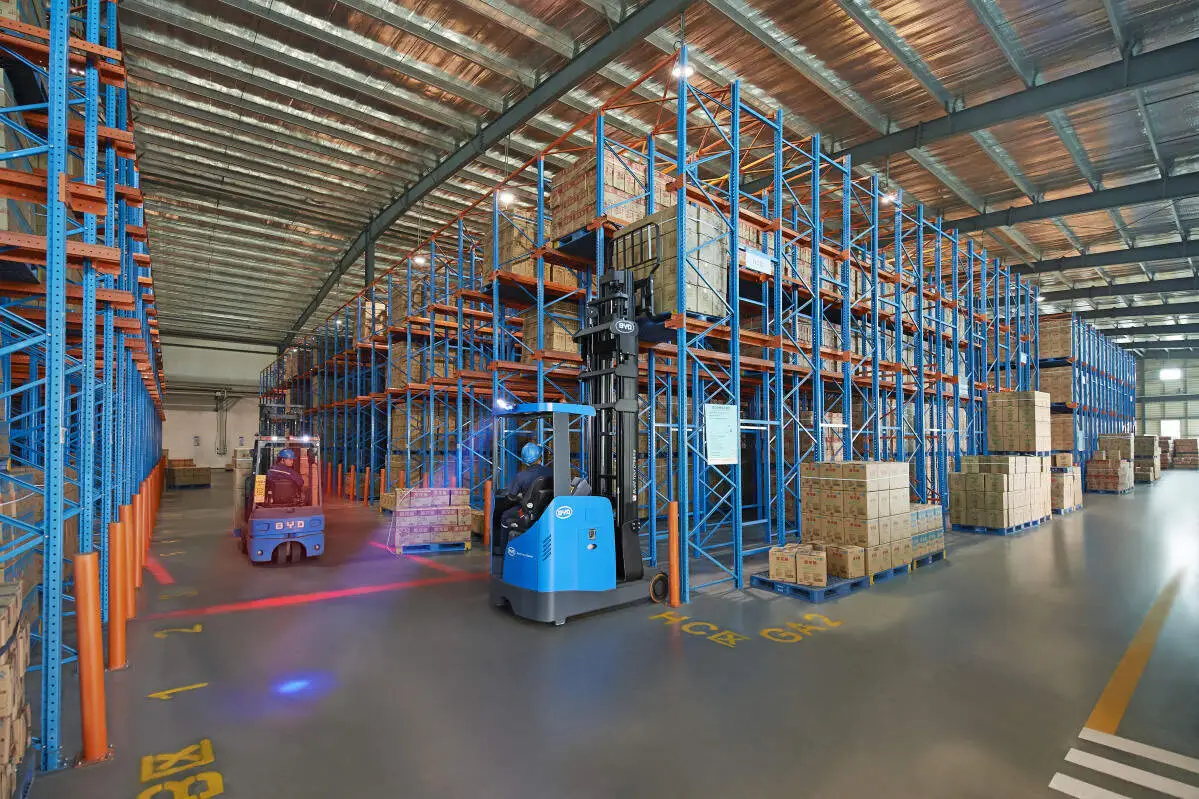
Core pain points of heavy loading and unloading in building materials warehouses
Building materials warehouses involve the storage and turnover of tiles, cement, steel and other categories. Such goods generally have the characteristics of large single size and large differences in volume regularity, which puts forward strict requirements on the load capacity of handling equipment. At the same time, the internal passages of the warehouse are mostly standard width, and there are many corners and dense stacking in some areas. The flexibility and stability of the equipment directly affect the operation fluency. In addition, under long-term high-intensity operation, the battery life and durability of the equipment have also become key factors restricting the operation efficiency of the warehouse.
Adaptation scheme of BYD counterbalance forklift truck
Load performance matching heavy load requirements
In view of the significant characteristics of building materials, the counterbalanced forklift has the rated load capacity suitable for heavy-duty scenarios, which can easily complete the handling of single-ton or even several-ton building materials goods, without the need for multiple split handling, effectively reducing the number of operation links.
Stability for complex scenarios
The counterweight structure equipped with the forklift has been rationally designed to maintain good body stability under full load handling, even when turning at the corner of the warehouse or driving on a ramp, it can reduce the risk of goods falling and ensure the safety of the operation.
Operational flexibility Adapt to warehouse layout
The steering system of the forklift is flexible and lightweight, and the minimum turning radius is adapted to the standard channel width of the warehouse. Operators can easily complete steering and docking operations in narrow areas to avoid channel congestion caused by the large size of the equipment.
Practical application results
Improvement of operational efficiency
In practical applications, the forklift's single-load handling capacity meets the heavy-duty requirements of building materials. Compared with traditional small-scale handling equipment, the single-load operation efficiency is significantly improved. The handling tasks that originally required multiple round trips can be completed at one time, shortening the turnaround time of goods, and effectively improving the daily average workload.
Optimization of operating costs
The forklift's long-lasting power system can support long-term continuous operation, reducing the waiting time for frequent charging or fuel replacement. At the same time, the durability of the equipment reduces the frequency and cost of daily maintenance, helping the warehouse optimize overall operating expenses.
Strengthening of security guarantees
The safety protection devices equipped with forklifts, including reversing warning and fork anti-lateral movement functions, further enhance the safety during heavy-duty operations, reduce the risk of cargo damage and personnel operation, and provide a reliable guarantee for the stable operation of the warehouse.

