


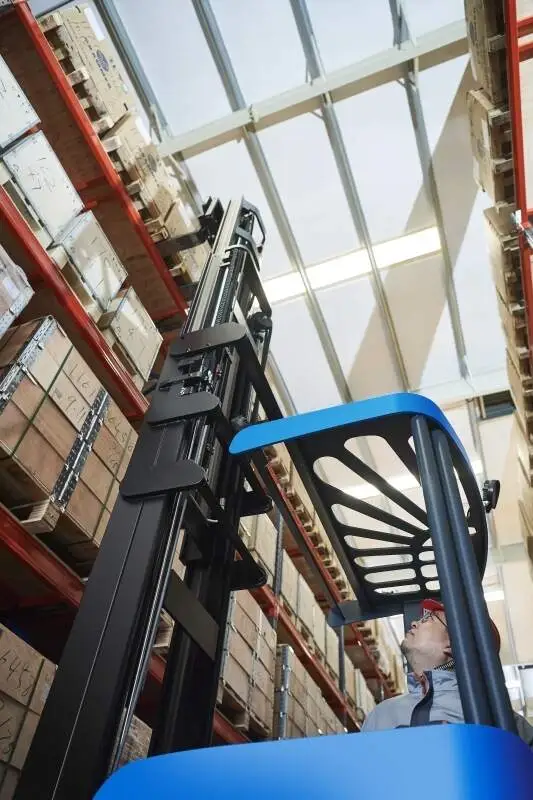
The chassis walking system of an electric forklift is the core support to ensure its efficient operation. It is coordinated by a variety of accessories such as drive wheels, steering mechanisms, transmission components, and braking devices. In daily operations, affected by factors such as load, road conditions, and maintenance frequency, chassis walking accessories are prone to various failures. Timely investigation and adoption of targeted accessory solutions can effectively prolong the service life of the equipment and reduce operation and maintenance costs.
Excessive wear of the driving wheel is a relatively common fault, which is manifested as obvious abnormal noise when the forklift is walking, the driving track is offset, and it is easy to slip under no-load or heavy-load conditions. Such faults are mostly related to excessive wear of the driving wheel tires, deformation of the rim, and excessive clearance of the hub bearing. The solution is: regularly check the depth of the tire pattern, and replace the tire of the same specification when the pattern is lower than the safety threshold; if the rim is deformed, replace the suitable rim accessories; check the clearance of the hub bearing, replace the bearing if it exceeds the standard range, and do a good job of lubricating and maintaining the bearing.
The steering stick or heavy is also a high-frequency fault, which is mainly manifested as the large operating resistance, unsmooth steering, and even the phenomenon of stagnation when the forklift is steering. The root causes of the fault are mostly loose wear of the steering rod ball head, lack of oil damage to the steering knuckle bearing, and abnormal steering gear and rack components. The response plan is: check the wear degree of the steering rod ball head, and replace the ball head accessories in time when there is obvious loose or excessive wear; lubricate and maintain the steering knuckle bearing, and replace the new bearing if the bearing is damaged; dismantle and check the steering gear and rack, and replace the corresponding gear and rack components if the tooth surface is seriously worn or stuck.
The fault of insufficient walking power is usually manifested as the forklift starting slowly, unable to climb normally when heavy load, and the walking speed is significantly reduced. This fault is mostly caused by excessive wear of the carbon brush of the walking motor, wear of the gear of the transmission gearbox, and insufficient lubricating oil caused by oil leakage from the oil seal of the walking reducer. The solution includes: regularly check the wear amount of the carbon brush of the walking motor, and replace the carbon brush when the length of the carbon brush is lower than the specified value; open the transmission gearbox to check the wear of the gear. If the tooth surface is seriously worn or the teeth are broken, replace the gear accessories of the corresponding specifications; check the oil seal of the walking reducer. If there is oil leakage, replace the oil seal and replenish the lubricating oil of the suitable
Brake failure or braking distance is too long to pay special attention to the fault, the performance is that the forklift can not stop in time after pressing the brake pedal, the braking distance exceeds the safe range. Such faults are closely related to excessive wear of the brake shoe, aging of the brake master pump seal, and air in the brake pipeline. The countermeasures are: check the thickness of the brake shoe, replace the brake shoe when it is lower than the safe value; disassemble the brake master pump, and replace the seal accessories if the seal is aging and failed; exhaust the brake pipeline to discharge the air in the pipeline to ensure stable pressure of the brake system.
In daily operation and maintenance, in addition to targeted handling of faults, a regular maintenance mechanism should also be established to clean and check chassis running accessories, and check hidden dangers in advance to ensure the stable operation of electric forklifts.

