


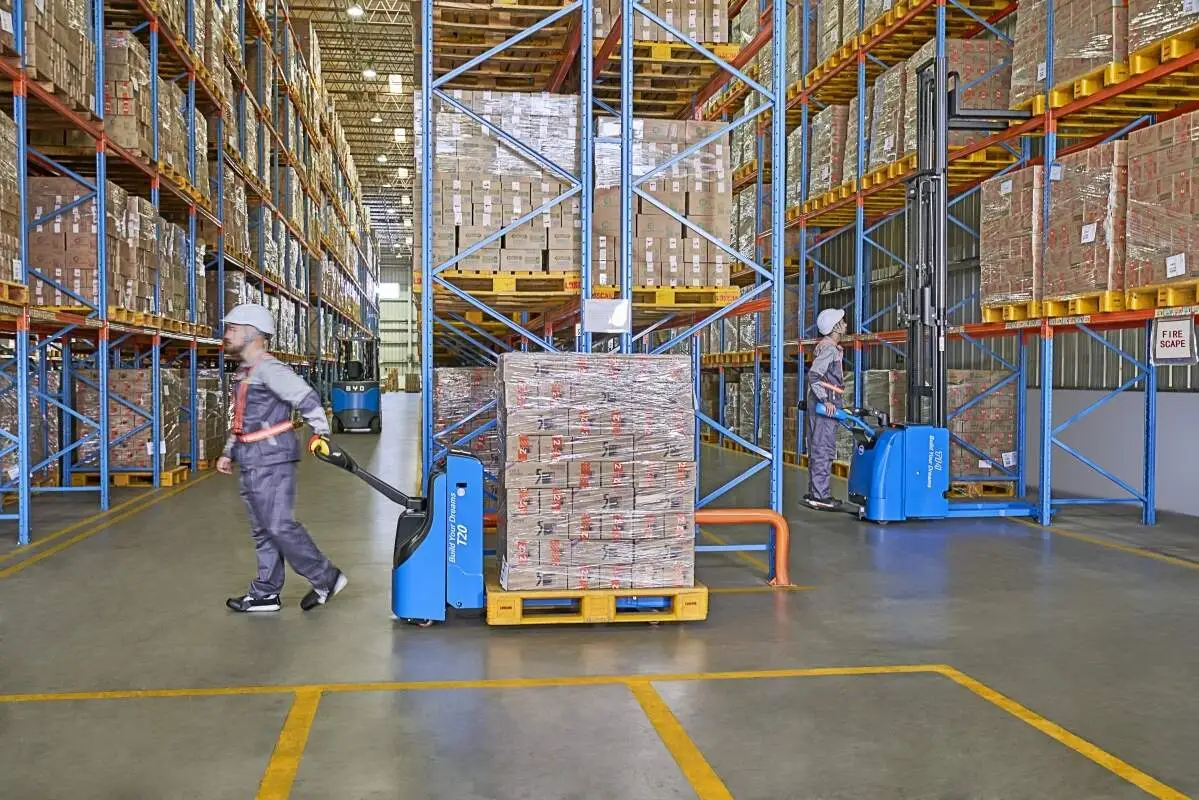
In warehousing and logistics operations, different types of electric work equipment have a clear functional positioning. The QX20 truck and the GX20 stacker are two types of equipment with different functions. Understanding their differences in use can help enterprises complete the material flow more efficiently.
Horizontal material transfer: the core of the QX20 truck
The main force of short-distance pallet handling
The QX20 truck takes horizontal material transfer as its core function and is suitable for short-distance pallet cargo movement between various areas in the warehouse. For example, it transports the pallet goods that have just been unloaded from the receiving area to the temporary storage area, or distributes raw material pallets for various stations next to the production line. Its steering is flexible, it can pass smoothly in narrow passages, and it is suitable for the spatial layout of most flat warehouses. The carrying capacity can meet the transshipment needs of daily pallet goods. The operating threshold is low, and ordinary staff can get started after simple training.
Optimization of Frequent Turnaround Scenarios
In scenarios with high frequency of goods turnover, such as material transfer from the unpacking area to the sorting area of the e-commerce warehouse, the advantages of the QX20 truck are even more obvious. It does not require vertical lifting operations, focuses on horizontal movement, and has higher operation efficiency. Its battery life can also support long-term high-frequency transshipment, reducing the waiting time for equipment to be charged halfway, and ensuring the smooth logistics process.
Vertical stacking operations: the exclusive advantage of the GX20 stacker
Shelf goods on and off the shelves
The core feature of the GX20 stacker truck is its vertical lifting ability, which can complete the loading and unloading of shelf goods. When the warehouse uses three-dimensional shelves for storage, it can lift the pallet goods to a height of 2-3 meters, accurately place them to the corresponding shelf level, and remove the goods that need to be shipped out of the warehouse from the high shelves. It solves the problem of material transfer in vertical space and helps the warehouse make full use of the three-dimensional space.
Essential tools for high-level storage
For finished product storage or spare parts warehouses with multi-layer shelves, the GX20 stacker is a necessary equipment to improve storage utilization. It can stack goods to a certain height and reduce the occupation of ground storage space. Especially in the case of limited warehouse area, the overall storage capacity can be greatly increased through three-dimensional storage to meet the storage needs of a large number of goods.
Segmentation differences of applicable scenarios
Adaptation of plane storage and three-dimensional storage
The QX20 truck is more suitable for storage scenarios with a flat layout. This kind of warehouse does not require high-level storage, and mainly focuses on horizontal circulation, such as the temporary storage area of raw materials in small factories and the back-end storage of convenience stores. The GX20 stacker truck is more suitable for three-dimensional storage environments. This kind of warehouse stores goods in layers through shelves, and requires equipment with vertical lifting ability to complete the operation of goods on and off the shelves.
Complementary matching of workflows
In a large comprehensive warehouse, the two pieces of equipment often form a complementary combination. The QX20 truck is responsible for transferring goods from the loading and unloading area to the shelf operation area, and the GX20 stacker truck is responsible for storing the goods on the shelves, or after removing the goods from the shelves, the QX20 truck is transferred to the outbound area. The two work together to build a complete material flow chain and improve the overall storage operation efficiency.

