


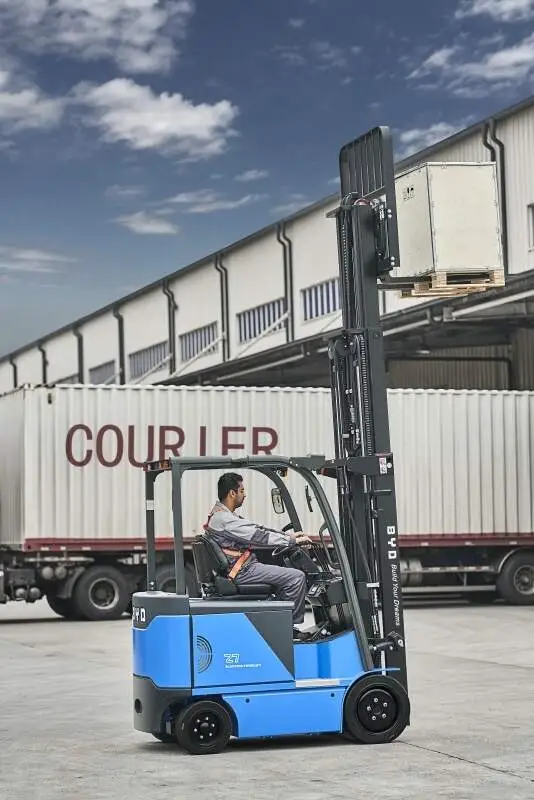
As the core equipment in intelligent warehousing and logistics, AGV forklifts have become the key to improving warehousing efficiency with the characteristics of automatic navigation and precise operation. The AP series AGV forklifts cover four models: ap15, ap20mpw, AP25, and AP30. They are designed for different operation needs. The following is a comparative interpretation of the core parameters to help users sort out the differences between each model so that they can choose on demand.
From the perspective of load parameters, the rated load of the four models is 1.5 tons, 2 tons, 2.5 tons, and 3 tons in sequence, corresponding to different operating scenarios. The light-load design of AP15 is suitable for handling the handling of small boxed goods and loose materials, and it is more flexible in small warehouses and parts processing workshops in e-commerce with narrow spaces. As a 2-ton model, AP20MPW takes into account load and flexibility. It is suitable for most general storage scenarios and can complete conventional operations such as transit and shelving of palletized goods. AP25 and AP30 are biased towards heavy-duty operations, suitable for handling long-distance handling of bulk goods and heavy parts, and can play an efficient role in large logistics parks and heavy-duty manufacturing warehouses.
The difference in size and passability parameters directly determines the adaptability of the equipment in different storage spaces. The AP15 body is relatively compact, with a smaller turning radius, which can flexibly shuttle in narrow passages and dense shelf areas, and is suitable for small storage environments with limited space; the AP20MPW body size is moderate, balancing load capacity and space adaptability, and can pass smoothly in most standard storage passages; the AP25 and AP30 have increased body length and width due to load requirements, and the turning radius is slightly larger, which is more suitable for spacious working passages and open storage areas to ensure the stability of heavy cargo handling.
In terms of performance and battery life parameters, each of the four models has its own emphasis. In terms of lifting height, it can meet the needs of conventional shelf operations, but the light-load model has a faster lifting speed, which can improve the operation turnover efficiency of light materials; in terms of battery life, the model with the larger load is equipped with a relatively higher battery capacity to ensure the continuous running time of heavy-duty operations, while the light-load model has a lighter battery and a short charging cycle, which is suitable for high-frequency and short-distance operations. In terms of walking speed, the light-load model has a slightly faster maximum walking speed, which is suitable for light material operation scenarios with fast turnover. The heavy-duty model mainly runs stably, and the walking speed is relatively smooth to ensure the safety of heavy-duty cargo handling.
Overall, the four models of the AP series AGV forklift truck have their own preferences in terms of load, size, and performance. When selecting a model, users need to match the most suitable model based on actual factors such as the size of their own storage space, the weight of the goods, and the frequency of operations, in order to maximize the operation value of the intelligent forklift and improve the overall efficiency of warehousing and logistics.

