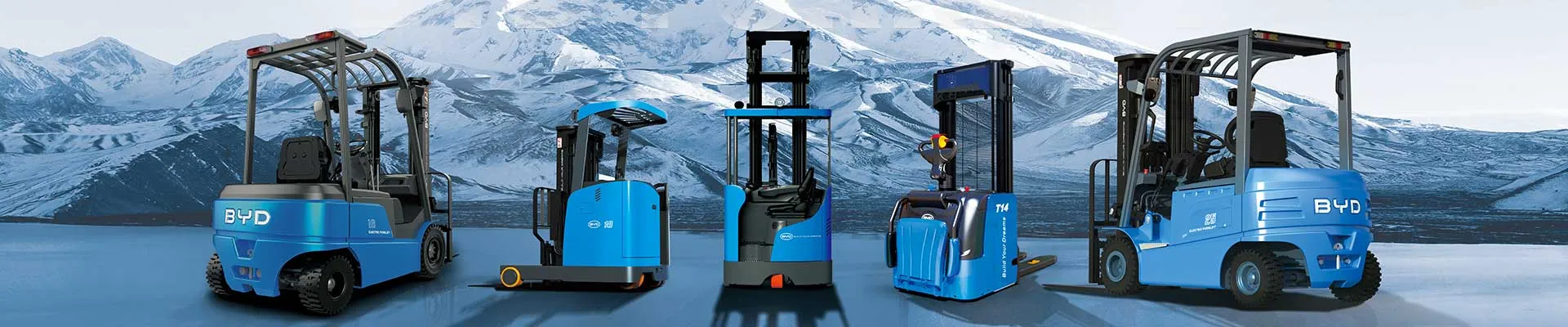
Forklifts serve as essential handling equipment for warehouse logistics, factory loading and cargo transportation. Different working conditions require matched forklift models. Many users are confused about three common forklift types: sit-down forklifts, stand-up forklifts and manual forklifts. As a professional supplier of BYD forklifts, we introduce their features, advantages and applicable scenarios in detail to help enterprises select suitable equipment and improve operational efficiency.
1. Sit-Down Forklift
The sit-down forklift is a widely used electric forklift for industrial heavy-duty operations. It is equipped with a standard seat, steering wheel, accelerator and brake pedals. Operators can work in a sitting posture with a user-friendly driving experience, which is easy to learn and comfortable for long-hour operation.
All BYD sit-down forklifts are equipped with high-performance lithium battery systems, delivering stable power output and reliable load capacity. These models support cargo handling, high-level stacking and long-distance transportation with a load range of 1 to 10 tons. Featuring solid body structure and stable performance, they adapt to high-intensity continuous operation in indoor warehouses and smooth outdoor factory sites, effectively reducing manual labor intensity.
Applicable Scenarios: Medium and large warehouses, factory assembly lines, heavy cargo transportation, high-frequency and long-hour handling work.
2. Stand-Up Forklift
The stand-up forklift is a compact and flexible electric handling device without a driving seat. Operators control the equipment via simple levers in a standing posture, with no complicated pedal operation required. Compared with sit-down forklifts, it has a smaller body size and a shorter turning radius, ensuring excellent flexibility.
BYD stand-up forklifts are specially designed for narrow-space working environments. They fit well in dense shelf warehouses, three-dimensional storage spaces and narrow factory aisles, and can pass through freight elevators and compact working stations smoothly. With stable start-stop performance and precise control, these forklifts reduce collision risks in narrow spaces while maintaining steady working efficiency, ideal for short-distance and high-frequency material stacking and handling.
Applicable Scenarios: Narrow-aisle warehouses, three-dimensional storage centers, compact factory workstations, short-distance and medium-light load handling tasks.
3. Manual Forklift
The manual forklift is a basic labor-saving handling tool with no electric drive or complex control components. It completes cargo movement and height adjustment through manual pushing and hydraulic lifting. The simple mechanical structure ensures low failure rates and zero charging maintenance requirements.
BYD manual forklifts adopt solid manufacturing materials and stable hydraulic systems, supporting smooth lifting and uniform load bearing. They feature lightweight bodies and low procurement and maintenance costs. Limited by manual operation, they are more suitable for low-intensity and short-distance handling tasks, rather than large-scale and high-frequency industrial operations.
Applicable Scenarios: Small stores, mini warehouses, short-distance light cargo transportation and occasional auxiliary loading and unloading work.
Forklift Selection Guide
BYD sit-down forklifts are suitable for heavy-load and long-duration operational demands. BYD stand-up forklifts work well for flexible handling in narrow spaces with high-frequency operation. BYD manual forklifts are cost-effective choices for casual and light-duty handling work. All BYD forklifts adopt eco-friendly lithium battery technology, low-noise operation and reliable manufacturing quality, with complete after-sales service to meet diverse warehouse handling demands across various industries.
For professional consultation, model selection and quotation of BYD forklifts, please contact: 17399989919@163.com