


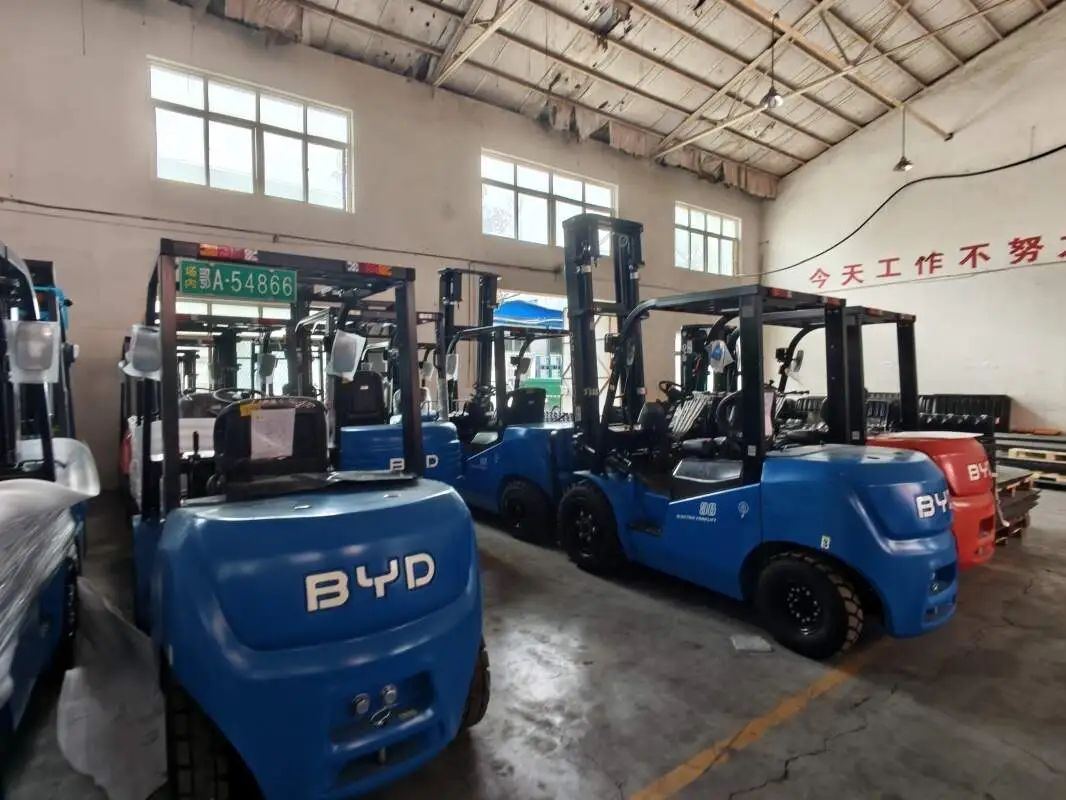
When introducing reach driverless forklifts, many companies often have a question: Does this type of equipment have to rely on magnetic stripes to function properly? In fact, the answer is not absolute. We analyze the application logic of different navigation schemes for you through practical tests.
Traditional Application of Magnetic Stripe Navigation in Unmanned forklift
Characteristics and limitations of magnetic stripe navigation
Magnetic stripe navigation is a common navigation method for early unmanned forklifts. It lays a magnetic stripe on the ground, allowing the forklift to rely on sensors to identify the magnetic stripe signal to plan the path. This method has mature technology, low initial investment cost, and can maintain stable operation accuracy in fixed operation scenarios. However, its limitations are also obvious. Magnetic stripes are easily worn and polluted, require regular maintenance, and once the path is laid, it is difficult to adjust flexibly and cannot adapt to frequently changing storage layouts.
Measured Analysis of Magnetic Stripe-free Navigation Technology
Measured job performance
We conducted a magnetic stripe-free navigation test on a reach-moving unmanned forklift, using a visual navigation scheme combined with SLAM algorithm. During the actual measurement process, the equipment can scan the environment in real time through cameras and laser sensors to build a three-dimensional map of the work scene, and can accurately locate without relying on the magnetic stripe laid on the ground. In a complex storage environment, with dense shelves and narrow passages, the equipment can still accurately plan the optimal path and avoid obstacles, and the operation accuracy can fully meet the daily storage and handling needs. When the warehouse layout is temporarily adjusted, it only needs to re-collect the environmental data to update the map, and the equipment can quickly adapt to the new operation path, which is far more flexible than the magnetic stripe navigation scheme.
Selection Basis for Navigation Scheme of Reach-moving Unmanned Forklift
Choose according to scenario requirements
Whether you need a magnetic stripe depends on the actual operational needs of the enterprise. If the warehouse layout is fixed for a long time and the operating environment is simple, magnetic stripe navigation can be used as a cost-effective choice. But if the warehouse needs to frequently adjust the shelf position, or the operating environment is complex and changeable, the flexibility and adaptability of magnetic stripe-free navigation will be more advantageous. In addition, the post-maintenance cost should also be considered. Magnetic stripe navigation requires regular inspection and replacement of magnetic stripes. In the long run, the maintenance cost is not low. Magnetic stripe-free navigation does not require additional ground facilities maintenance, which is more suitable for enterprises that pursue efficient and flexible operations.
In summary, it is not necessary to use magnetic stripes for reach-moving unmanned forklifts. Companies can choose the most suitable navigation solution according to their own storage scenarios, operational requirements, and cost budgets.

