


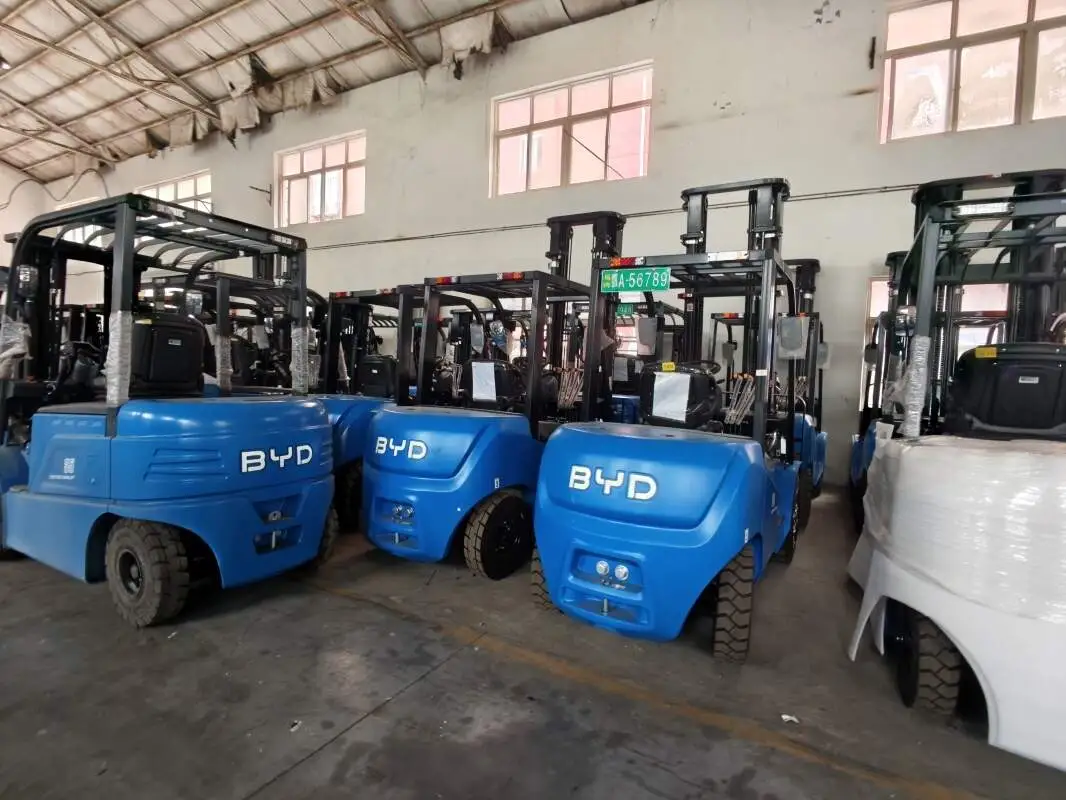
With the continuous improvement of space utilization requirements in the warehousing industry, narrow-aisle three-dimensional warehouses have become the choice for many enterprises to optimize their warehousing layouts due to the advantages of high-density storage. This type of warehouse has narrow aisles and far higher shelf heights than ordinary warehouses, which places extremely high demands on the flexibility of operating equipment. electric forklifts, with their own characteristics, have become the core operating equipment suitable for such scenarios.
Steering flexibility for tight spaces
The channel width of a narrow-channel three-dimensional warehouse is usually only half or even narrower than that of an ordinary warehouse, making it difficult for traditional forklifts to complete steering and U-turns in a limited space. Electric forklifts use a flexible steering system, and some models can achieve in-situ steering. The extremely small turning radius allows it to easily complete steering, U-turns, and other operations in narrow passages without reserving additional operating space. It is fully adapted to the working environment of narrow passages and avoids the waste of space caused by the large size of the equipment.
Compact body to match high-density storage layout
In order to adapt to the high-density shelf layout of the three-dimensional warehouse, the electric forklift adopts a compact body design, the overall size is small, and it can be freely shuttled in the narrow passage between the shelves. At the same time, the lifting height of the electric forklift can be adjusted according to the height of the shelf, which can accurately reach the storage space of the high-rise shelf, helping enterprises make full use of the vertical storage space of the three-dimensional warehouse and improve the overall storage capacity. There is no need to widen the channel for equipment traffic or reduce the shelf density.
Precise operation enhances job safety and efficiency
In a narrow-channel three-dimensional warehouse, the storage location of goods is compact, and the working space is limited, which requires extremely high accuracy in the operation of forklifts. The electric forklift is equipped with a precise micro-motion control system, and the operator can control the speed and lifting position of the forklift through delicate operation to achieve accurate alignment of goods and shelves, reduce the risk of goods colliding and falling, and improve operation safety. At the same time, precise operation can also shorten the time of a single operation and improve the overall storage operation efficiency.
Low energy consumption, suitable for closed storage environment
Narrow-channel three-dimensional warehouses are mostly closed or semi-closed spaces, which have strict requirements on the noise and emissions of operating equipment. Electric forklifts use electricity as the power source, have no exhaust emissions during operation, and the noise level is much lower than that of traditional fuel forklifts, which will not cause pollution to the storage environment and provide operators with a more comfortable working environment. In addition, the energy consumption of electric forklifts is relatively stable, and reasonable planning of charging time can meet daily operation needs, and maintenance costs are also lower.
In summary, electric forklifts, with their flexible steering, strong space adaptability, accurate operation, and low energy consumption, perfectly match the operation requirements of narrow-channel three-dimensional warehouses, helping enterprises improve space utilization and operation efficiency. They are ideal operating equipment in this type of warehousing scenario.

