


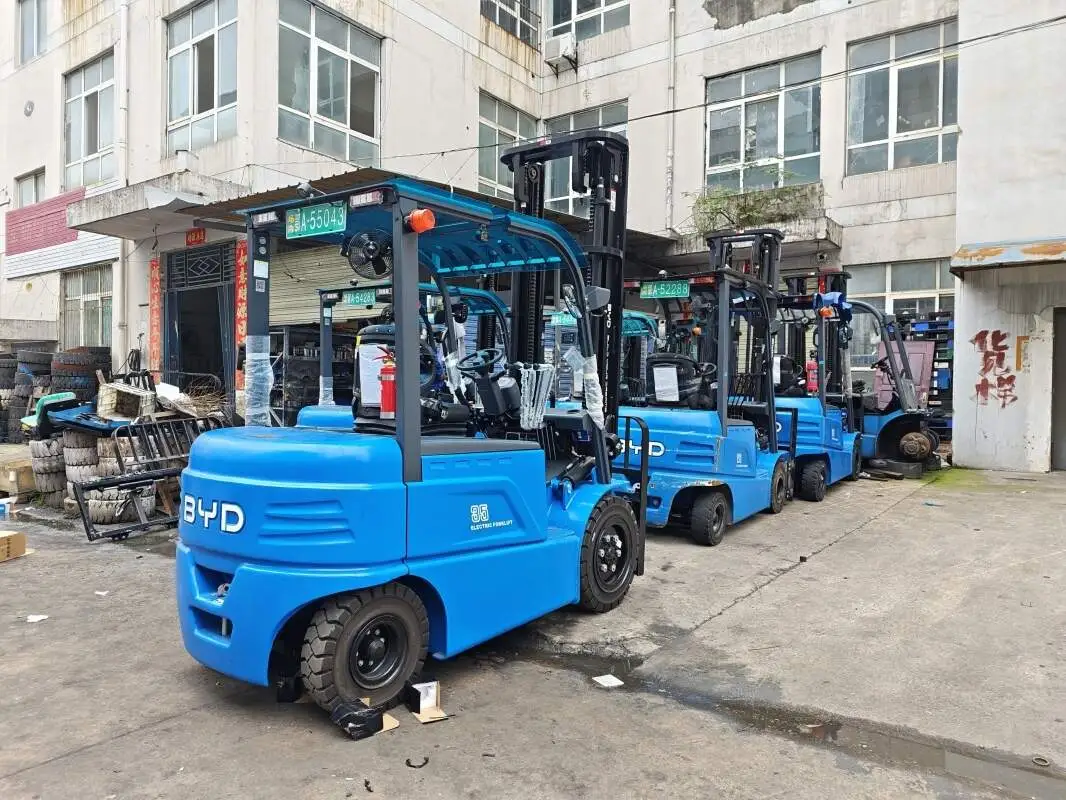
In warehousing and logistics operations, the selection of electric forklifts directly affects operation efficiency and cost control, and different models of forklifts are suitable for different warehousing scenarios. BYD AF300 and AF500 electric forklifts have obvious differences in core parameters due to different positioning. The following analysis is carried out from multiple dimensions to provide reference for enterprise selection.
The first is the difference in load capacity. The AF300 focuses on a 3-ton load, which is suitable for warehousing scenarios dominated by small and light goods, such as express turnover in e-commerce warehouses and material handling in small parts warehouses, which can meet daily medium and light cargo loading and unloading needs. The AF500 is positioned at a 5-ton load, designed for heavy cargo operations, suitable for industrial raw materials warehouses and large finished product warehousing areas, and can stably complete the handling and stacking of heavy pallets and large equipment.
The second is the difference in body size. The AF300 has a smaller body width and a more compact turning radius. It is suitable for narrow-channel storage environments. It can be flexibly shuttled in dense shelf areas or small warehouses with limited space, reducing space occupation and improving operation flexibility. To adapt to heavy-duty needs, the AF500 has a wider body structure and a correspondingly larger turning radius. It is more suitable for open storage spaces, such as open-air operation areas in large logistics parks and high-rise and high-space storage centers, which can smoothly complete a wide range of cargo transshipment.
Furthermore, there is the difference between battery life and operation time. The battery capacity of the AF300 is adapted to moderate and mild operation intensity, and a single charge can meet the regular operation needs of about 8 hours. It is suitable for scenarios with moderate operation time and low operation frequency in a single day. The AF500 is equipped with a larger capacity battery with stronger battery life. It can support more than 10 hours of continuous operation on a single charge, and can adapt to long-term and high-load storage operation needs, reducing the frequency of charging in the middle.
Finally, there are differences in operation adaptation scenarios. From the perspective of lifting height, the maximum lifting height of the AF300 is more suitable for low-rise shelf operations, generally suitable for shelves 3-5 meters high; the maximum lifting height of the AF500 is higher, and can be adapted to high-rise heavy-duty shelves of 5-8 meters to meet the high stacking requirements of heavy goods.
When selecting a model, an enterprise needs to match the corresponding forklift model according to the actual conditions such as the weight level of its own warehoused goods, warehouse space layout, daily working hours, and shelf height, in order to maximize operational efficiency and cost optimization.

