


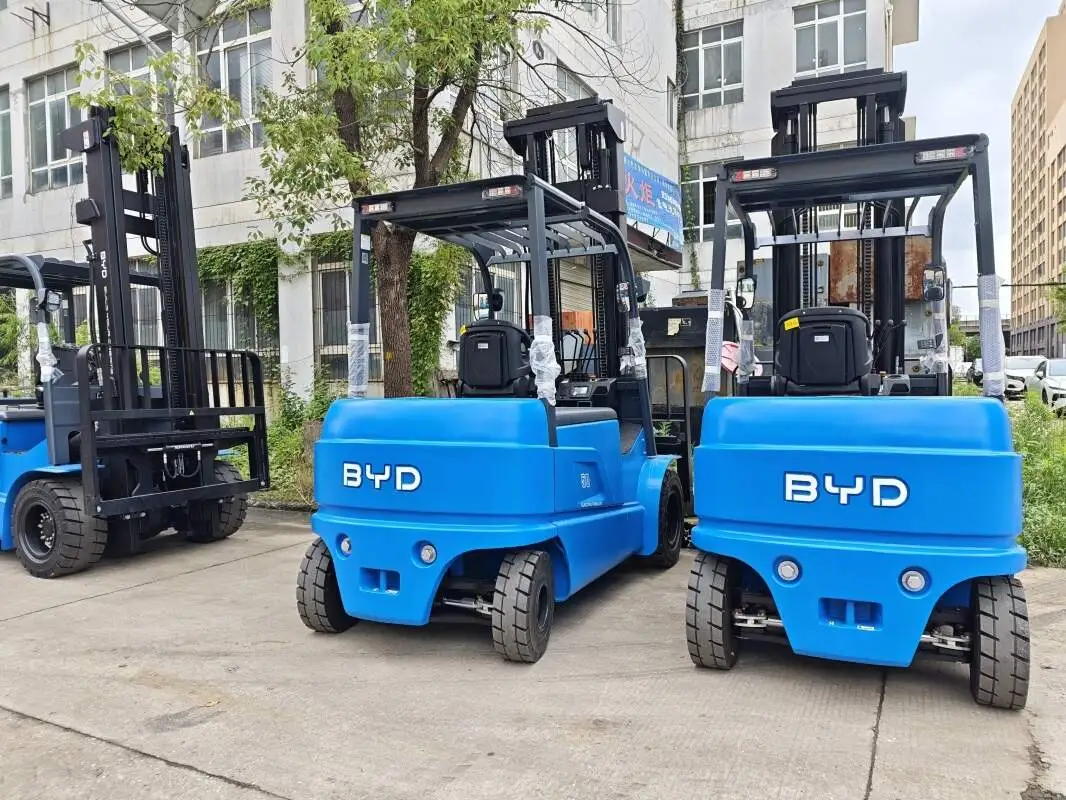
In the warehousing operation scenario, forklift wheels, as the core load-bearing and operating components, operate in stacks, ramps, hardened floors and other environments for a long time, prone to wear and tear, aging and other problems, which affect the operation stability and operation efficiency of forklifts. Among them, wear-resistant polyurethane wheels have become common replacement parts for warehousing BYD forklifts due to their wear resistance, low noise, and adaptability to a variety of storage floors.
First of all, it is necessary to accurately determine the timing of wheel group replacement: when the surface wear depth of the wheel group exceeds 1/3 of the original thickness, or local cracking or degumming occurs, it should be replaced in time; in addition, when the forklift is running, the direction of deviation, abnormal noise increases, or the wheel group deforms significantly after load-bearing, it is also necessary to consider replacing the wheel group accessories.
The replacement process needs to follow the standard steps: the first step is to make safety preparations, park the forklift on a flat ground, pull up the handbrake, and pad the anti-skid pad to ensure that the forklift is in a stable state; the second step is to disassemble the old wheel group, use professional tools to loosen the wheel group fixing bolts, remove the worn wheel group smoothly, and pay attention to avoid bumping the surrounding parts; the third step is to install a new wear-resistant polyurethane wheel group, align the installation holes, and tighten the fixing bolts according to the specified torque to ensure that the wheel group fits closely with the shaft position; the fourth step is to debug and check, start the forklift slowly, and conduct a short-distance driving test to observe whether the wheel group rotates smoothly and confirm that there is no abnormal noise or deviation.
After the replacement is completed, daily maintenance should not be ignored: regularly clean the debris and debris on the surface of the wheel group to avoid hard particles from wearing the wheel surface; regularly check the tightness of the wheel group fixing bolts to prevent loosening during operation; according to the frequency of storage operations, conduct a comprehensive investigation of the wheel group wear every 3 months to detect potential problems in advance and ensure the stable operation of the forklift.

