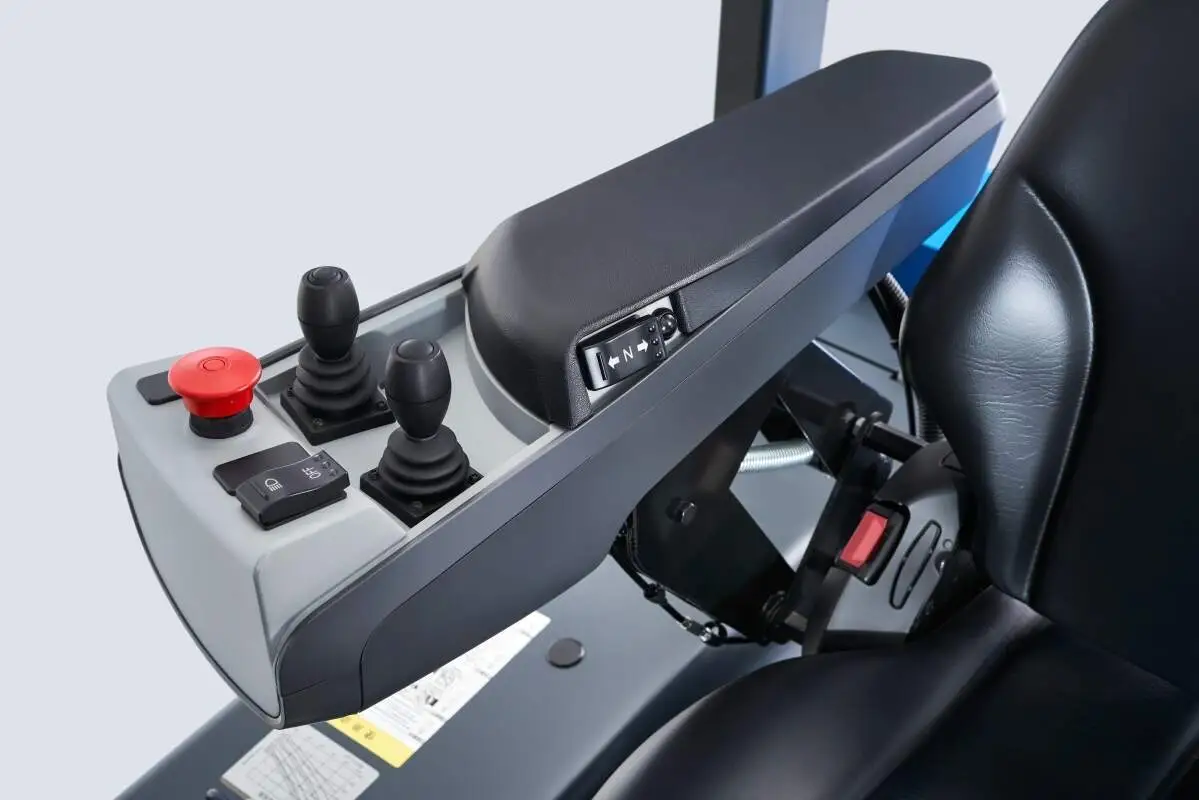
Werkstatt für elektronische Rohstoffe Antistatischer und explosionsgeschützter Lithiumbatterie-Gabelstapler Gebrauchsanweisung

2026-06-27

Werkstatt für elektronische Rohstoffe Antistatischer und explosionsgeschützter Lithiumbatterie-Gabelstapler Gebrauchsanweisung(Figur1)

In der Werkstatt für elektronische Rohstoffe gibt es eine Vielzahl von elektronischen Bauteilen und Rohstoffen, die empfindlich auf statische Elektrizität und offene Flammen reagieren. Daher müssen Lithium-Ionen-Gabelstapler mit antistatischen und explosionsgeschützten Funktionen für den Materialtransfer eingesetzt werden, um die Produktionssicherheit zu gewährleisten. Im Folgenden finden Sie detaillierte Anweisungen für den Einsatz dieses Gabelstaplertyps.

Vorbereitung vor der Verwendung

Überprüfen Sie zunächst den Zustand des Fahrzeugs. Es muss sichergestellt werden, dass die antistatische Erdungsvorrichtung des Gabelstaplers in gutem Zustand und effektiv ist, die explosionsgeschützten Teile nicht beschädigt oder locker sind, die Lithiumbatterie vollständig geladen ist und es keine Leckagen gibt, das Bremssystem und das Lenksystem normal funktionieren und die Gabel flexibel zu heben ist. Zweitens: Bereiten Sie sich auf den Personenschutz vor. Die Bediener müssen antistatische Arbeitskleidung und antistatische Schuhe tragen. Es ist strengstens verboten, Feuer, brennbare und explosive Gegenstände in den Arbeitsbereich mitzunehmen. Lange Haare müssen fest gebunden und in die Arbeitskappe gesteckt werden.

Verwendete Betriebsspezifikationen

Es ist notwendig, auf den Fahrbetrieb zu achten. Beim Fahren in der Werkstatt darf die Geschwindigkeit die vorgeschriebene Grenze nicht überschreiten. Beim Abbiegen und Durchfahren enger Passagen ist es notwendig, im Voraus abzubremsen, die Umgebung zu beobachten und Kollisionen mit Regalen, Geräten und Personal zu vermeiden. Während des Betriebs ist es strengstens untersagt, plötzlich zu beschleunigen und zu bremsen, um zu verhindern, dass das Material verrutscht oder statische Funken entstehen. Beim Gießen von Materialien ist es notwendig, den Abstand der Gabeln anzupassen, sie sanft in den Boden des Tabletts einzuführen und sie langsam anzuheben, um sicherzustellen, dass das Material reibungslos auf die Gabel gelegt wird. Überlastungsvorgänge sind strengstens untersagt. Während des Übertragens darf die Höhe des Materials die Sichtlinie des Bedieners nicht verdecken. Wenn ein ultrahoher Transfer erforderlich ist, muss eine spezielle Person für das Kommando eingesetzt werden. Beim Betrieb in der Nähe des Lagerbereichs für elektronische Rohstoffe ist es notwendig, einen Sicherheitsabstand einzuhalten, um zu vermeiden

Wartung und Lagerung nach dem Gebrauch

Nach dem Betrieb ist es notwendig, den Gabelstapler in dem dafür vorgesehenen explosionsgeschützten Bereich abzustellen, den Netzschalter auszuschalten, die Handbremse hochzuziehen und die Gabel in die niedrigste Position zu bringen. Nach Beendigung des täglichen Betriebs muss der Gabelstapler gereinigt werden, um Staub und Materialrückstände auf der Oberfläche zu entfernen, die Leitfähigkeit der antistatischen Erdungsvorrichtung zu überprüfen, ob die explosionsgeschützten Teile abgenutzt sind oder nicht, und den Staub auf der Oberfläche der Lithiumbatterie rechtzeitig zu reinigen, um eine gute Wärmeableitung zu gewährleisten. Führen Sie regelmäßig eine umfassende Überholung des Gabelstaplers gemäß dem Wartungshandbuch durch, einschließlich explosionsgeschützter Dichtungen, antistatischer Komponenten, Lithiumbatterieleistung usw. Wenn Probleme festgestellt werden, melden Sie diese rechtzeitig zur Reparatur. Es ist strengstens verboten, mit Fehlern zu arbeiten.

Notfallmaßnahmen

Wenn während des Betriebs eine anormale statische Elektrizität, eine Erwärmung der Lithiumbatterie, eine Beschädigung explosionsgeschützter Teile usw. auftritt, ist es notwendig, den Betrieb sofort zu stoppen, in einen sicheren Bereich zu evakuieren, die Stromversorgung des Gabelstaplers zu unterbrechen und dies rechtzeitig der Werkstattleitung zu melden, und die Fachleute werden dies untersuchen und beheben. Im Falle eines Notfalls, z. B. bei verschüttetem Material oder Verdacht auf einen Brand, sind entsprechende Maßnahmen gemäß dem Notfallplan der Werkstatt zu ergreifen und gegebenenfalls das Notruftelefon anzurufen.

We use cookie to improve your online experience. By continuing to browse this website, you agree to our use of cookie.

Cookies

Please read our Terms and Conditions and this Policy before accessing or using our Services. If you cannot agree with this Policy or the Terms and Conditions, please do not access or use our Services. If you are located in a jurisdiction outside the European Economic Area, by using our Services, you accept the Terms and Conditions and accept our privacy practices described in this Policy.
We may modify this Policy at any time, without prior notice, and changes may apply to any Personal Information we already hold about you, as well as any new Personal Information collected after the Policy is modified. If we make changes, we will notify you by revising the date at the top of this Policy. We will provide you with advanced notice if we make any material changes to how we collect, use or disclose your Personal Information that impact your rights under this Policy. If you are located in a jurisdiction other than the European Economic Area, the United Kingdom or Switzerland (collectively “European Countries”), your continued access or use of our Services after receiving the notice of changes, constitutes your acknowledgement that you accept the updated Policy. In addition, we may provide you with real time disclosures or additional information about the Personal Information handling practices of specific parts of our Services. Such notices may supplement this Policy or provide you with additional choices about how we process your Personal Information.


Cookies

Cookies are small text files stored on your device when you access most Websites on the internet or open certain emails. Among other things, Cookies allow a Website to recognize your device and remember if you've been to the Website before. Examples of information collected by Cookies include your browser type and the address of the Website from which you arrived at our Website as well as IP address and clickstream behavior (that is the pages you view and the links you click).We use the term cookie to refer to Cookies and technologies that perform a similar function to Cookies (e.g., tags, pixels, web beacons, etc.). Cookies can be read by the originating Website on each subsequent visit and by any other Website that recognizes the cookie. The Website uses Cookies in order to make the Website easier to use, to support a better user experience, including the provision of information and functionality to you, as well as to provide us with information about how the Website is used so that we can make sure it is as up to date, relevant, and error free as we can. Cookies on the Website We use Cookies to personalize your experience when you visit the Site, uniquely identify your computer for security purposes, and enable us and our third-party service providers to serve ads on our behalf across the internet.

We classify Cookies in the following categories:
 ●  Strictly Necessary Cookies
 ●  Performance Cookies
 ●  Functional Cookies
 ●  Targeting Cookies


Cookie List
A cookie is a small piece of data (text file) that a website – when visited by a user – asks your browser to store on your device in order to remember information about you, such as your language preference or login information. Those cookies are set by us and called first-party cookies. We also use third-party cookies – which are cookies from a domain different than the domain of the website you are visiting – for our advertising and marketing efforts. More specifically, we use cookies and other tracking technologies for the following purposes:

Strictly Necessary Cookies
These cookies are necessary for the website to function and cannot be switched off in our systems. They are usually only set in response to actions made by you which amount to a request for services, such as setting your privacy preferences, logging in or filling in forms. You can set your browser to block or alert you about these cookies, but some parts of the site will not then work. These cookies do not store any personally identifiable information.

Functional Cookies
These cookies enable the website to provide enhanced functionality and personalisation. They may be set by us or by third party providers whose services we have added to our pages. If you do not allow these cookies then some or all of these services may not function properly.

Performance Cookies
These cookies allow us to count visits and traffic sources so we can measure and improve the performance of our site. They help us to know which pages are the most and least popular and see how visitors move around the site. All information these cookies collect is aggregated and therefore anonymous. If you do not allow these cookies we will not know when you have visited our site, and will not be able to monitor its performance.

Targeting Cookies
These cookies may be set through our site by our advertising partners. They may be used by those companies to build a profile of your interests and show you relevant adverts on other sites. They do not store directly personal information, but are based on uniquely identifying your browser and internet device. If you do not allow these cookies, you will experience less targeted advertising.

How To Turn Off Cookies
You can choose to restrict or block Cookies through your browser settings at any time. Please note that certain Cookies may be set as soon as you visit the Website, but you can remove them using your browser settings. However, please be aware that restricting or blocking Cookies set on the Website may impact the functionality or performance of the Website or prevent you from using certain services provided through the Website. It will also affect our ability to update the Website to cater for user preferences and improve performance. Cookies within Mobile Applications

We only use Strictly Necessary Cookies on our mobile applications. These Cookies are critical to the functionality of our applications, so if you block or delete these Cookies you may not be able to use the application. These Cookies are not shared with any other application on your mobile device. We never use the Cookies from the mobile application to store personal information about you.

If you have questions or concerns regarding any information in this Privacy Policy, please contact us by email at . You can also contact us via our customer service at our Site.