Unterscheidung zwischen vorwärts fahrenden und fußläufig stapelbaren Lithium-Batterie-Speicher-Gabelstaplern

2026-06-26

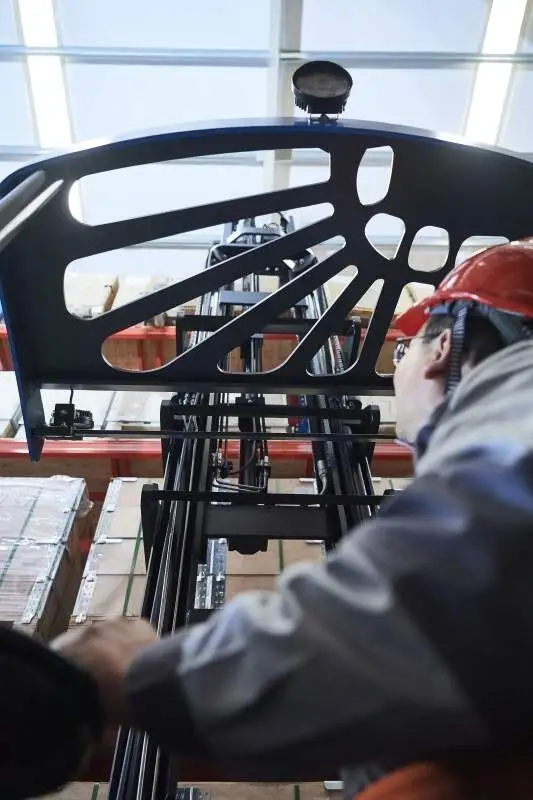
Unterscheidung zwischen vorwärts fahrenden und fußläufig stapelbaren Lithium-Batterie-Speicher-Gabelstaplern(Figur1)

In der Kategorie der Lithium-Ionen-Lagergabelstapler sind Schubmaststapler und Schrittstapler zwei weit verbreitete Geräte. Viele Unternehmen verwechseln bei der Auswahl von Modellen oft die Anwendungsszenarien und die funktionale Positionierung der beiden. Die Klärung der wichtigsten Unterscheidungspunkte zwischen den beiden kann Unternehmen dabei helfen, die Anforderungen des Lagerbetriebs genau zu erfüllen und die betriebliche Effizienz zu verbessern.

Unterschiede in der Kernstruktur und den Betriebsmethoden

Strukturelle Merkmale eines Reach-Lithium-Batterie-Speicher-Gabelstaplers

Der vorwärts fahrende Lithium-Batterie-Speicher-Gabelstapler ist mit einer einziehbaren Türrahmenstruktur ausgestattet, die um eine gewisse Strecke nach vorne verlängert werden kann, was für tiefe Gabeln bequem ist, um Waren aufzunehmen und zu platzieren. Der Bediener verfügt über eine unabhängige geschlossene oder offene Kabine, die während des Betriebs mit dem Gabelstapler bewegt werden kann. Er hat ein gutes Sichtfeld und kann sich an höhere Anforderungen an den Regalbetrieb anpassen. Das Gerät hat ein relativ großes Eigengewicht und eine hohe Stabilität, so dass auch schwerere Güter transportiert werden können.

Strukturelle Merkmale eines stapelbaren Lithium-Batterie-Gabelstaplers

Die Türrahmenhöhe des stapelbaren Lithiumbatterie-Speichergabelstaplers ist relativ niedrig und die Struktur ist kompakter. Der Bediener muss dem Gabelstapler zu Fuß folgen und die Ausrüstung vorwärts und rückwärts steuern und durch den flexibleren Griff heben. Das Gerät hat ein geringes Gewicht und einen kleinen Wenderadius, der sich für das Pendeln in engen Passagen eignet, und konzentriert sich mehr auf den Frachtumschlag und das Stapeln in kleinem Maßstab.

Anpassungsunterschiede für Arbeitsplatzszenarien

Anwendungsszenarien von Reichweiten-Gabelstaplern

Lithium-Batterie-Speicherstapler eignen sich besser für die Lagerung auf hoher Ebene in großen Lagerzentren oder E-Commerce-Lagern. Sie können Regalhöhen von mehr als 8 Metern bewältigen und sind effizienter bei der Handhabung von Palettenwaren in Chargen. Gleichzeitig können sie in Szenarien für den Gütertransport über große Entfernungen die körperliche Anstrengung des Bedieners verringern und die Gesamtbetriebsgeschwindigkeit verbessern.

Anwendungsszenarien von Stapelstaplern zum Gehen

Der zu Fuß stapelnde Lithium-Batterie-Speicher-Gabelstapler eignet sich für Szenen mit begrenztem Platz wie kleine Lagerhäuser und Back-End-Lager in Convenience Stores, insbesondere in Bereichen mit einer Kanalbreite von weniger als 2 Metern. Seine flexible Lenkfähigkeit kann seine Vorteile voll ausspielen. Darüber hinaus kann die Flexibilität der Ausrüstung bei der Kommissionierung von losen Waren und beim Stapeln von Kleinserien den Anforderungen präziser Vorgänge besser gerecht werden.

Wichtige Überlegungen zur Typenauswahl

Stauraum und Regalhöhe

Wenn die Höhe des Lagerregals mehr als 6 Meter beträgt und der Arbeitskanal relativ geräumig ist, wird ein vorwärts fahrender Lithiumbatterie-Lagergabelstapler bevorzugt; wenn die Regalhöhe weniger als 4 Meter beträgt und der Kanal schmal ist, ist ein laufender Stapelstapler die bessere Wahl.

Arbeitsbelastung und Handhabungsabstand

In Szenarien mit hoher täglicher Arbeitsbelastung und langen Abfertigungsstrecken können Reichweiten-Gabelstapler die Betriebseffizienz verbessern und die Arbeitskosten senken, während für Kleinserien und Kurzstrecken-Kommissioniervorgänge die Flexibilität von zu Fuß stapelbaren Gabelstaplern vorteilhafter ist.

Arbeitskosten und Betriebsschwellen

Walking Stacking Gabelstapler sind einfach zu bedienen und ermöglichen den Bedienern einen schnellen Einstieg ohne professionelle Ausbildung bei geringen Arbeitskosten. Reach-Gabelstapler erfordern von den Bedienern bestimmte berufliche Fähigkeiten, und die Ausbildungskosten sind relativ hoch, was sie für Unternehmen mit einem stabilen Betriebsteam geeignet macht.

Insgesamt müssen die Unternehmen ihren eigenen Lagerraum, ihren Betriebsbedarf und ihre Arbeitskräfte kombinieren, um die Eigenschaften der beiden Gerätetypen vernünftig zu unterscheiden und den am besten geeigneten Lithiumbatterie-Gabelstapler auszuwählen.

We use cookie to improve your online experience. By continuing to browse this website, you agree to our use of cookie.

Cookies

Please read our Terms and Conditions and this Policy before accessing or using our Services. If you cannot agree with this Policy or the Terms and Conditions, please do not access or use our Services. If you are located in a jurisdiction outside the European Economic Area, by using our Services, you accept the Terms and Conditions and accept our privacy practices described in this Policy.
We may modify this Policy at any time, without prior notice, and changes may apply to any Personal Information we already hold about you, as well as any new Personal Information collected after the Policy is modified. If we make changes, we will notify you by revising the date at the top of this Policy. We will provide you with advanced notice if we make any material changes to how we collect, use or disclose your Personal Information that impact your rights under this Policy. If you are located in a jurisdiction other than the European Economic Area, the United Kingdom or Switzerland (collectively “European Countries”), your continued access or use of our Services after receiving the notice of changes, constitutes your acknowledgement that you accept the updated Policy. In addition, we may provide you with real time disclosures or additional information about the Personal Information handling practices of specific parts of our Services. Such notices may supplement this Policy or provide you with additional choices about how we process your Personal Information.


Cookies

Cookies are small text files stored on your device when you access most Websites on the internet or open certain emails. Among other things, Cookies allow a Website to recognize your device and remember if you've been to the Website before. Examples of information collected by Cookies include your browser type and the address of the Website from which you arrived at our Website as well as IP address and clickstream behavior (that is the pages you view and the links you click).We use the term cookie to refer to Cookies and technologies that perform a similar function to Cookies (e.g., tags, pixels, web beacons, etc.). Cookies can be read by the originating Website on each subsequent visit and by any other Website that recognizes the cookie. The Website uses Cookies in order to make the Website easier to use, to support a better user experience, including the provision of information and functionality to you, as well as to provide us with information about how the Website is used so that we can make sure it is as up to date, relevant, and error free as we can. Cookies on the Website We use Cookies to personalize your experience when you visit the Site, uniquely identify your computer for security purposes, and enable us and our third-party service providers to serve ads on our behalf across the internet.

We classify Cookies in the following categories:
 ●  Strictly Necessary Cookies
 ●  Performance Cookies
 ●  Functional Cookies
 ●  Targeting Cookies


Cookie List
A cookie is a small piece of data (text file) that a website – when visited by a user – asks your browser to store on your device in order to remember information about you, such as your language preference or login information. Those cookies are set by us and called first-party cookies. We also use third-party cookies – which are cookies from a domain different than the domain of the website you are visiting – for our advertising and marketing efforts. More specifically, we use cookies and other tracking technologies for the following purposes:

Strictly Necessary Cookies
These cookies are necessary for the website to function and cannot be switched off in our systems. They are usually only set in response to actions made by you which amount to a request for services, such as setting your privacy preferences, logging in or filling in forms. You can set your browser to block or alert you about these cookies, but some parts of the site will not then work. These cookies do not store any personally identifiable information.

Functional Cookies
These cookies enable the website to provide enhanced functionality and personalisation. They may be set by us or by third party providers whose services we have added to our pages. If you do not allow these cookies then some or all of these services may not function properly.

Performance Cookies
These cookies allow us to count visits and traffic sources so we can measure and improve the performance of our site. They help us to know which pages are the most and least popular and see how visitors move around the site. All information these cookies collect is aggregated and therefore anonymous. If you do not allow these cookies we will not know when you have visited our site, and will not be able to monitor its performance.

Targeting Cookies
These cookies may be set through our site by our advertising partners. They may be used by those companies to build a profile of your interests and show you relevant adverts on other sites. They do not store directly personal information, but are based on uniquely identifying your browser and internet device. If you do not allow these cookies, you will experience less targeted advertising.

How To Turn Off Cookies
You can choose to restrict or block Cookies through your browser settings at any time. Please note that certain Cookies may be set as soon as you visit the Website, but you can remove them using your browser settings. However, please be aware that restricting or blocking Cookies set on the Website may impact the functionality or performance of the Website or prevent you from using certain services provided through the Website. It will also affect our ability to update the Website to cater for user preferences and improve performance. Cookies within Mobile Applications

We only use Strictly Necessary Cookies on our mobile applications. These Cookies are critical to the functionality of our applications, so if you block or delete these Cookies you may not be able to use the application. These Cookies are not shared with any other application on your mobile device. We never use the Cookies from the mobile application to store personal information about you.

If you have questions or concerns regarding any information in this Privacy Policy, please contact us by email at . You can also contact us via our customer service at our Site.