
 简体中文
简体中文 繁体中文
繁体中文 Deutsch
 日本語
日本語 한국어
한국어 Tiếng Việt
 Русский
 ไทย
ไทย Bahasa Indonesia
 Bahasa Melayu
 Filipino
 لالعربية
 Français

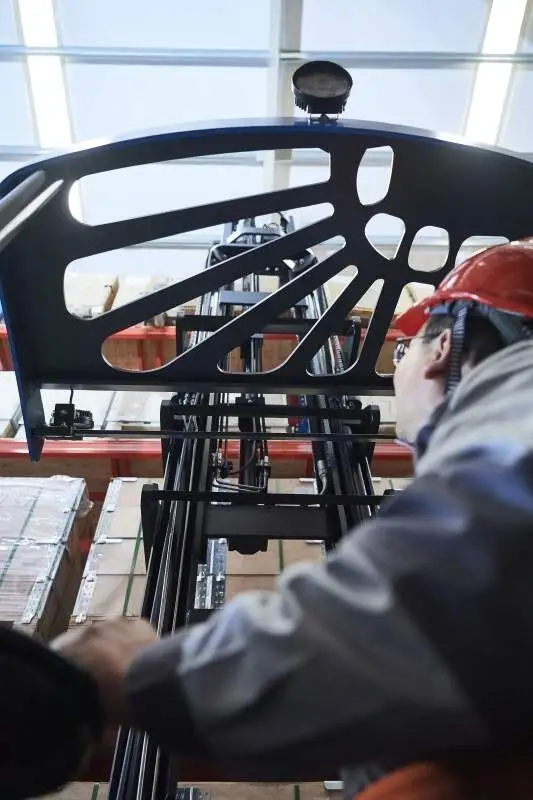
In the category of lithium-ion storage forklifts, reach and walking stacking forklifts are two widely used equipment. Many companies often confuse the application scenarios and functional positioning of the two when selecting models. Clarifying the key points of distinction between the two can help companies accurately match the needs of warehousing operations and improve operational efficiency.
Differences in core structure and operation methods
Structural Characteristics of Reach Lithium Battery Storage Forklift
The forward-moving lithium battery storage forklift is equipped with a retractable door frame structure, which can be extended forward a certain distance, which is convenient for deep forks to pick up and place goods. The operator has an independent closed or open cab, which can be moved with the forklift during operation. It has a good field of vision and can adapt to higher shelf operation requirements. The equipment has relatively large self-weight and strong stability, which can carry heavier goods.
Structural Characteristics of Walking Stacking Lithium Battery Storage Forklift
The door frame height of the walking stacking lithium battery storage forklift is relatively low and the structure is more compact. The operator needs to follow the forklift on foot, and control the equipment forward, backward and lift through the handle, which is more flexible. The equipment has a light weight and a small turning radius, which is suitable for shuttling in narrow passages, and focuses more on small-scale cargo handling and stacking.
Adaptation differences for job scenarios
Application scenarios of reach forklifts
Reach lithium battery storage forklifts are more suitable for high-level storage operations in large storage centers or e-commerce warehouses. They can handle shelf heights of more than 8 meters and are more efficient in handling pallet goods in batches. At the same time, in long-distance cargo transfer scenarios, it can reduce the operator's physical exertion and improve the overall operation speed.
Application scenarios of walking stacking forklifts
The walking stacking lithium battery storage forklift is suitable for scenes with limited space such as small warehouses and back-end storage in convenience stores, especially in areas with a channel width of less than 2 meters. Its flexible steering ability can give full play to its advantages. In addition, in the picking of loose goods and small batch stacking operations, the flexibility of the equipment can better meet the needs of precise operations.
Key considerations for type selection
Storage space and shelf height
If the height of the warehouse shelf is more than 6 meters and the working channel is relatively spacious, a forward-moving lithium battery storage forklift is preferred; if the shelf height is less than 4 meters and the channel is narrow, a walking stacking forklift is a more suitable choice.
workload and handling distance
In scenarios with large daily workloads and long handling distances, reach forklifts can improve operation efficiency and reduce labor costs; while for small-batch, short-distance picking operations, the flexibility of walking stacking forklifts is more advantageous.
Labor costs and operating thresholds
Walking stacking forklifts are easy to operate, allowing operators to get started quickly without professional training, with low labor input costs. Reach forklifts require operators to have certain professional skills, and the training cost is relatively high, making them suitable for enterprises with a stable operation team.
Overall, enterprises need to combine their own storage space, operating requirements, and manpower to reasonably distinguish the characteristics of the two types of equipment and choose the most suitable lithium battery storage forklift.


