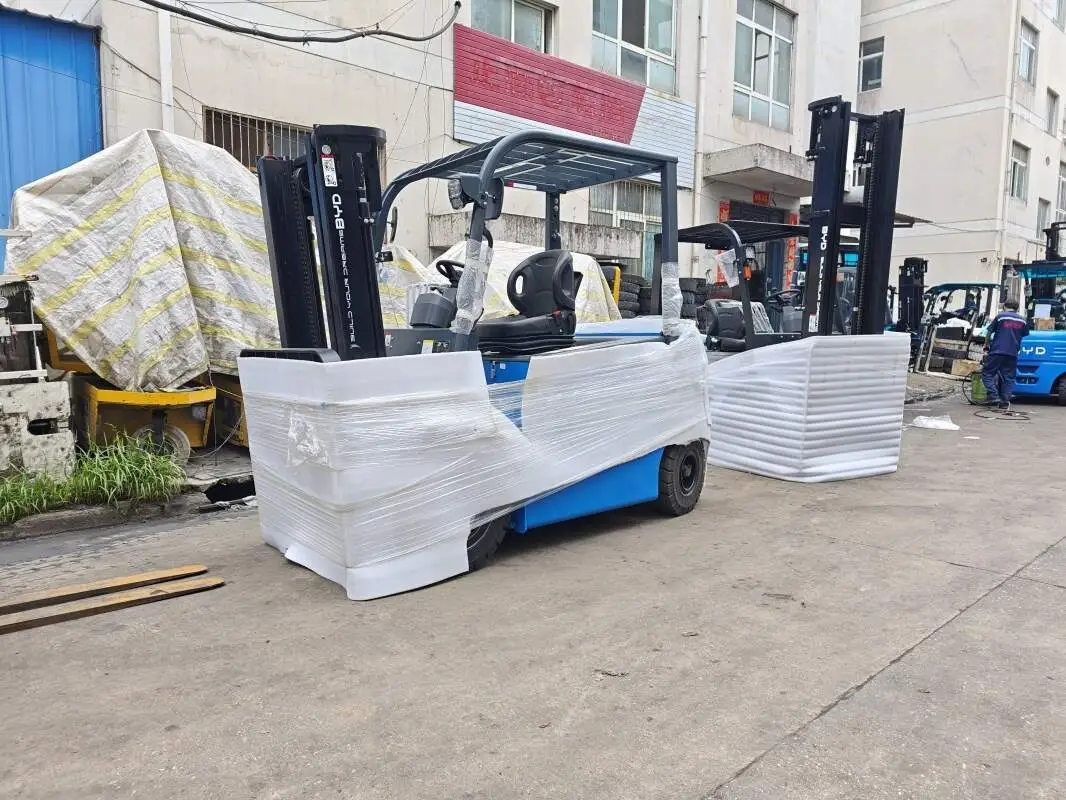
Lithium-Gabelstapler-Schnelllade- und Leistungswechselmodus, geeignet für die unterbrechungsfreie Handhabung im Lager

2026-06-30

Lithium-Gabelstapler-Schnelllade- und Leistungswechselmodus, geeignet für die unterbrechungsfreie Handhabung im Lager(Figur1)

Im Bereich der Lagerhaltung und Logistik ist der ununterbrochene Umschlag von Lagern ein wichtiges Bindeglied, um den effizienten Betrieb der Lieferkette zu gewährleisten, und Gabelstapler als zentrale Umschlaggeräte haben einen direkten Einfluss auf die Kontinuität des Betriebs. Lithium-Ionen-Gabelstapler haben sich aufgrund ihrer umweltfreundlichen und effizienten Eigenschaften zum Mainstream entwickelt, und der Schnelllade- und Stromwechselmodus hat sich als Anpassungsplan für die ununterbrochenen Umschlagsanforderungen von Lagern erwiesen.

Die Kernanforderung der ununterbrochenen Lagerabwicklung

Anforderungen an den Dauerbetrieb bei hoher Belastung

Die tägliche Abwicklung von Lagern umfasst oft mehrere Glieder wie den Warenumschlag und die Auftragssortierung, die einen langen Dauerbetrieb der Gabelstapler erfordern. Der herkömmliche Modus der Energienachfüllung hat das Problem, dass der Energieverbrauch über einen langen Zeitraum nachgefüllt wird, was leicht zu einer Betriebsunterbrechung führen kann und nicht mit dem kontinuierlichen Betriebsrhythmus bei hoher Belastung übereinstimmt.

Das Arbeitstempo ist hoch

Die Betriebszeit im Lager ist eng mit der Pünktlichkeit der Bestellung verbunden. Von der Einlagerung der Waren über die Sortierung bis hin zum Ausgang sind alle Verbindungen miteinander verbunden. Der Nachschubprozess muss so weit wie möglich komprimiert werden, um Ausfallzeiten der Ausrüstung zu vermeiden, die den gesamten Betriebsprozess beeinträchtigen und die Liefereffizienz der Bestellungen verlangsamen.

Anpassungslogik des Schnelllade-Schaltmodus eines Lithium-Batterie-Gabelstaplers

Effizienz der Energienachfüllung entspricht dem Rhythmus der Hausaufgaben

Der Schnelllademodus kann den Gabelstapler in kurzer Zeit mit ausreichender Leistung nachfüllen, und der Energieaustauschmodus kann das schnelle Umschalten der Batterie realisieren. Die Kombination der beiden Modi ermöglicht es dem Gabelstapler, lange anzuhalten und auf Nachschub zu warten. Der Gabelstapler kann die Arbeitslücke nutzen, um den Nachschub abzuschließen, wodurch die Kontinuität des Betriebs effektiv gewährleistet und sich an die Bedürfnisse des Lagers für eine ununterbrochene Handhabung angepasst wird.

Starke Anpassungsfähigkeit der Szene

Im Lager kann ein spezieller Stromaustauschbereich oder eine Schnellladestation geplant werden, und das rationelle Layout wird mit der Betriebsroute kombiniert, die nicht zu viel Lagerraum beansprucht oder die normale Entwicklung anderer Betriebsverbindungen beeinträchtigt. Unabhängig davon, ob es sich um ein großes Lagerzentrum oder ein kleines und mittelgroßes Lager handelt, kann es das Layout an seine eigene Situation anpassen, um die Koordination von zusätzlicher Energie und Betrieb zu erreichen.

Praktische Punkte zur Gewährleistung einer unterbrechungsfreien Handhabung im Schnelllade- und Stromaustauschmodus

Rationale Planung von Energierückfüllungspunkten

Je nach Verteilung des Lagerbetriebsbereichs und der täglichen Fahrroute des Gabelstaplers wird eine angemessene Anzahl von Schnellladesäulen oder Kraftwerken aufgestellt, um sicherzustellen, dass der Gabelstapler den Nachschubpunkt während der Betriebslücke schnell erreichen kann, wodurch die Fahrzeit verkürzt und die Nachschubeffizienz verbessert wird.

Einrichtung eines Batteriemanagementmechanismus

Führen Sie die tägliche Wartung und Stromüberwachung der Ersatzbatterie durch und überprüfen Sie regelmäßig den Leistungsstatus der Batterie, um sicherzustellen, dass sich die Batterie beim Stromwechsel in einem guten nutzbaren Zustand befindet, um eine Betriebsunterbrechung aufgrund eines Batterieausfalls zu vermeiden.

Schulung zur Spezifikation des Personalbetriebs

Organisieren Sie Gabelstaplerfahrer, um den Standardprozess des Schnellladens und der Leistungsänderung zu erlernen, sich mit den wichtigsten Punkten des Gerätebetriebs vertraut zu machen, die Zeit des zusätzlichen Betriebs zu verkürzen, die Kontinuität des Betriebs weiter zu verbessern und die reibungslose Umsetzung der ununterbrochenen Handhabung zu gewährleisten.

Der Schnelllade- und Austauschmodus des Lithium-Ionen-Gabelstaplers löst effektiv das Problem der Betriebsunterbrechung im traditionellen Nachschubmodus, indem er die Effizienz der Energienachfüllung optimiert und sich an die Betriebsszene des Lagers anpasst, und bietet dem Lager zuverlässige Unterstützung, um eine unterbrechungsfreie Handhabung zu realisieren. In der gegenwärtigen Ära steigender Effizienzanforderungen in der Lagerhaltung und Logistik wird dieser Modus zu einer wichtigen Richtung für die Nachfüllung von Lager- und Umschlaggeräten und hilft Unternehmen, die allgemeine Betriebseffizienz zu verbessern.

We use cookie to improve your online experience. By continuing to browse this website, you agree to our use of cookie.

Cookies

Please read our Terms and Conditions and this Policy before accessing or using our Services. If you cannot agree with this Policy or the Terms and Conditions, please do not access or use our Services. If you are located in a jurisdiction outside the European Economic Area, by using our Services, you accept the Terms and Conditions and accept our privacy practices described in this Policy.
We may modify this Policy at any time, without prior notice, and changes may apply to any Personal Information we already hold about you, as well as any new Personal Information collected after the Policy is modified. If we make changes, we will notify you by revising the date at the top of this Policy. We will provide you with advanced notice if we make any material changes to how we collect, use or disclose your Personal Information that impact your rights under this Policy. If you are located in a jurisdiction other than the European Economic Area, the United Kingdom or Switzerland (collectively “European Countries”), your continued access or use of our Services after receiving the notice of changes, constitutes your acknowledgement that you accept the updated Policy. In addition, we may provide you with real time disclosures or additional information about the Personal Information handling practices of specific parts of our Services. Such notices may supplement this Policy or provide you with additional choices about how we process your Personal Information.


Cookies

Cookies are small text files stored on your device when you access most Websites on the internet or open certain emails. Among other things, Cookies allow a Website to recognize your device and remember if you've been to the Website before. Examples of information collected by Cookies include your browser type and the address of the Website from which you arrived at our Website as well as IP address and clickstream behavior (that is the pages you view and the links you click).We use the term cookie to refer to Cookies and technologies that perform a similar function to Cookies (e.g., tags, pixels, web beacons, etc.). Cookies can be read by the originating Website on each subsequent visit and by any other Website that recognizes the cookie. The Website uses Cookies in order to make the Website easier to use, to support a better user experience, including the provision of information and functionality to you, as well as to provide us with information about how the Website is used so that we can make sure it is as up to date, relevant, and error free as we can. Cookies on the Website We use Cookies to personalize your experience when you visit the Site, uniquely identify your computer for security purposes, and enable us and our third-party service providers to serve ads on our behalf across the internet.

We classify Cookies in the following categories:
 ●  Strictly Necessary Cookies
 ●  Performance Cookies
 ●  Functional Cookies
 ●  Targeting Cookies


Cookie List
A cookie is a small piece of data (text file) that a website – when visited by a user – asks your browser to store on your device in order to remember information about you, such as your language preference or login information. Those cookies are set by us and called first-party cookies. We also use third-party cookies – which are cookies from a domain different than the domain of the website you are visiting – for our advertising and marketing efforts. More specifically, we use cookies and other tracking technologies for the following purposes:

Strictly Necessary Cookies
These cookies are necessary for the website to function and cannot be switched off in our systems. They are usually only set in response to actions made by you which amount to a request for services, such as setting your privacy preferences, logging in or filling in forms. You can set your browser to block or alert you about these cookies, but some parts of the site will not then work. These cookies do not store any personally identifiable information.

Functional Cookies
These cookies enable the website to provide enhanced functionality and personalisation. They may be set by us or by third party providers whose services we have added to our pages. If you do not allow these cookies then some or all of these services may not function properly.

Performance Cookies
These cookies allow us to count visits and traffic sources so we can measure and improve the performance of our site. They help us to know which pages are the most and least popular and see how visitors move around the site. All information these cookies collect is aggregated and therefore anonymous. If you do not allow these cookies we will not know when you have visited our site, and will not be able to monitor its performance.

Targeting Cookies
These cookies may be set through our site by our advertising partners. They may be used by those companies to build a profile of your interests and show you relevant adverts on other sites. They do not store directly personal information, but are based on uniquely identifying your browser and internet device. If you do not allow these cookies, you will experience less targeted advertising.

How To Turn Off Cookies
You can choose to restrict or block Cookies through your browser settings at any time. Please note that certain Cookies may be set as soon as you visit the Website, but you can remove them using your browser settings. However, please be aware that restricting or blocking Cookies set on the Website may impact the functionality or performance of the Website or prevent you from using certain services provided through the Website. It will also affect our ability to update the Website to cater for user preferences and improve performance. Cookies within Mobile Applications

We only use Strictly Necessary Cookies on our mobile applications. These Cookies are critical to the functionality of our applications, so if you block or delete these Cookies you may not be able to use the application. These Cookies are not shared with any other application on your mobile device. We never use the Cookies from the mobile application to store personal information about you.

If you have questions or concerns regarding any information in this Privacy Policy, please contact us by email at . You can also contact us via our customer service at our Site.