
 简体中文
简体中文 繁体中文
繁体中文 Deutsch
 日本語
日本語 한국어
한국어 Tiếng Việt
 Русский
 ไทย
ไทย Bahasa Indonesia
 Bahasa Melayu
 Filipino
 لالعربية
 Français

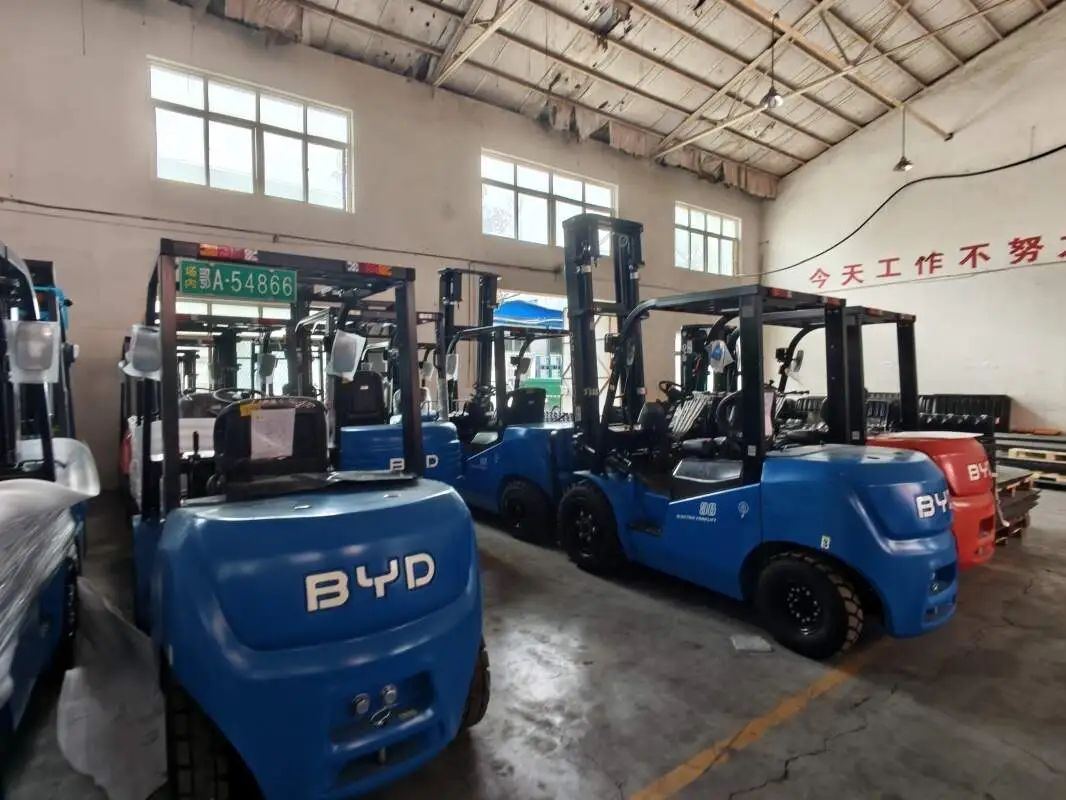
With the intelligent development of the logistics and warehousing industry, lithium-ion forklifts have become the mainstream of the market due to their environmentally friendly and efficient advantages. The quotation and procurement factors of BYD lithium-ion forklifts have attracted much attention.
There are reasonable differences in the market quotation of BYD lithium-ion forklifts. The counterbalanced lithium-ion forklift has a strong bearing capacity and can adapt to a variety of scenarios such as outdoor heavy cargo handling. The quotation range is relatively high; the pallet-type lithium-ion forklift focuses on short-distance light-load handling, which is mostly used for indoor warehousing operations. The quotation range is more close to the people. At the same time, external factors such as changes in market supply and demand and fluctuations in raw material prices will lead to slight fluctuations in quotations. When purchasing, you need to pay attention to real-time market dynamics.
There are many core factors that affect the procurement of BYD lithium battery forklifts. In terms of configuration parameters, battery capacity, load-bearing weight, lifting height, etc. directly affect the quotation. Large-capacity batteries are suitable for long-term operation needs, and the corresponding quotation is higher. Higher load-bearing weight and lifting height will also improve price positioning. In terms of usage scenarios, indoor warehousing values flexibility and low noise, and outdoor operations need strong waterproofing and anti-interference capabilities. Different scene-adapted forklift configurations have different procurement costs. In terms of after-sales services, although quality assurance period, maintenance network distribution, and parts supply efficiency are not directly reflected in the quotation, they will affect subsequent use costs and need to be comprehensively evaluated. In addition, enterprises can usually obtain a certain bargaining space for bulk procurement, and the larger the procurement scale, the lower the unit cost, which is also an important factor affecting the final procurement cost.
When purchasing, enterprises need to consider various factors such as job requirements, budget scope, etc., comprehensively consider the matching degree of quotation with product performance and service, and select the equipment that suits their own needs.


