
 简体中文
简体中文 繁体中文
繁体中文 Deutsch
 日本語
日本語 한국어
한국어 Tiếng Việt
 Русский
 ไทย
ไทย Bahasa Indonesia
 Bahasa Melayu
 Filipino
 لالعربية
 Français

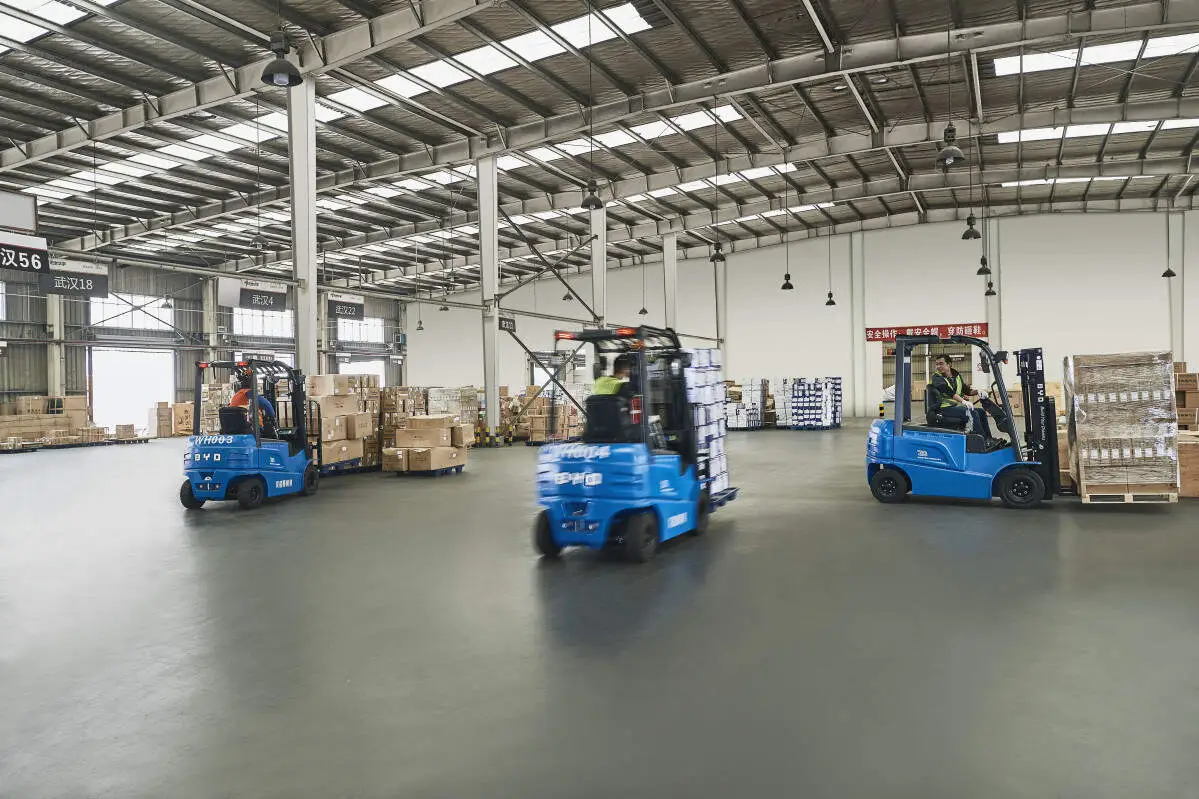
With the continuous improvement of storage space utilization requirements, narrow-channel operation scenarios are becoming more and more common. Reach lithium-ion forklifts have become common equipment in such scenarios by virtue of their own characteristics. This article will analyze the practical points in narrow-channel operations from multiple dimensions to help practitioners better carry out their operations.
The core adaptation advantages of narrow channel operations
The core challenge of narrow passages lies in space limitations, and the body structure design of the forward-moving lithium-ion forklift is more suitable for such scenarios. Its compact body size, combined with a small turning radius, can complete steering and U-turns in limited passages without reserving too much extra space. At the same time, the door frame forward design can realize the front and rear expansion of the fork without moving the body, further reducing the lateral space required for operation, and adapting to the shelf access requirements in narrow passages.
Key points of operation skills for narrow channel operations
When working in narrow aisles, operation accuracy is crucial. First, the starting and steering speed needs to be controlled to avoid collisions caused by too fast, especially when close to shelves or obstacles, low speed mode should be used to ensure stable operation. Second, when the fork is aligned, the auxiliary aiming device of the vehicle needs to be used to slowly adjust the position to ensure that the fork is accurately inserted into the tray fork hole to avoid scratching the shelf or goods. In addition, during the lifting of goods, it is necessary to keep the goods stable and avoid the goods falling or the vehicle being offset due to shaking.
Daily maintenance to ensure smooth operation
In order to ensure the smooth operation of the narrow aisle, daily maintenance cannot be ignored. Regularly check the steering system of the vehicle to ensure that the steering is flexible and card-free, so as to avoid steering failure in the narrow aisle. At the same time, pay attention to the battery status to ensure that the power is sufficient to avoid power failure in the middle of the operation affecting the efficiency. In addition, the lubrication of the fork and the door frame also needs to be carried out regularly to ensure the smooth operation of the telescopic and lifting, and reduce the operation interruption caused by mechanical failure.
Practical strategies for improving efficiency
In narrow channel operations, efficiency improvement can start from the details. Rationally plan the operation route to reduce unnecessary back and forth movement, optimize the pickup sequence according to the storage location of the goods, and improve the cargo handling volume of a single operation. At the same time, take advantage of the fast charging characteristics of lithium-ion forklifts to rationally arrange the charging time to avoid delaying the operation progress due to waiting for charging. In addition, regular training of operators to improve their operation proficiency is also the key to improving the overall operation efficiency.
Reach-type lithium-ion forklifts have many advantages in narrow-channel operations, but only by mastering the correct operation methods and maintenance skills can they give full play to their performance and improve the efficiency and space utilization of warehousing operations while ensuring the safety of operations.


