
 简体中文
简体中文 繁体中文
繁体中文 Deutsch
 日本語
日本語 한국어
한국어 Tiếng Việt
 Русский
 ไทย
ไทย Bahasa Indonesia
 Bahasa Melayu
 Filipino
 لالعربية
 Français

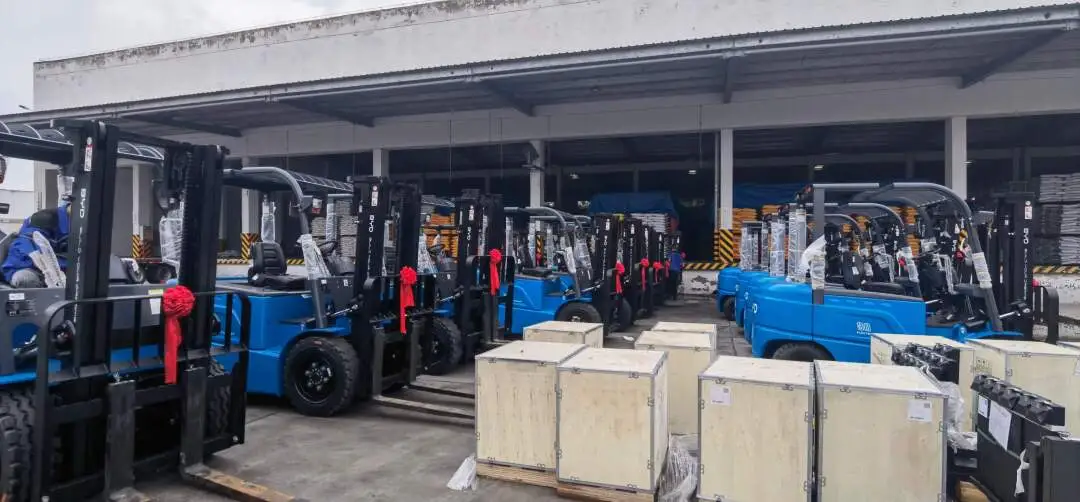
In modern warehousing and logistics and indoor and outdoor short-distance handling scenarios, electric forklifts are widely used due to their zero-emission and low-noise characteristics. Among them, three-point lithium-ion forklifts and four-point forklifts are two common models. Due to their different structures, there are obvious differences in application scenarios. Practitioners can choose according to their own site conditions and operation needs.
First look at the characteristics and application scenarios of three-point lithium forklifts. The body structure of this type of forklift is two driving wheels in front or behind, and one load-bearing wheel is on the other side, forming a triangular support layout as a whole. Its core advantage is that the turning radius is very small, and the turning radius of some models is even close to its own length, which can easily complete steering and cargo handling in a narrow channel. In addition, three-point lithium forklifts are usually small and flexible, with relatively light weight and low pressure on the ground, making them suitable for working on floors or floors with limited load-bearing capacity. However, the triangular support structure also brings certain limitations. For example, when driving at high speed or handling higher cargo, the body stability is slightly lower than that of four-point models, so the load capacity is generally within a small range. Overall, three-point lithium-ion forklifts are more suitable for narrow-channel warehousing, floor operations, and rapid transshipment of light-duty goods, such as shelf replenishment in large supermarkets, equipment and material handling in multi-storey office buildings, and in-workshop turnover in small electronics factories.
Let's take a look at the characteristics and application scenarios of the four-point forklift. This type of forklift adopts a rectangular or quasi-rectangular support layout with four wheels. The two driving wheels are usually located at the front or rear wheels, and the other two are load-bearing wheels or steering wheels. Its biggest advantage is that the body has good stability. Whether it is driving at high speed, making sudden stops and turns, or handling high-weight goods, it can maintain a good balance and is not prone to rollover risks. At the same time, the load capacity of the four-point forklift covers a wider range, from small to medium or even large loads. There are corresponding models available, and some models can also be replaced to expand the operation function. However, the body of the four-point forklift is relatively large, and the turning radius is also much larger than that of the three-point lithium-electric forklift of the same level. It requires a wider working channel to drive smoothly. In addition, four-point forklifts with larger dead weight have higher pressure requirements on the ground and are not suitable for use on the ground with weaker load-bearing capacity. Overall, four-point forklifts are more suitable for large warehouses with wide aisles, open-air freight yards or flat and open outdoor venues, and long-distance transshipment of medium and heavy-duty goods, such as raw materials and finished product warehouses in large manufacturing enterprises, cargo loading and unloading areas in logistics centers, and short-distance handling in large building materials markets.
When selecting an electric forklift, practitioners should first consider the width of the working channel, followed by the load and stack height of the goods. They should also make comprehensive judgments based on factors such as the ground conditions of the work site, the indoor and outdoor environment, and the daily working hours. Only in this way can they choose the most cost-effective model that best suits their own needs.


