
 简体中文
简体中文 繁体中文
繁体中文 Deutsch
 日本語
日本語 한국어
한국어 Tiếng Việt
 Русский
 ไทย
ไทย Bahasa Indonesia
 Bahasa Melayu
 Filipino
 لالعربية
 Français

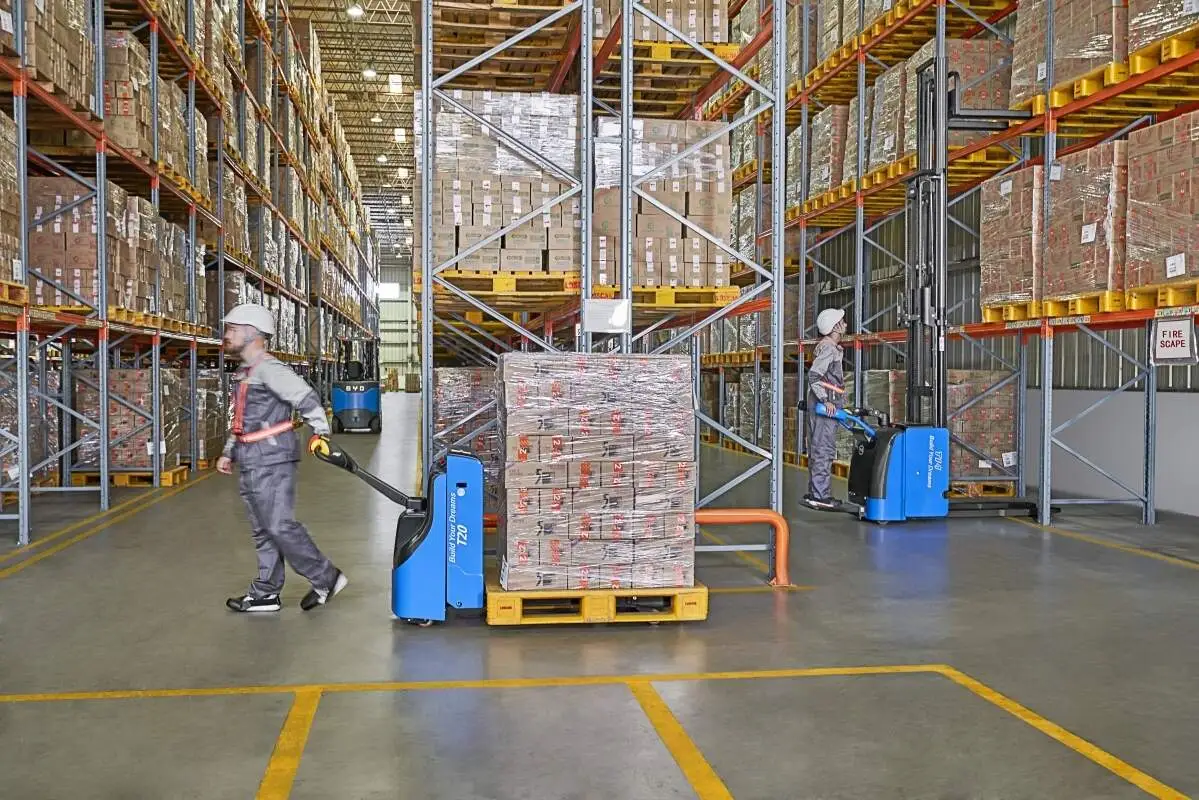
With the development of e-commerce, cold chain front warehouses, parts storage and other formats, more and more warehouses have begun to increase storage density through compression channel width, which puts forward higher requirements for the adaptability of storage operation equipment. Three-point lithium-ion forklifts have become a common choice for such scenarios due to their small body and small turning radius, but to really choose the right model, it is also necessary to consider various practical needs.
First of all, it is necessary to clarify the specific parameters of the narrow channel, which is the core premise of selection. What needs to be measured is the net width and clearance height of the right-angle stacking channel, rather than just looking at the marked width of the channel. The net width refers to the minimum distance between the inside of the shelf column. When selecting, sufficient safety clearance should be reserved to avoid scratches between the body and the shelf. Generally speaking, the net channel width of the right-angle stacking corresponding to a suitable three-point lithium electric forklift will be slightly larger than the minimum turning radius when it is fully loaded and the unilateral reservation of the goods beyond the fork. The clearance height should be determined in combination with the lifting height commonly used in warehouses and the safe distance from the goods to the top facilities to ensure that the forklift will not encounter fire sprinklers, lighting fixtures, etc. when lifting the goods.
Secondly, we must consider the daily load-bearing and operation requirements. The load-bearing requirements should not only look at the maximum weight of a single handling, but also take into account the volume of commonly handled goods and the load attenuation during stacking. If the goods are lighter but larger, you may need to choose a model with a better view of the gantry, and pay attention to the impact of the size of the goods on the width of the channel. When the stacking height is high, pay attention to the stability of the gantry of the three-point lithium-ion forklift. Priority is given to models equipped with attachments such as side shifters and spacing forks, which can improve the efficiency and safety of the stacking to a certain extent. However, the installation of attachments may have a subtle impact on the carrying capacity, which needs to be confirmed in advance.
Finally, pay attention to the convenience of battery life and maintenance. The battery life of a lithium-ion forklift should be able to cover daily operating shifts. If there is a need for two or three shifts, you can choose a model that supports quick power change to reduce the interruption caused by charging waiting. In terms of maintenance, the status of the motor, battery pack and other core components of the three-point lithium-ion forklift can be viewed through the display screen. You only need to do basic work such as body cleaning and tire inspection every day, and the maintenance cost is relatively low. When selecting, you can focus on the design of ease of operation.


