
 简体中文
简体中文 繁体中文
繁体中文 Deutsch
 日本語
日本語 한국어
한국어 Tiếng Việt
 Русский
 ไทย
ไทย Bahasa Indonesia
 Bahasa Melayu
 Filipino
 لالعربية
 Français

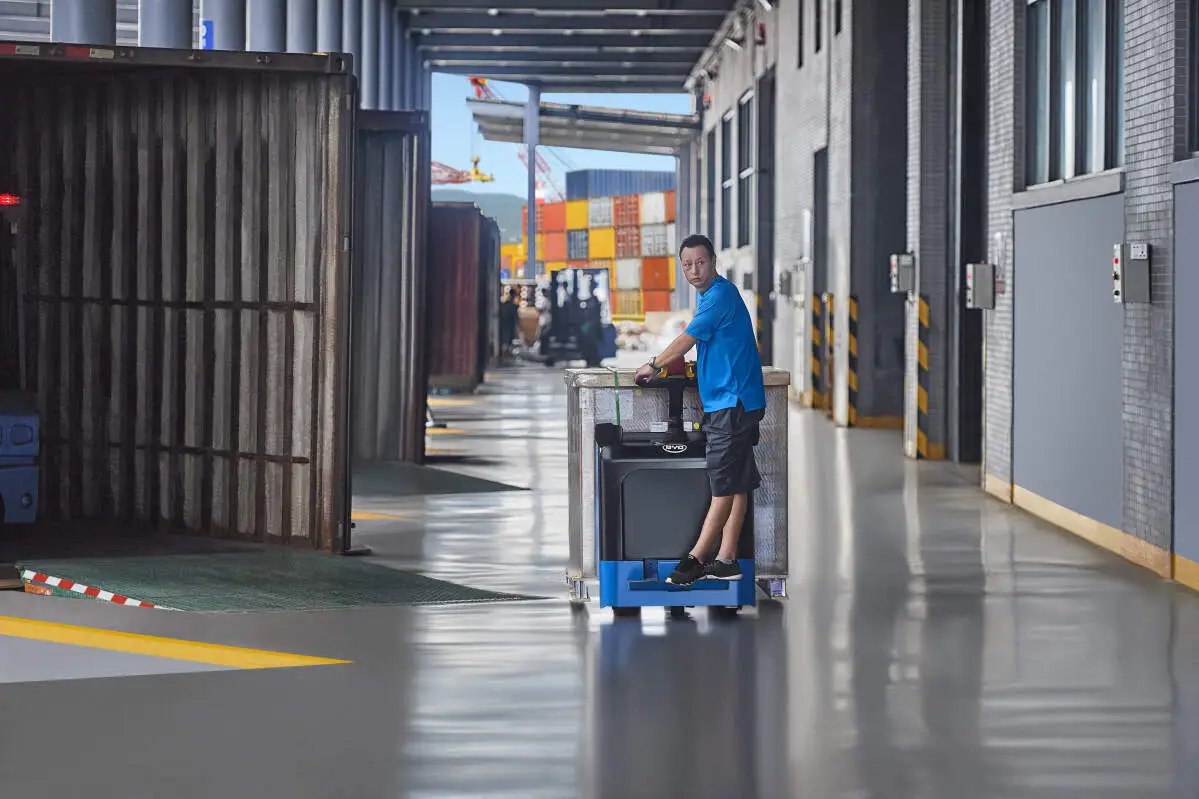
Overview of the basic characteristics of two types of lithium-ion forklifts
The core characteristics of a reach lithium-ion forklift truck
The forward-moving lithium-ion forklift is equipped with a door frame structure that can be moved back and forth. During operation, the door frame can drive the fork forward, and the goods can be accessed without the need to move the whole body. It has better flexibility and operation convenience, and the battery life can meet the single-day operation requirements of most conventional warehouses.
Core characteristics of three-way narrow-channel lithium-ion forklift truck
The fork of the three-way narrow-channel lithium-ion forklift can be rotated and moved laterally, and the cargo can be accessed and stored in a narrow space without steering. The body design is more compact, capable of adapting to narrow storage channels, and has stable high-rise shelf operation capabilities.
depth comparison of applicable scenarios
Storage space adaptation scenario
Reach-type lithium-ion forklifts are suitable for conventional narrow storage spaces with a channel width of 2.5 meters to 3.5 meters. Such spaces are mostly found in ordinary e-commerce warehouses, manufacturing raw material warehouses, etc., without excessive compression of storage spacing. They can balance space utilization and operation convenience.
The three-way narrow channel lithium forklift is designed for ultra-narrow storage space with a channel width of 1.5 meters to 2.5 meters, which is more suitable for high-density three-dimensional warehouses, medical cold chain warehouses, and other scenarios that require extremely high storage density. It can greatly increase the storage capacity per unit area.
Job requirement matching scenario
Reach-type lithium-ion forklifts are more suitable for operating scenarios with frequent pallet handling and medium-height shelf access. This type of operation involves the rapid turnover of goods, and the operating threshold is low. Ordinary operators who have undergone simple training can be competent.
Three-way narrow-channel lithium-ion forklifts are more suitable for precise access operations on high-rise shelves (usually more than 8 meters), suitable for scenes with long storage cycles and strict space utilization requirements, but there are certain requirements for the operator's operating skills. Professional training is required before they can be employed.
Operational efficiency and cost scenarios
From the perspective of operational efficiency, the forward-moving lithium-ion forklift has a faster single-access speed in conventional channels, making it suitable for small and medium-sized cargo turnover; the three-way narrow-channel lithium-ion forklift does not need to be frequently turned in ultra-narrow channels, which can reduce the operation path and improve the overall operation efficiency under high-density warehousing, but the equipment procurement and maintenance costs are relatively high, making it more suitable for enterprises with long-term high-density storage needs.
In summary, when selecting two types of lithium-ion forklifts, enterprises need to consider factors such as the width of their storage channels, the height of shelves, the type of operation, and the cost budget, and choose the appropriate equipment reasonably to improve the overall efficiency of storage operations.


