
 简体中文
简体中文 繁体中文
繁体中文 Deutsch
 日本語
日本語 한국어
한국어 Tiếng Việt
 Русский
 ไทย
ไทย Bahasa Indonesia
 Bahasa Melayu
 Filipino
 لالعربية
 Français

The Core Challenge of Narrow Channel Warehouse Expansion
Furniture industry warehousing often faces the problem of complex categories and large quantities of goods. Many enterprises are limited by the narrow channel width due to early warehouse planning restrictions, and they want to expand their capacity but are limited by limited space. Traditional warehousing equipment has a large turning radius, making it difficult to operate flexibly in narrow channels, and the utilization rate of vertical space is also low, making warehouse expansion a bottleneck and unable to meet the growing storage demand, which has become a pain point for many furniture companies.
Flexible working in tight spaces
In the furniture warehouse in this real shot, the channel width is only two-thirds that of the conventional warehouse, and the conventional equipment can hardly operate smoothly. With its compact body design, the BYD RTR20i stacking equipment can easily complete operations such as in-situ steering and precise alignment in a narrow channel. In the real shot, the equipment smoothly drives into the narrow channel, and the forks are accurately aligned with the solid wood panels on the shelves. The whole process is smooth and card-free, and the operation efficiency is not affected by space restrictions, showing good space adaptation.
Effective improvement of storage utilization
During the actual shooting process, it can be seen that the stacking equipment can achieve a higher working height and fully tap the vertical space potential of the warehouse. The upper shelves that used to be idle due to the limited working height of the equipment are now used to store large goods such as mattresses and fabric sofas, which has increased the storage capacity of the warehouse by nearly 30%. By rationally planning the layout of the upper and lower layers of goods, the originally crowded and messy warehouse has become orderly and orderly, and the expansion effect is intuitive.
Detailed design for furniture storage
In view of the diverse sizes and easy bumping characteristics of furniture goods, the fork design of the stacking equipment has a flexible adjustment range, which can adapt to different sizes of furniture goods. In the real shot, when the equipment forks a large combined wardrobe, the width of the fork is flexibly adjusted according to the size of the goods to ensure that the goods are stably held up and avoid bumping damage during handling. At the same time, the running speed of the equipment can be adjusted according to the weight of the goods to ensure the safety and stability of the large furniture handling process.
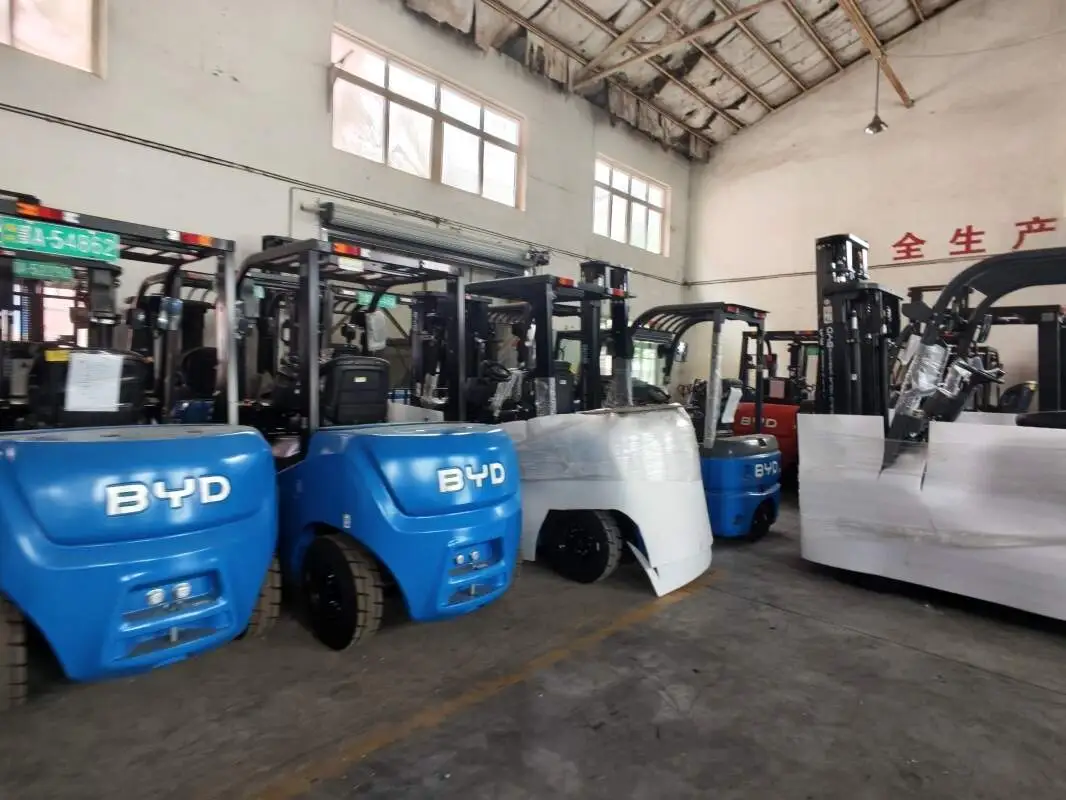
Overall, BYD RTR20i stacking equipment provides a practical solution for the expansion of narrow-channel warehouses in the furniture industry by adapting to narrow-channel space, improving vertical storage utilization, and optimizing furniture adaptation details. This real shot also intuitively demonstrates its practical value in actual warehousing scenarios, providing a reference direction for enterprises with similar needs.


