
 简体中文
简体中文 繁体中文
繁体中文 Deutsch
 日本語
日本語 한국어
한국어 Tiếng Việt
 Русский
 ไทย
ไทย Bahasa Indonesia
 Bahasa Melayu
 Filipino
 لالعربية
 Français

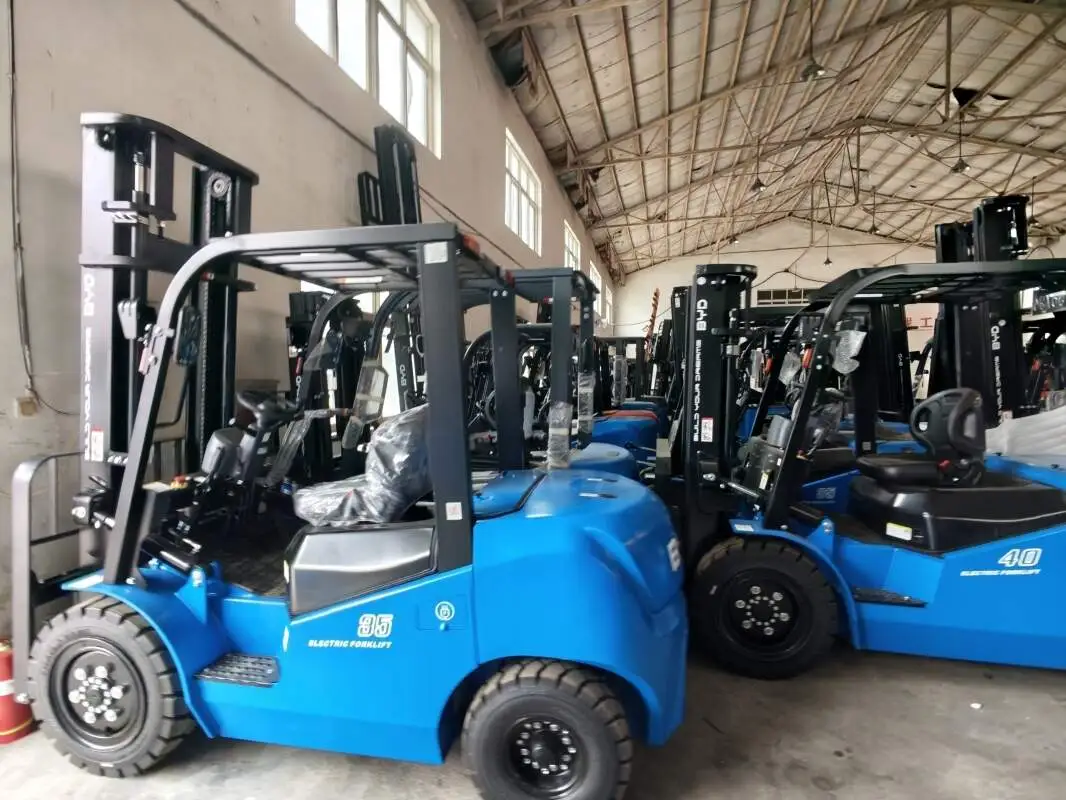
Manufacturing finished product warehousing often faces problems such as high storage density, large channel space occupation, and limited operation efficiency. Especially for finished product warehousing with a wide variety of categories and large batches, how to improve storage capacity and operation efficiency in limited space is a problem that many manufacturing enterprises need to solve urgently. The recently completed finished product intensive warehousing transformation project of a manufacturing enterprise effectively solved this dilemma by introducing the three-way stacking forklift RTR16i.
Warehousing pain points before renovation
Insufficient space utilization. The original storage used ordinary forklift operations, which required a wide passage to be reserved, resulting in scattered shelf layout, a large amount of space was occupied by the passage, and the storage density only reached about 60% of the available space of the site, unable to meet the demand for finished product inventory growth.
The operation efficiency is low. Manual operation of ordinary forklifts to access goods not only requires a long channel turnaround time, but also has the problem of difficulty in accessing high-level shelves, and the average daily operation volume is difficult to match the production and shipment rhythm of enterprises.
Inventory management is difficult. The scattered shelf layout makes it take a long time to take stock and find goods, and it is prone to deviations in inventory data, which affects the accuracy of order delivery.
Adaptation and transformation scheme of three-way stacking forklift
Shelf layout optimization. According to the characteristics of three-way stacking forklifts that can operate in narrow aisles, the layout of storage shelves is re-planned to reduce the width of the aisle from 3.5 meters to 1.8 meters, while increasing the number of shelf layers to make full use of storage vertical space.
Operation process adjustment. Combined with the three-way walking and side-shifting fork picking functions of the forklift, a targeted access process is formulated to clarify the storage area of different categories of finished products, reduce the detour path of cargo handling, and improve the continuity of operations.
Personnel operation training. Organize warehouse operators to participate in forklift operation training to familiarize themselves with the operation specifications and safety precautions of three-way stacking forklifts to ensure that the equipment can be put into use efficiently and safely.
Actual results after landing
The space utilization rate has been significantly improved. After the renovation, the storage capacity of the warehouse has increased by about 45% compared to before. The finished product inventory that originally needed to be expanded to accommodate the warehouse can now be satisfied only by optimizing the layout and upgrading the equipment, saving the cost of site expansion.
The operation efficiency has been greatly improved. The narrow channel operation capability and fast forklift function of the three-way stacking forklift have reduced the single access time by 30% and increased the daily operation volume by 40%, which can better match the shipment needs of enterprises.
The accuracy of inventory management has been improved. Centralized shelf layout and the precise operation of forklifts have improved the accuracy of inventory counting to more than 98%, reducing the problem of order delays caused by inventory deviations.
The Enlightenment of Warehousing Transformation
For the intensive warehousing transformation of finished products in the manufacturing industry, it is not limited to the adjustment of shelf layout. It is also necessary to combine the appropriate warehousing equipment, give full play to the technical advantages of the equipment, and optimize from multiple dimensions such as space utilization, operation process, and personnel operation. At the same time, when selecting warehousing equipment, enterprises should fully consider their own warehousing characteristics and operation needs to ensure that the equipment can be effectively adapted to the existing scene to maximize the transformation benefits.


