
 简体中文
简体中文 繁体中文
繁体中文 Deutsch
 日本語
日本語 한국어
한국어 Tiếng Việt
 Русский
 ไทย
ไทย Bahasa Indonesia
 Bahasa Melayu
 Filipino
 لالعربية
 Français

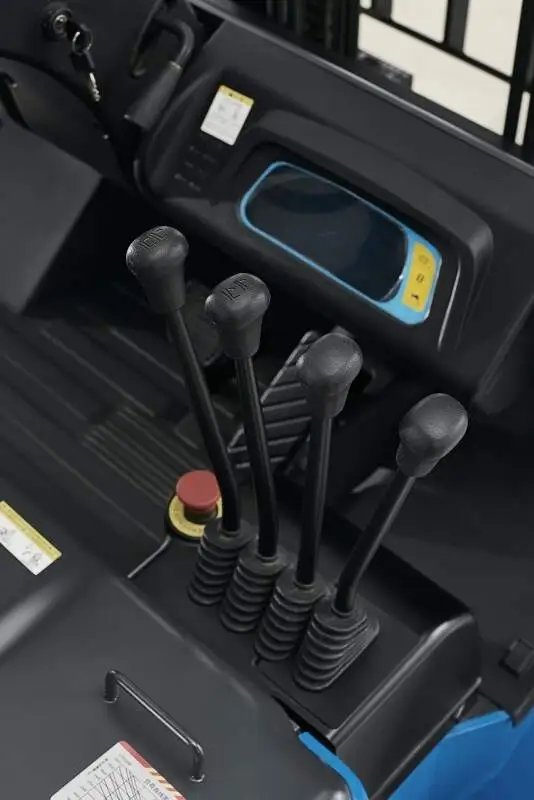
For the long-distance handling of heavy goods by pallet stacking, choosing the right electric forklift is the key to improving operation efficiency and ensuring safety. This article shares practical methods for selecting 5-ton lithium-ion forklifts from multiple core dimensions.
First of all, we should pay attention to the load stability requirements in heavy-duty scenarios. The goods in such scenarios are mostly metal raw materials, large equipment parts, whole chemical raw materials, etc., and the weight of a single support is often close to or even reaches the rated value of 5 tons. When selecting, you can give priority to models with relatively larger wheelbase and wheelbase. The wheelbase can greatly reduce the risk of rollover when driving and turning. The wide wheel base can disperse the bearing pressure to improve the stability during static parking and loading and unloading. At the same time, pay attention to the material and structure of the gantry. It is recommended to choose a reinforced gantry to avoid the deformation and shaking of the gantry when lifted to a high position.
Secondly, it is necessary to match the actual channel conditions at the storage site. The channel width directly determines whether the turning radius of the vehicle is applicable. Generally speaking, the larger the minimum turning radius of a 5-ton lithium battery forklift, the wider the required channel. You can first measure the net width of the main channel and the working channel in the warehouse, and then compare it with the minimum right-angle stacking channel width parameter marked by the vehicle to ensure that the vehicle can pass smoothly and complete the stacking and pickup operation under full load. If the channel space is limited, you can consider choosing a model with a side shifter attachment to assist in fine-tuning the position of the goods and reduce the requirements for the channel width.
In addition, consider the battery life and charging scheme of the battery. The heavy-duty scene has a long operation time and heavy goods, and the power consumption is fast. It is recommended to choose a model with a battery capacity that matches the operation time. Generally, choose the appropriate discharge depth and charging interval according to the average daily operation time. At the same time, pay attention to the charging method. The fast-charging model can use the rest gap to replenish power, which is suitable for continuous operation scenarios with two or three shifts. The slow-charging model is suitable for scenarios with long idle time after a single operation.


