
 简体中文
简体中文 繁体中文
繁体中文 Deutsch
 日本語
日本語 한국어
한국어 Tiếng Việt
 Русский
 ไทย
ไทย Bahasa Indonesia
 Bahasa Melayu
 Filipino
 لالعربية
 Français

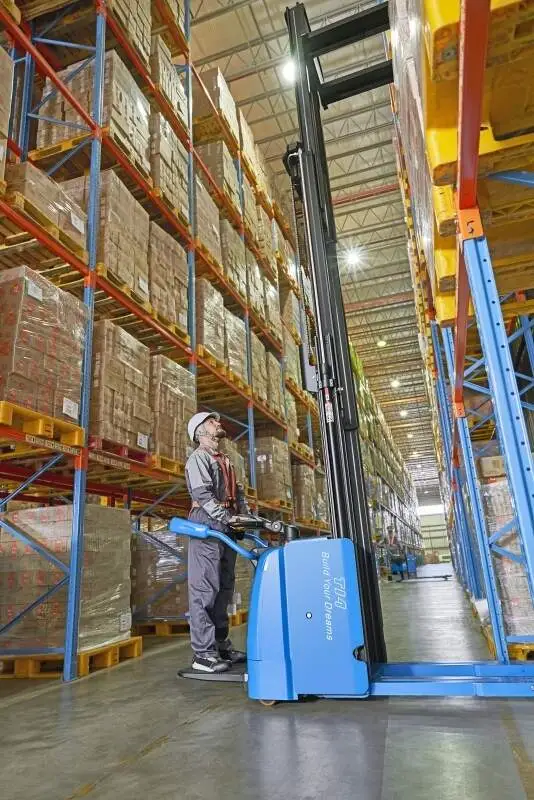
With the development of domestic warehousing and logistics, the demand for small electric handling equipment continues to increase. Among them, ride-on and walk-on forklifts powered by lithium batteries have become a common choice for many small warehouses, e-commerce courier sites, and production workshops due to the characteristics of environmental protection, quiet operation, and flexible operation. Many users easily confuse these two types of equipment when purchasing for the first time. Next, we will sort out their differences from several common dimensions.
The first is the operation mode and space adaptability. Walking small lithium-ion forklifts mainly rely on human assistance to move or the operator follows the body, and controls the driving direction, lifting and braking through the operating handle at the armrest. The structure is compact and compact, and the width of the body is narrow. Generally, it can be adapted to narrower channels, suitable for shuttle operations between dense shelves, or areas with short handling distances and frequent turns. The ride-on small lithium-ion forklift is equipped with an independent seat, as well as a steering wheel or joystick combined control system. The operator works in a seated position throughout the process, and does not need to consume too much physical strength. However, the body is relatively wider and longer, and there are certain requirements for the width of the working channel. It is more suitable for use in scenes where the channel is relatively spacious and the handling distance is longer.
Secondly, the load and lifting height range of daily operations. Generally speaking, the common load range of walking small lithium-ion forklifts is relatively small, and the lifting height is more suitable for the daily stacking of goods in the middle and low layers, which can meet the needs of most small warehouses on the basis of off-shelf and short barge transportation. The common load range of seat-mounted small lithium-ion forklifts is slightly larger, and the lifting height of some models can also cover the shelves of the middle and high layers, and the operation efficiency is relatively higher.
Finally, there is the applicable operating time. Walking small lithium-ion forklifts are light in weight, slow in speed, and usually have a shorter battery life for a single continuous operation, but most of the lithium batteries of this type of model support quick replacement, which is suitable for fragmented operation scenarios. The seats equipped with seat-mounted small lithium-ion forklifts can relieve the fatigue of the operator, and the driving speed is relatively fast, which is suitable for scenarios with long continuous operation time. Some models also support lithium battery configurations with longer battery life.


