
 简体中文
简体中文 繁体中文
繁体中文 Deutsch
 日本語
日本語 한국어
한국어 Tiếng Việt
 Русский
 ไทย
ไทย Bahasa Indonesia
 Bahasa Melayu
 Filipino
 لالعربية
 Français

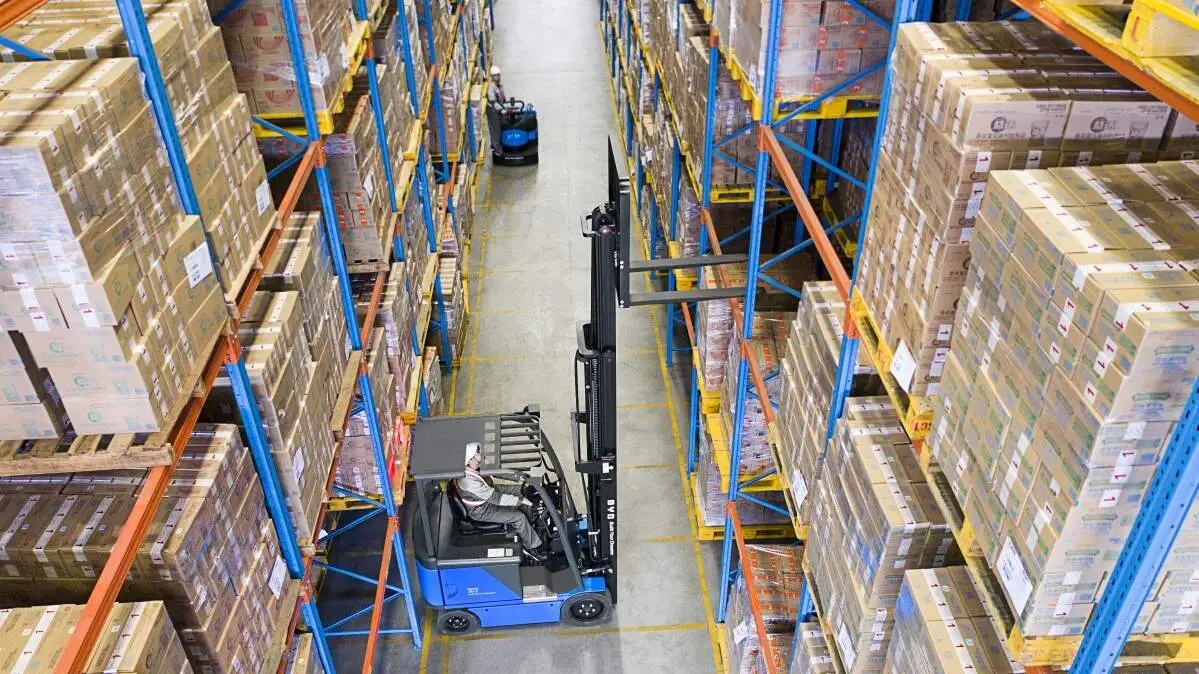
Nowadays, narrow-aisle warehouses have become the choice of many warehousing companies because they can maximize the use of storage space. In such scenarios, the practical performance of handling equipment directly affects the efficiency and cost of operations. Electric forklifts and fuel forklifts, as mainstream options, have their own advantages and disadvantages.
Spatial fit comparison
The advantages of narrow channel adaptation for electric forklifts
The width of the narrow channel warehouse channel is usually 2-3 meters. The electric forklift body is compact and the turning radius is smaller. It can complete operations such as in-situ steering and right-angle turning in a narrow space without excessive redundant space, and can make full use of the storage area. At the same time, the body is highly controllable, and it is not easy to scratch the shelves when it is adapted to high-level shelf access.
Space limitations of fuel forklifts
Due to the structure of the power system, the body size of the fuel forklift is too large, and the turning radius is larger than that of the electric forklift. When operating in a narrow channel, a wider space is required, which restricts the utilization of the storage area. The exhaust pipe of some models is prominent, and it is easy to scratch the shelves or goods when operating in a narrow space, which poses a potential safety hazard.
Operation efficiency and stability comparison
Operational Continuity Advantages of Electric Forklifts
The electric forklift is battery-driven, with fast start and stable acceleration. It can maintain a stable operation rhythm in the scene of frequent start-stop and steering in narrow passages. Low noise, no excessive pollution in closed warehouses, and less interference to operators. Simple daily maintenance, no need to change oil and filter elements frequently, short downtime for maintenance, and more guaranteed operation time.
The power and shortcomings of fuel forklifts
Fuel forklifts have strong power and are suitable for heavy-duty handling, but frequent starts and stops in narrow channels will increase fuel consumption, and the power output is not as stable as that of electric forklifts, which is easy to cause the goods to shake. And closed warehouse operations will emit exhaust gas, pollute the air, affect the health of personnel, require additional ventilation equipment, and increase operating costs.
Energy consumption and cost comparison
The long-term cost advantage of electric forklifts
Electric forklifts use electricity as an energy source, and the cost is lower than that of fuel. Charging at low electricity prices at night can further reduce energy consumption costs. Although the initial purchase cost is slightly higher, long-term use and low maintenance costs make the whole more competitive. The battery has a long service life and a stable replacement cycle, which is convenient for enterprises to plan costs.
The short-term cost characteristics of fuel forklifts
The initial purchase cost of fuel forklifts is low, but the daily fuel consumption cost is high, and it is difficult to control the cost when the oil price fluctuates. The maintenance frequency is high, and the oil needs to be changed regularly and the engine needs to be checked, so the maintenance cost cannot be ignored. Under the high-intensity operation of narrow aisles, the fuel consumption increases, and the long-term operating cost is higher than that of electric forklifts.
Overall, in the narrow-aisle warehouse handling scenario, electric forklifts have more advantages in terms of space adaptation, operation continuity, and long-term costs, making them suitable for enterprises that focus on space utilization, efficiency, and cost control. Fuel forklifts are suitable for scenarios with heavy load requirements and loose space. Therefore, enterprises need to choose models based on their own needs.


