
 简体中文
简体中文 繁体中文
繁体中文 Deutsch
 日本語
日本語 한국어
한국어 Tiếng Việt
 Русский
 ไทย
ไทย Bahasa Indonesia
 Bahasa Melayu
 Filipino
 لالعربية
 Français

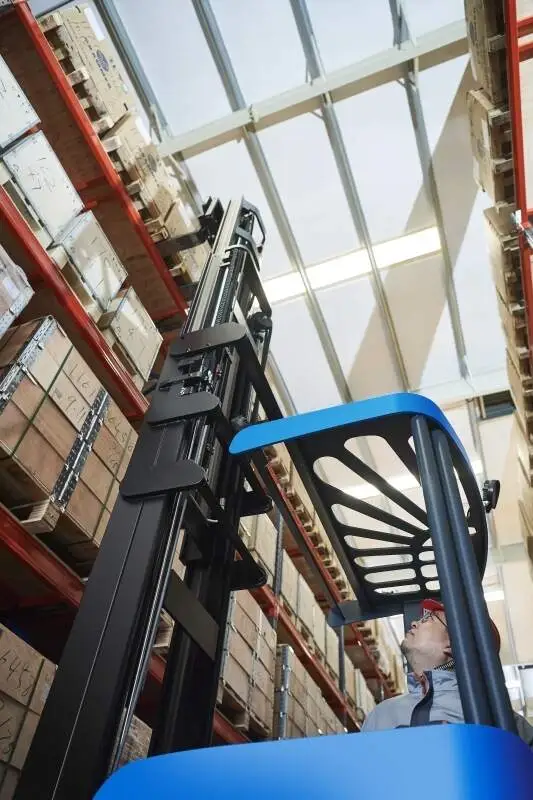
Due to the high order density and high space utilization requirements of e-commerce warehousing, narrow aisles have become a common layout, but in such scenarios, cargo transshipment is vulnerable to space constraints, which affects operational efficiency. It is particularly crucial to choose the right equipment.
Clear the core requirements for narrow aisle transshipment
The width of the narrow aisles in e-commerce warehouses is mostly between 1.5 and 2.5 meters. Transshipment operations need to take into account the speed of cargo turnover, space adaptability, and operational safety. It is necessary to avoid collisions with shelves and facilities, and to adapt to different types of goods such as pallets and small goods, while reducing interference with personnel movements.
Precise selection of equipment types
For horizontal transshipment needs, priority is given to narrow-channel electric pallet forklifts. This type of equipment has a small turning radius and can steer flexibly in a limited space, making it suitable for short-distance pallet cargo transshipment. If you need to balance low-level stacking and transshipment, you can choose a small electric stacker. Its compact fuselage design can be adapted to narrow aisles while meeting certain stacking requirements.
Matching principle of performance parameters
When selecting equipment, it is necessary to pay attention to the core parameters: the turning radius should be less than half of the width of the aisle to ensure that there is no risk of collision when steering; the load capacity should match the average weight of daily transshipment goods to avoid overload operations; the endurance should be adapted to the single-day operation time to reduce the impact of midway charging on efficiency; in addition, the operating field of the equipment should be clear, so that the operator can observe the surrounding environment in a small space.
Supplementary Suggestions for Scenario Adaptation
For the narrow aisles of loft storage, it is recommended to use lightweight electric transfer equipment to reduce the load-bearing pressure of the floor. In high-frequency storage scenarios, equipment with strong stability and low failure rate is preferred to reduce downtime and maintenance time. At the same time, the difficulty of equipment operation needs to be adapted to the proficiency of warehousers to reduce the probability of operation errors.
The rational selection of transfer equipment can not only improve the efficiency of e-commerce storage in narrow aisles, but also reduce safety hazards and provide reliable protection for storage operations.


