
 简体中文
简体中文 繁体中文
繁体中文 Deutsch
 日本語
日本語 한국어
한국어 Tiếng Việt
 Русский
 ไทย
ไทย Bahasa Indonesia
 Bahasa Melayu
 Filipino
 لالعربية
 Français

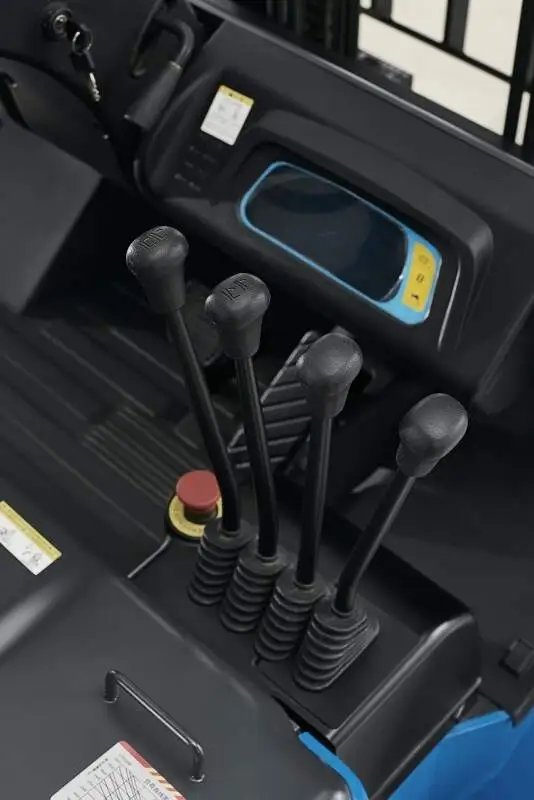
Small dense shelf warehouses often face the problem of narrow working channels due to compact space and dense shelf arrangement. Traditional forklifts have wide body size and large steering radius, which not only makes it difficult to operate flexibly in narrow channels, but also easy to scratch shelves and goods. It may also limit the improvement of operation efficiency due to exhaust emissions that do not meet indoor environmental protection requirements. The adaptation characteristics of narrow-channel lithium-ion forklifts just solve the core pain points of such warehouses. Its compact body design adapts to narrow channel size, and the minimum steering radius is smaller. It can complete in-situ steering, right-angle turning and other actions in a narrow space without reserving additional operating space. It fully exploits the storage potential of dense shelves. At the same time, the lithium battery power has zero emissions, low noise, and is suitable for indoor closed environment operations. The characteristics of lithium battery fast charging and fast release can meet the needs of high-frequency operations, reduce downtime and charging time, and ensure the continuity of operations. For the specific application scheme of small dense shelf warehouses, it is necessary to promote from multiple dimensions. In the selection stage, the forklift of the corresponding specification should be selected according to the parameters such as warehouse channel width, shelf height, and cargo weight. For example, when the channel width is less than 2 meters, the model with narrower body width is preferred. When the shelf height exceeds 5 meters, it is matched with a high-level gantry to ensure access stability. In the operation process, it is necessary to formulate a reasonable route to avoid cross-operation, cooperate with the warehouse management system to plan tasks in advance, reduce invalid driving, and use the precise handling of forklifts to In terms of daily maintenance, regularly check the status and performance of lithium batteries, perform routine maintenance on the steering system and gantry structure, and establish a personnel training mechanism to standardize the operation process and reduce safety hazards. Through the rational application of narrow-channel lithium-ion forklifts, the space utilization rate of small and dense shelf warehouses can be effectively improved, the operation efficiency can be optimized, and the damage rate of goods and operation risks can be reduced, which brings practical benefits to warehouse operations.


