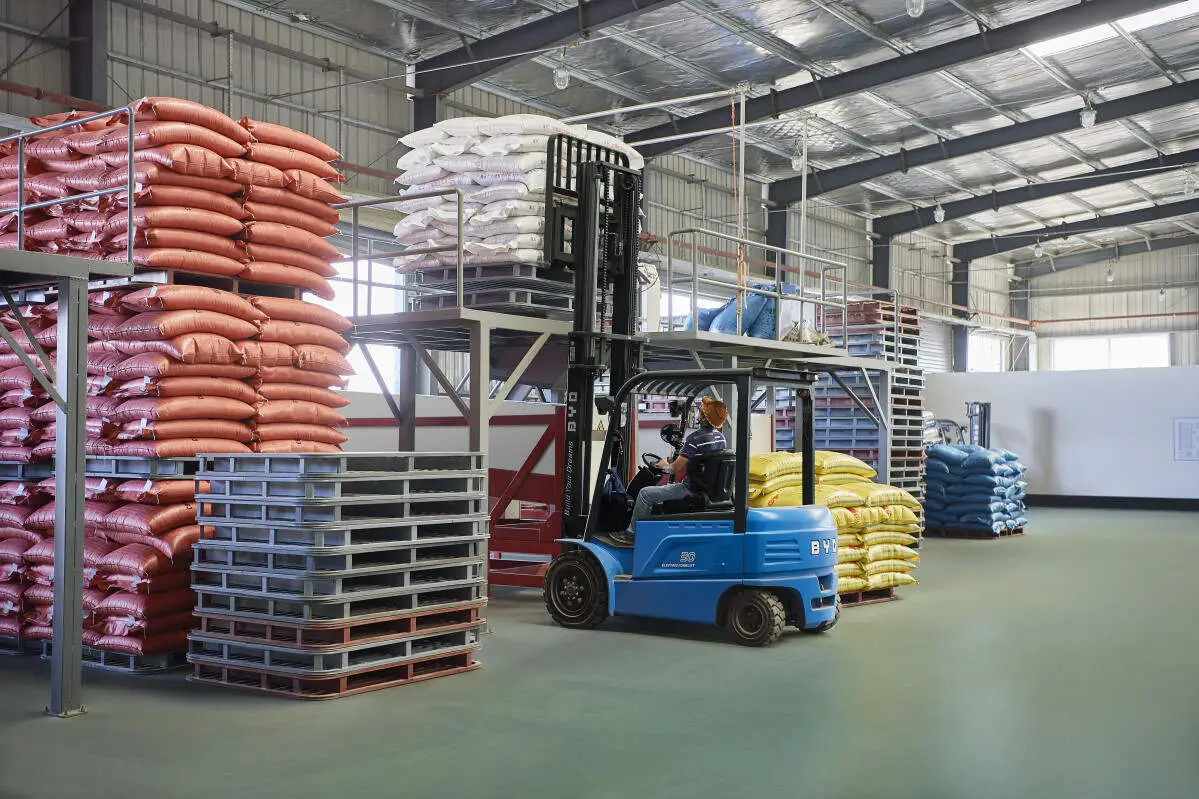
Three-point small lithium forklift turning operation instructions

2026-06-26

Three-point small lithium forklift turning operation instructions(Image1)

In scenes with high space requirements such as warehousing and logistics, three-point small lithium-ion forklifts are widely used due to their flexible steering advantages. Mastering the correct turning operation skills can effectively avoid scratching goods or facilities and ensure smooth and safe operation. First of all, basic inspection and preparation should be done before operation to confirm that the vehicle is in normal condition, including sufficient power, sensitive brakes, clear and recognizable turn signals, and no loose deformation of the fork arms. At the same time, the obstacles in the operation channel should be cleaned up. Observe the width of the channel and the occlusion at the turn in advance, and plan a general driving route.

Secondly, when turning in the ordinary channel, follow the principle of slow deceleration and early wheel beating, observe in advance whether there are pedestrians or other working vehicles on both sides of the channel and the rear, turn on the turn signals in the corresponding direction, and after confirming safety, gently step on the brakes to slow down at a distance of three to five meters from the turning point, and control the speed within the safe range. When the front wheel of the body approaches the inner edge of the turning point, rotate the steering wheel smoothly. The rotation amplitude is adjusted according to the width of the channel and the turning characteristics of the vehicle itself. To avoid the one-time full steering wheel causing the body to lose control or the rear wheel to scratch, pay attention to the distance between the outside of the body and the edge of the channel, the fork arm and the goods. If the distance is found to be too close, the steering wheel can be fine-tuned. After most of the body passes the turning point, it can be smoothly turned back Drive at a safe speed.

In addition, narrow space turning is the core application scenario of three-point small lithium-ion forklifts, which is relatively difficult to operate and requires more caution. Before entering a narrow space, the vehicle should be stopped in advance to confirm again whether the space size meets the minimum turning radius of the vehicle. If there are uncertainties, you can get off the vehicle and observe first. If necessary, adjust the placement of the goods, and bring the goods as close as possible to the root of the fork arm and reduce it to a safe height to reduce the occupied space and line of sight of the goods. When turning, also turn on the turn signals in advance to minimize the speed of the vehicle. By using a split wheel, first turn the steering wheel slightly to allow the front wheel to slowly cut into the turning point. Then, according to the position of the vehicle and the surrounding conditions, turn the steering wheel alternately and gradually adjust the body posture to ensure that there is a sufficient safe distance between the body and the obstacles. The whole process should be focused, ready to stop and adjust at any time. After the body has completely passed through the narrow space, then return to the steering wheel normally and increase the speed.

Finally, after completing the turning operation, turn off the turn signal in time, adjust the vehicle to the appropriate driving lane, and continue the follow-up operation. In daily operations, operators should regularly practice turning skills, familiarize themselves with the steering characteristics of the vehicle, and develop good habits of safe operation.

We use cookie to improve your online experience. By continuing to browse this website, you agree to our use of cookie.

Cookies

Please read our Terms and Conditions and this Policy before accessing or using our Services. If you cannot agree with this Policy or the Terms and Conditions, please do not access or use our Services. If you are located in a jurisdiction outside the European Economic Area, by using our Services, you accept the Terms and Conditions and accept our privacy practices described in this Policy.
We may modify this Policy at any time, without prior notice, and changes may apply to any Personal Information we already hold about you, as well as any new Personal Information collected after the Policy is modified. If we make changes, we will notify you by revising the date at the top of this Policy. We will provide you with advanced notice if we make any material changes to how we collect, use or disclose your Personal Information that impact your rights under this Policy. If you are located in a jurisdiction other than the European Economic Area, the United Kingdom or Switzerland (collectively “European Countries”), your continued access or use of our Services after receiving the notice of changes, constitutes your acknowledgement that you accept the updated Policy. In addition, we may provide you with real time disclosures or additional information about the Personal Information handling practices of specific parts of our Services. Such notices may supplement this Policy or provide you with additional choices about how we process your Personal Information.


Cookies

Cookies are small text files stored on your device when you access most Websites on the internet or open certain emails. Among other things, Cookies allow a Website to recognize your device and remember if you've been to the Website before. Examples of information collected by Cookies include your browser type and the address of the Website from which you arrived at our Website as well as IP address and clickstream behavior (that is the pages you view and the links you click).We use the term cookie to refer to Cookies and technologies that perform a similar function to Cookies (e.g., tags, pixels, web beacons, etc.). Cookies can be read by the originating Website on each subsequent visit and by any other Website that recognizes the cookie. The Website uses Cookies in order to make the Website easier to use, to support a better user experience, including the provision of information and functionality to you, as well as to provide us with information about how the Website is used so that we can make sure it is as up to date, relevant, and error free as we can. Cookies on the Website We use Cookies to personalize your experience when you visit the Site, uniquely identify your computer for security purposes, and enable us and our third-party service providers to serve ads on our behalf across the internet.

We classify Cookies in the following categories:
 ●  Strictly Necessary Cookies
 ●  Performance Cookies
 ●  Functional Cookies
 ●  Targeting Cookies


Cookie List
A cookie is a small piece of data (text file) that a website – when visited by a user – asks your browser to store on your device in order to remember information about you, such as your language preference or login information. Those cookies are set by us and called first-party cookies. We also use third-party cookies – which are cookies from a domain different than the domain of the website you are visiting – for our advertising and marketing efforts. More specifically, we use cookies and other tracking technologies for the following purposes:

Strictly Necessary Cookies
These cookies are necessary for the website to function and cannot be switched off in our systems. They are usually only set in response to actions made by you which amount to a request for services, such as setting your privacy preferences, logging in or filling in forms. You can set your browser to block or alert you about these cookies, but some parts of the site will not then work. These cookies do not store any personally identifiable information.

Functional Cookies
These cookies enable the website to provide enhanced functionality and personalisation. They may be set by us or by third party providers whose services we have added to our pages. If you do not allow these cookies then some or all of these services may not function properly.

Performance Cookies
These cookies allow us to count visits and traffic sources so we can measure and improve the performance of our site. They help us to know which pages are the most and least popular and see how visitors move around the site. All information these cookies collect is aggregated and therefore anonymous. If you do not allow these cookies we will not know when you have visited our site, and will not be able to monitor its performance.

Targeting Cookies
These cookies may be set through our site by our advertising partners. They may be used by those companies to build a profile of your interests and show you relevant adverts on other sites. They do not store directly personal information, but are based on uniquely identifying your browser and internet device. If you do not allow these cookies, you will experience less targeted advertising.

How To Turn Off Cookies
You can choose to restrict or block Cookies through your browser settings at any time. Please note that certain Cookies may be set as soon as you visit the Website, but you can remove them using your browser settings. However, please be aware that restricting or blocking Cookies set on the Website may impact the functionality or performance of the Website or prevent you from using certain services provided through the Website. It will also affect our ability to update the Website to cater for user preferences and improve performance. Cookies within Mobile Applications

We only use Strictly Necessary Cookies on our mobile applications. These Cookies are critical to the functionality of our applications, so if you block or delete these Cookies you may not be able to use the application. These Cookies are not shared with any other application on your mobile device. We never use the Cookies from the mobile application to store personal information about you.

If you have questions or concerns regarding any information in this Privacy Policy, please contact us by email at . You can also contact us via our customer service at our Site.