
 简体中文
简体中文 繁体中文
繁体中文 Deutsch
 日本語
日本語 한국어
한국어 Tiếng Việt
 Русский
 ไทย
ไทย Bahasa Indonesia
 Bahasa Melayu
 Filipino
 لالعربية
 Français

The core motivation for equipment upgrade in warehousing enterprises
With the development of the warehousing industry, enterprises are facing increasing storage pressure, and the limitations of traditional equipment are gradually becoming apparent. On the one hand, rising land costs have prompted enterprises to continuously compress storage space, and narrow channel layout has become the mainstream. However, traditional forklifts have a large turning radius, making it difficult to operate flexibly in narrow spaces, resulting in low space utilization. On the other hand, traditional fuel or lead-acid forklifts have high energy consumption, high maintenance costs, and emission issues that do not conform to the development trend of green warehousing and cannot adapt to the efficient and environmentally friendly needs of modern warehousing.
Adaptability Analysis of Narrow Channel Lithium Battery Forklift
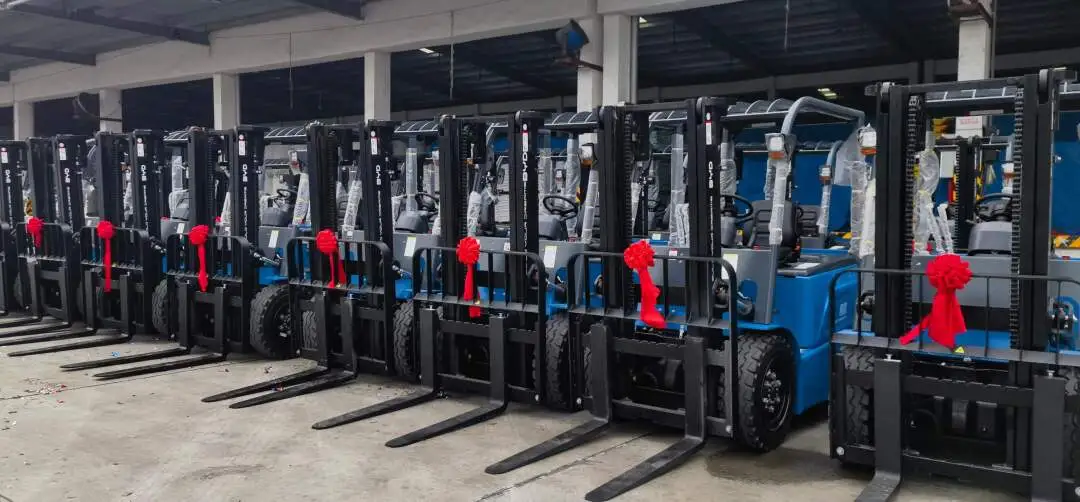
The design characteristics of narrow-channel lithium-ion forklifts make them an ideal choice for upgrading storage equipment. In terms of space adaptation, this type of forklift has a smaller turning radius, which can complete steering, stacking and other operations in narrow-width channels, greatly improving the utilization rate of storage space and helping enterprises store more goods in limited sites. In terms of performance adaptation, lithium-ion forklifts are powered by lithium batteries, which have the characteristics of fast charging and stable battery life, which can meet the needs of long-term continuous operation. At the same time, there is no fuel emission, which meets environmental protection requirements and has relatively low maintenance costs.
The practical path of the replacement process
Warehousing enterprises need to follow a scientific and practical path when replacing equipment. First, an evaluation of existing warehousing scenarios should be carried out, including channel width, stacking height, cargo type, operation frequency, etc., in order to determine the specific parameters and quantity of narrow-channel lithium-ion forklifts. Secondly, a transition plan should be formulated. The old and new equipment can be replaced in parallel to avoid affecting daily operations. Finally, personnel training should be organized to familiarize operators with the operation process and safety specifications of the new equipment to ensure smooth operation.
Operation and maintenance and benefit tracking after replacement
After completing the equipment replacement, the enterprise needs to establish a complete operation and maintenance system, and regularly conduct battery inspection and component maintenance on the lithium-ion forklift to extend the service life of the equipment. At the same time, it is necessary to track the benefits after replacement, analyze from multiple dimensions such as space utilization, operation efficiency, energy consumption cost, etc., evaluate the upgrade effect, and provide a basis for subsequent equipment optimization. Through continuous operation, maintenance and tracking, ensure that the narrow-channel lithium-ion forklift can create value for the enterprise in the long run.


