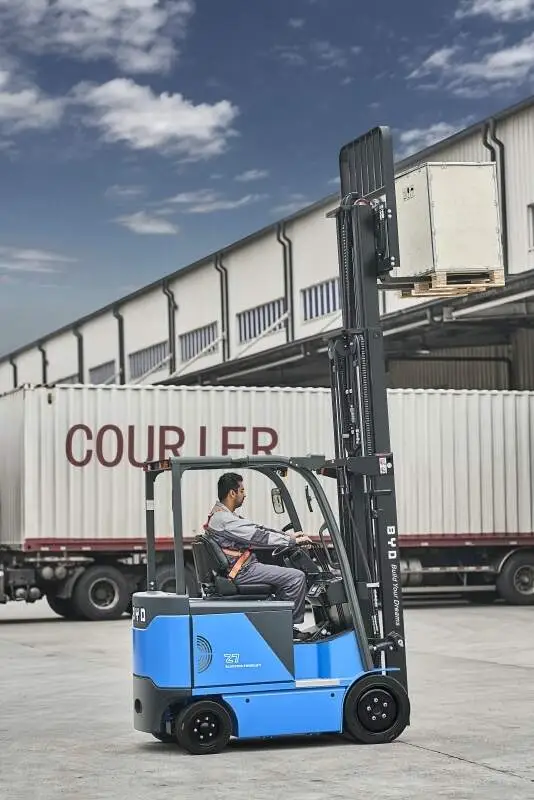
Manual hydraulic forklifts are essential, cost-effective tools for material handling in warehouses, factories, and small storage facilities. Unlike powered alternatives, they combine human effort with hydraulic systems to lift and transport goods, making them ideal for tight spaces or areas without electric power. Understanding their different types helps businesses select equipment tailored to operational needs.
Hand pallet jacks are the most common variety, built for horizontal transport of palletized loads. Their forks slide under pallets, and a hydraulic pump lifts loads just enough to clear the ground—usually a few inches. This minimal lift height makes them perfect for moving goods between storage racks, loading docks, and delivery vehicles. Lightweight and easy to maneuver in narrow aisles, they require minimal maintenance, making them a staple for daily small to medium-scale material handling tasks.
Manual stacker forklifts expand functionality by enabling vertical lifting, typically to heights between 4 and 10 feet. Operated via a hand crank or lever to activate the hydraulic system, these models let workers stack pallets on shelves or retrieve items from elevated storage. They suit warehouses prioritizing vertical space utilization, offering a cost-effective alternative to powered stackers for low-volume operations, though they demand more physical effort due to the lifting task.
High-lift manual hydraulic forklifts cater to needs for greater vertical reach, with lift heights up to 12 feet or more. Equipped with robust hydraulic systems and stable frames, they safely lift heavy loads to access taller storage racks. This type is widely used in retail distribution centers and manufacturing facilities where vertical storage maximizes limited floor space, addressing the challenge of accessing high-shelf inventory without powered equipment.
Low-profile manual hydraulic forklifts are designed for tight, confined spaces where standard models cannot operate, such as under low-height shelves or in narrow aisles with limited overhead clearance. Their compact structure features a lower overall height and shorter fork length, enabling easy navigation in small storage rooms, refrigerated warehouses, or vehicles with restricted loading space. Despite their smaller size, they maintain reliable hydraulic lifting capabilities for light to medium loads.
Choosing the right manual hydraulic forklift depends on factors like required lift height, load capacity, operating environment, and usage frequency. Evaluating these elements helps businesses enhance operational efficiency, reduce worker physical strain, and optimize material handling workflows. Whether moving pallets across a warehouse floor or stacking goods on high shelves, there is a manual hydraulic forklift designed to meet specific operational demands.