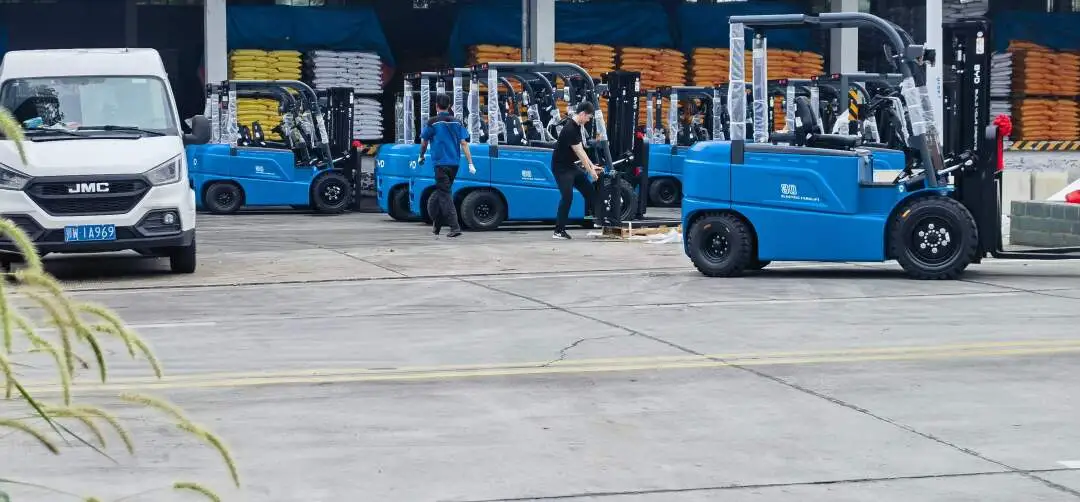
Warehouse forklifts are essential tools for streamlining material handling operations, but manual and electric variants feature distinct design choices that cater to different operational needs. Understanding these core differences helps businesses select the most suitable equipment for their storage environments.
The most fundamental distinction lies in power system design. Manual warehouse forklifts rely entirely on human force to operate. Their design incorporates a simple hydraulic pump system activated by a hand lever, which lifts and lowers the forks. There are no electrical components, batteries, or motors, resulting in a compact, lightweight structure that requires no external power source. In contrast, electric forklifts are equipped with a rechargeable battery pack and an electric motor that drives both the lifting mechanism and the vehicle’s movement. Their design includes dedicated battery compartments, wiring systems, and control modules, adding complexity and weight but eliminating the need for manual force input.
Operation mechanisms further set the two designs apart. Manual forklifts demand physical effort from operators: they must repeatedly pump the lever to raise loads, manually steer the vehicle, and push or pull it across the warehouse floor. This design limits continuous operation time, as operators tire quickly, making manual forklifts ideal for short, light-duty tasks. Electric forklifts, however, feature electronically controlled operations. Operators use ergonomic buttons or joysticks to manage fork movement, and power steering reduces steering effort significantly. This design allows for longer, more consistent operation with minimal physical strain, suiting high-volume, extended warehouse tasks.
Performance capabilities also differ due to design variations. Manual forklifts typically have lower weight capacities, ranging from small to moderate loads, and limited lifting heights, as human force can only generate so much hydraulic pressure. Their travel speed is dependent on the operator’s strength, making them slower for moving goods across large spaces. Electric forklifts, by contrast, offer higher weight capacities and greater lifting heights, powered by the electric motor’s consistent force. Their travel speed is regulated and stable, enabling faster material transport and improving overall operational efficiency in large warehouses.
Maintenance requirements are another key design difference. Manual forklifts have fewer components, so maintenance focuses primarily on checking hydraulic fluid levels, inspecting lever and pump wear, and lubricating moving parts. These tasks are simple, low-cost, and can be performed in-house with basic tools. Electric forklifts, however, require more specialized maintenance. Operators need to regularly monitor battery health, clean electrical connections, and service the electric motor and control systems. Battery replacement and professional servicing add to long-term maintenance costs, though electric models often have fewer mechanical wear parts, reducing frequent minor repairs.
In conclusion, the design differences between manual and electric warehouse forklifts directly impact their suitability for specific warehouse tasks. Manual models offer simplicity and low cost for light-duty, small-space operations, while electric variants provide efficiency, power, and ergonomics for high-volume, large-scale material handling.